



Maculabatis randalli (Last, Manjaji-Matsumoto & Moore, 2012)
Arabian banded whipray
muatnaik fotos/gambar dan video
Gambar | imej Google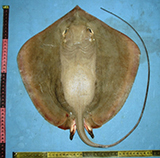 Maculabatis randalli
foto/gambar oleh Osmany, H.B.
Gambar | imej Google
foto/gambar oleh Osmany, H.B.
klasifikasi / Nama Nama-nama umum | Sinonim (persamaan) | Catalog of Fishes(Marga, Jenis) | ITIS | CoL | WoRMS | Cloffa
Ikan bertulang rawan (sharks and rays) > Myliobatiformes (Stingrays) > Dasyatidae (Stingrays) > Urogymninae
Etymology: randalli: Named for J.E. Randall, Bishop Museum; whose work on the taxonomy of Indo-Pacific fishes is legendary, and who was amongst the first authors to publish a photographic image of this species (as H. gerrardi) in his guide to the fishes of Oman (Randall, 1995).
Eponymy: Dr John ‘Jack’ Ernest Randall Jr. [...] (Ref. 128868), visit book page.
More on authors: Last, Manjaji-Matsumoto & Moore.
Etymology: randalli: Named for J.E. Randall, Bishop Museum; whose work on the taxonomy of Indo-Pacific fishes is legendary, and who was amongst the first authors to publish a photographic image of this species (as H. gerrardi) in his guide to the fishes of Oman (Randall, 1995).
Eponymy: Dr John ‘Jack’ Ernest Randall Jr. [...] (Ref. 128868), visit book page.
More on authors: Last, Manjaji-Matsumoto & Moore.
Lingkungan: lingkungan / zona iklim / kisaran kedalaman / jangkauan distribusi Ekologi
laut dasar (demersal); kisaran kedalaman 1 - 40 m (Ref. 90168). Tropical
Penyebaran Wilayah | Daerah-daerah FAO | Ekosistem | Kemunculan | peta titik | Introduksi | Faunafri
Western Indian Ocean: off Kuwait, Bahrain, Qatar and Iran. known from the Persian Gulf from where it is possibly endemic (Ref. 90168).
Ukuran / Berat / umur
deskripsi pendek Kunci identifiaksi (pengenalan) | Morfologi | Morfometrik
This medium-sized species (to at least 62 cm DW) is distinguished by the following set of characters: disc weakly rhomboidal; preorbital snout moderately elongate with weak apical lobe, snout angle 113-119°; rounded pectoral-fin apices, angle 96-98°; small, protrusible orbits; relatively broad mouth, its width 0.9-1.2 in internasal width; distance between first gill slits 2.5-2.6 times internasal distance; distance between fifth gill slits times 1.5-1.7 times internasal distance, 27-29% of ventral head length; broad pelvic-fin base, 13-17% DW; in juveniles, the tail behind sting is subcircular with deep longitudinal ventral groove and prominent mid-lateral ridge, in adults, it is weakly depressed; 1-2 (usually 1) small, broadly heart-shaped to seed shaped suprascapular denticles, primary denticle band and thorns absent; secondary denticle band irregularly sub-oval, relatively narrow (its maximum width across scapulocoracoid barely exceeding its width at spiracles), with well-defined lateral margins, narrowly tapering near tail base; fully developed band and covering entire dorsal surface of tail by 33 cm DW; dorsal surface mainly uniformly coloured (occasionally with dark flecks in specimens smaller than 25 cm DW), disc margin sometimes paler dorsally; ventral disc uniformly whitish, not black edged; in adults, darker dorsal surface of tail sharply demarcated from paler ventral surface; in neonates and juveniles, dark tail with conspicuous white saddles, its distal portion usually almost uniformly dark; pectoral-fin radials 124-129; 108-111 total vertebral count (excluding 1st synarcual centra), 43-44 monospondylous centra, 65-68 pre-sting diplospondylous centra (Ref. 90168).
Body shape (shape guide): other; Cross section: flattened.
Body shape (shape guide): other; Cross section: flattened.
Known from the Persian Gulf which is mostly shallower than 40 m and with depths rarely exceeding 60 m; soft substrates, mostly sand and mud (Ref. 90168).
Siklus hidup dan perilaku kawin Kematangan | Reproduksi, perkembang biakan | Pemijahan | telur-telur | Fekunditas | Larva
rujukan utama
Unggah referensi Anda | Acuan | Koordinator : McEachran, John | mitra
Last, P.R., B.M. Manjaji-Matsumoto and A.B.M. Moore, 2012. Himantura randalli sp. nov., a new whipray (Myliobatoidea: Dasyatidae) from the Persian Gulf. Zootaxa 3327:20-32. (Ref. 90168)
Status IUCN Red List (Ref. 130435: Version 2025-2 (Global))
kurang bimbang (LC) ; Date assessed: 08 February 2017
CITES
Not Evaluated
ancaman kepada manusia
Harmless
penggunaan manusia
FAO - Publication: search | FishSource |
informasi lanjut
Ekologi trofik
Item makanan (mangsa)
Komposisi makanan
Konsumsi makanan
Ransum makanan
Pemangsa
Item makanan (mangsa)
Komposisi makanan
Konsumsi makanan
Ransum makanan
Pemangsa
Ekologi
Ekologi
Ekologi
Dinamika populasi
Parameter pertumbuhan
Maks. usia / ukuran
Panjang-berat rel.
Panjang-panjang rel.
ukuran frekuensi
Konversi massa
pemulihan
Kelimpahan
Parameter pertumbuhan
Maks. usia / ukuran
Panjang-berat rel.
Panjang-panjang rel.
ukuran frekuensi
Konversi massa
pemulihan
Kelimpahan
Siklus hidup
Reproduksi, perkembang biakan
Kematangan
Kedewasaan / insang rel.
Fekunditas
Pemijahan
Agregasi pemijahan
telur-telur
pekembangan telor
Larva
Dinamika larva
Reproduksi, perkembang biakan
Kematangan
Kedewasaan / insang rel.
Fekunditas
Pemijahan
Agregasi pemijahan
telur-telur
pekembangan telor
Larva
Dinamika larva
Anatomi
Area insang
Otak
Otolith
Area insang
Otak
Otolith
Fisiologi
Komposisi tubuh
Nutrisi
Konsumsi oksigen
Jenis renang
Kecepatan berenang
Pigmen visual
Suara ikan
Penyakit & Parasit
Toksisitas (LC50)
Komposisi tubuh
Nutrisi
Konsumsi oksigen
Jenis renang
Kecepatan berenang
Pigmen visual
Suara ikan
Penyakit & Parasit
Toksisitas (LC50)
Genetika
genom
Genetika
Heterozigositas
Diturunkan
Keanekaragaman Genetik
genom
Genetika
Heterozigositas
Diturunkan
Keanekaragaman Genetik
Yang berhubungan dengan manusia
Sistem akuakultur
profil budidaya air
Strain
Kasus Ciguatera
Perangko, koin, dll.
Sistem akuakultur
profil budidaya air
Strain
Kasus Ciguatera
Perangko, koin, dll.
Alat, peralatan
E-book | Penuntun lapangan | tanda freqkuenci panjang | peringkat sejarah hidup | peta titik |
Tangkap-MSY |
laporan khas
muat turun XML
Sumber internet
AFORO (otoliths) | Aquatic Commons | BHL | Cloffa | Websites from users | semak peneliti ikan | CISTI | Catalog of Fishes: Marga, Jenis | DiscoverLife | ECOTOX | FAO - Publication: search | Faunafri | Fishipedia | Fishtrace | GloBI | Google Books | Google Scholar | Google | IGFA World Record | OneZoom | Open Tree of Life | Otolith Atlas of Taiwan Fishes | PubMed | Reef Life Survey | Socotra Atlas | TreeBase | Tree of Life | Wikipedia: pergi, Cari | World Records Freshwater Fishing | Catatan Zoologi
Estimasi berdasarkan model
Suhu yang disukai (Acuan 123201): 24.4 - 29.3, mean 26.9 °C (based on 128 cells).
Indeks keanekaragaman filogenetik (Acuan 82804): PD50 = 0.5020 [Uniqueness, from 0.5 = low to 2.0 = high].
Bayesian length-weight: a=0.01023 (0.00482 - 0.02174), b=3.06 (2.86 - 3.26), in cm total length, based on LWR estimates for this (Sub)family-body shape (Ref. 93245).
Tingkat Trofik (Acuan 69278): 3.7 ±0.4 se; based on size and trophs of closest relatives