



Harttiella pilosa Covain & Fisch-Muller, 2012
Uploaden van uw Foto's en video's
Afbeeldingen | Google afbeelding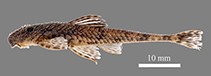 Harttiella pilosa
Afbeelding van Fisch-Muller, S.
Afbeeldingen | Google afbeelding
Afbeelding van Fisch-Muller, S.
Classificatie / Namen Lokale namen | Synoniemen | Catalog of Fishes(Genus, Soort(en)) | ITIS | CoL | WoRMS | Cloffa
> Siluriformes (Catfishes) > Loricariidae (Armored catfishes) > Loricariinae
Etymology: pilosa: Name from Latin pilosus meaning hairy, in reference to the unusual aspect of male head.
Eponymy: Charles Frederick Hartt (1840–1878) was a Canadian geologist, palaeontologist and naturalist, who was a member of the Thayer Expedition (1865–1866) to Brazil, a country in which he was a specialist. [...] (Ref. 128868), visit book page.
Etymology: pilosa: Name from Latin pilosus meaning hairy, in reference to the unusual aspect of male head.
Eponymy: Charles Frederick Hartt (1840–1878) was a Canadian geologist, palaeontologist and naturalist, who was a member of the Thayer Expedition (1865–1866) to Brazil, a country in which he was a specialist. [...] (Ref. 128868), visit book page.
Milieu: milieu / Klimaatzone / Diepte / verspreidingsgebied Ecologie
; zoet water demersaal; pH range: 6.5 - ?. Tropical; 24°C - ? (Ref. 90209)
Verspreiding Gebieden | FAO regio's | Ecosystemen | Voorkomen | Verspreidingskaart | Introducties | Faunafri
South America: Known only from the type locality, Critique Grillon, a tributary of Orapu River in Tortue Mountains, French Guiana.
Grootte / Gewicht / Leeftijd
Korte beschrijving Determinatiesleutels | Morfologie | Morfometrie
Dorsale zachte stralen (totaal) : 7; Anale stekels: 1; Anale zachte stralen: 5. Can be distinguished from all congeners by its hispid appearance (vs. smooth to velvety in congeneric species) and its specific barcode sequences (JF292271, JF292272, JF292273). Differs from species belonging to the crassicauda group by a shorter head [mean = 23.74 ± 1.35% of SL vs 25.54 ± 1.41 < mean < 26.18 ± 1.34% of SL; (HSD, p-values < 0.0033)], and from other species of the longicauda group by a deeper body at dorsal-fin origin [mean = 11.92 ± 0.97% of SL vs 9.86 ± 0.79 < mean < 10.66 ± 0.87% of SL; (HSD, p-values < 0.0069)] (Ref. 90209).
Body shape (shape guide): elongated.
Body shape (shape guide): elongated.
This species was encountered immediately upstream of a 30 m high waterfall and was collected downstream of the waterfall. The area of the river where this species was found was 10 m wide with shallow clear water and a bottom substrate consisting of gravel, pebbles, boulders, bed rock and sand mainly constituted of iron hydroxide (Ref. 90209).
Levenscyclus en paargedrag Maturiteit | Voortplanting | Paaien | Eieren | Fecunditeit | Larven
Hoofdreferentie
Upload uw referenties | Referenties | Coördinator : Fisch-Muller, Sonia | Medewerkers
Covain, R., S. Fisch-Muller, J.I. Montoya-Burgos, J.H. Mol, P.-Y. Le Bail and S. Day, 2012. The Harttiini (Siluriformes, Loricariidae) from the Guianas: a multi-table approach to assess their diversity, evolution, and distribution. Cybium 36(1):115-161. (Ref. 90209)
Status op de Rode Lijst van het IUCN (Ref. 130435: Version 2025-2 (Global))
Ernstig bedreigd (CR) (B2ab(iii)); Date assessed: 14 January 2021
CITES
Not Evaluated
Gevaar voor de mens
Harmless
Gebruik door de mens
FAO - Publication: search | FishSource |
Meer informatie
Trofische ecologie
Voedsel (prooien)
Dieetsamenstelling
Voedselconsumptie
Voedselrantsoenen
Predatoren
Voedsel (prooien)
Dieetsamenstelling
Voedselconsumptie
Voedselrantsoenen
Predatoren
Ecologie
Ecologie
Ecologie
Populatiedynamica
Groeiparameters
Max. leeftijden / maten
Lengte-gewicht rel.
Lengte-lengte rel.
Lengtefrequenties
Massaconversie
Rekrutering
Abundantie
Groeiparameters
Max. leeftijden / maten
Lengte-gewicht rel.
Lengte-lengte rel.
Lengtefrequenties
Massaconversie
Rekrutering
Abundantie
Levenscyclus
Voortplanting
Maturiteit
Rijpheid/kieuwen rel.
Fecunditeit
Paaien
Paaibestanden
Eieren
Ontwikkeling van de eieren
Larven
Larvale populatiedynamiek
Voortplanting
Maturiteit
Rijpheid/kieuwen rel.
Fecunditeit
Paaien
Paaibestanden
Eieren
Ontwikkeling van de eieren
Larven
Larvale populatiedynamiek
Anatomie
Kieuwoppervlak
Hersenen
Otoliet
Kieuwoppervlak
Hersenen
Otoliet
Fysiologie
Lichaamssamenstelling
Voedingsstoffen
Zuurstofverbruik
Type zwemmen
Zwemsnelheid
Visuele pigmenten
Vis geluid
Ziekten en parasieten
Toxiciteit (LC50)
Lichaamssamenstelling
Voedingsstoffen
Zuurstofverbruik
Type zwemmen
Zwemsnelheid
Visuele pigmenten
Vis geluid
Ziekten en parasieten
Toxiciteit (LC50)
Genetica
genoom
Genetica
Heterozygositeit
Erfelijkheid
Genetische diversiteit
genoom
Genetica
Heterozygositeit
Erfelijkheid
Genetische diversiteit
Menselijk gerelateerd
Aquacultuursystemen
Aquacultuurprofielen
Kweeklijnen
Ciguatera gevallen
Postzegels, munten, diversen.
Aquacultuursystemen
Aquacultuurprofielen
Kweeklijnen
Ciguatera gevallen
Postzegels, munten, diversen.
Tools
Speciale rapporten
Bekijk gegevens voor het houden in een aquarium | Bekijk Fact Sheets voor de soort | Bekijk Aquacultuur Fact Sheets
Download XML
Internetbronnen
AFORO (otoliths) | Aquatic Commons | BHL | Cloffa | Websites from users | Bekijk FishWatcher | CISTI | Catalog of Fishes: Genus, Soort(en) | DiscoverLife | ECOTOX | FAO - Publication: search | Faunafri | Fishipedia | Fishtrace | GloBI | Google Books | Google Scholar | Google | IGFA World Record | OneZoom | Open Tree of Life | Otolith Atlas of Taiwan Fishes | PubMed | Reef Life Survey | Socotra Atlas | TreeBase | Tree of Life | Wikipedia: ga naar, zoek | World Records Freshwater Fishing | Zoobank | Zoological Record
Schattingen op basis van modellen
Fylogenetische diversiteitsindex (Ref. 82804): PD50 = 0.5078 [Uniqueness, from 0.5 = low to 2.0 = high].
Bayesian length-weight: a=0.00398 (0.00185 - 0.00857), b=3.11 (2.93 - 3.29), in cm total length, based on LWR estimates for this (Sub)family-body shape (Ref. 93245).
Trofisch niveau (Ref. 69278): 2.8 ±0.2 se; based on size and trophs of closest relatives