التصنيف / Names
الأسماء الشائعة | مرادفات | Catalog of Fishes(جنس, الانواع) | ITIS | CoL | WoRMS | Cloffa
>
Siluriformes (Catfishes) >
Loricariidae (Armored catfishes) > Hypostominae
Etymology: Peckoltia: Because of Gustavo Peckolt,member of the Natural History Commission of Rondon (Ref. 45335); otali: The specific name 'otali' is a Wayana Amerindian name meaning secret, in reference to the coloration of the species, similar to its biotope, making it difficult to observe. Wayana Amerindians live on the sides of the Upper Maroni River basin where the new species was found. A noun in apposition.
Eponymy: Gustavo Peckolt (1861–1923) was a Brazilian-born German botanist and pharmacist. [...] (Ref. 128868), visit book page.
Environment: milieu / climate zone / نطاق العمق / distribution range
البيئة
; المياه العذبة القاع. Tropical
South America: upper Maroni River basin in French Guiana and Suriname.
الحجم / وزن / العمر
النضج: Lm ? range ? - ? cm
Max length : 7.7 cm SL ذكر/ مختلط الجنس; (Ref. 90183)
وصف مختصر
مفاتيح التعريف | الوصف الخارجي | قياسات المظهر الخارجي
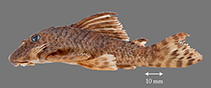
الأشواك الظهرية (المجموع) : 2; الأشعة الظهرية الناعمة (المجموع) : 7; أشعه شرجية لينه: 5. This species can be diagnosed from all other congeners by a unique color pattern of adults, and from Guianese species by its specific barcode sequence (JF747005). Color pattern consists of numerous blackish-brown spots of irregular size and shape, distributed on head and on entire body except naked ventral areas, resulting in a mottled aspect of dorsum, while spots are aligned to form transverse bands on fins, at least on caudal fin. Juvenile specimens present large transversal blackish bands, or dorsal saddles, on the body that are similar to those characteristic of several Peckoltia including the type species Peckoltia vittata. Brown spots on posterior part of the body are also present in Peckoltia oligospila, Peckoltia sabaji, Peckoltia capitulata and Peckoltia simulata, but in these species spots are rounded, comparatively larger and regularly spaced, and they usually do not form bands on fins. It is further distinguished from these species by having a deeper body (22.5-25.7% SL, mean 23.8, vs. less than 23.4 at occiput; 12.4-13.8% SL, mean 13.1, vs. less than 11.7 at caudal peduncle) and a wider body (33.8-37.1% SL, mean 35.2, vs. less than 32.7 at cleithrum). Differs from Peckoltia bachi that is also mottled, by having the eye high on the head (vs. low) and a much narrower interorbital (29.8-34.4% HL, mean 32.6, vs. 57.9-59.9, mean 58.8) (Ref. 90183).
Body shape (shape guide): elongated.
Facultative air-breathing in the genus (Ref. 126274); In rapids, it occurs mostly in sunny and shallow clear water, swiftly flowing currents, with medium- sized rocks substrate (Ref. 90183).
Life cycle and mating behavior
النضج | التكاثر | وضع البيض | بيض | الخصوبة | Larvae
Fisch-Muller, S., J.I. Montoya-Burgos, P.-Y. Le Bail and R. Covain, 2012. Diversity of the Ancistrini (Siluriformes: Locariidae) from the Guianas: the Panaque group, a molecular appraisal with description of new species. Cybium 36(1):163-193. (Ref. 90183)
IUCN Red List Status (Ref. 130435: Version 2025-1)
استخدامات بشرية
أدوات
تقارير خاصة
Download XML
مصادر علي الأنترنت
Estimates based on models
Phylogenetic diversity index (مرجع
82804): PD
50 = 0.5000 [Uniqueness, from 0.5 = low to 2.0 = high].
Bayesian length-weight: a=0.01549 (0.00719 - 0.03336), b=2.98 (2.81 - 3.15), in cm total length, based on LWR estimates for this (Sub)family-body shape (Ref.
93245).
Fishing Vulnerability (Ref.
59153): Low vulnerability (10 of 100).
🛈