Classification / Names
Noms communs | Synonymes | Catalog of Fishes(Genre, Espèce) | ITIS | CoL | WoRMS | Cloffa
>
Gobiiformes (Gobies) >
Gobiidae (Gobies) > Sicydiinae
Etymology: Stiphodon: Greek, stiphos, -eos, -oys = mass + Greek, odous = teeth (Ref. 45335); alcedo: Named from the Latin alcedo, meaning kingfisher, as the metallic turquoise on the head and body and the orange around the belly of the nuptial coloured male is similar to the plumage of the kingfisher, Alcedo atthis. A noun in apposition.
Environment: milieu / climate zone / profondeur / distribution range
Écologie
; eau douce démersal; amphidrome (Ref. 131349). Subtropical
Asia: Okinawa Island and Iriomote Island of the Ryukyu Archipelago, Japan.
Length at first maturity / Taille / Poids / Âge
Maturité: Lm 2.9, range 3 - 3 cm
Max length : 4.3 cm SL mâle / non sexé; (Ref. 90212); 4.8 cm SL (female)
Description synthétique
Clés d'identification | Morphologie | Morphométrie
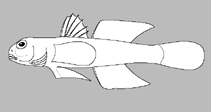
Épines dorsales (Total) : 7; Rayons mous dorsaux (Total) : 9 - 10; Épines anales: 1; Rayons mous anaux: 10; Vertèbres: 25 - 27. Distinguished from its congeners by having the following characters: dorsal fins, usually VI-I, 9, male having pointed, but not filamentous, first dorsal fin with elongate spines 4 and 5, posterior tip of fin usually extending to base of soft-rays 2-5 of second dorsal fin; pectoral fin with 15-17 (mode 16) rays; 32-40 premaxillary teeth; dentary with 32-45 horizontal teeth; female with two black longitudinal bands laterally on body arranged with a larger interval between two bands; lower band composed of 8-11 regular blotches, upper band thin and pale; all fins of female usually with faint markings; non-nuptial colored male having a dark brown longitudinal band just below lateral midline; nuptial colored male lacking this band, and having blackish or sometimes orange body, metallic turquoise laterally on head, metallic turquoise spot on upper pectoral-fin base when alive; and male often with 1-6 somewhat obscure black spots on pectoral-fin rays (Ref. 90212).
Body shape (shape guide): elongated.
Adults and juveniles inhabit freshwater streams, usually in pools. Often form shoals with conspecific individuals and the congeners Stiphodon percnopterygionus and Stiphodon atropurpureus, and occasionally with Stiphodon imperiorientis.
Life cycle and mating behavior
Maturité | Reproduction | Frai | Œufs | Fécondité | Larves
Maeda, K., T. Mukai and K. Tachinara, 2011. A new species of amphidromous goby, Stiphodon alcedo, from the Ryukyu Archipelago (Gobiidae: Sicydiinae). Cybium 35(4):285-298. (Ref. 90212)
Statut dans la liste rouge de l'IUCN (Ref. 130435: Version 2025-1)
Menace pour l'homme
Harmless
Utilisations par l'homme
Pêcheries: sans intérêt
Outils
Articles particuliers
Télécharger en XML
Sources Internet
Estimates based on models
Phylogenetic diversity index (Réf.
82804): PD
50 = 0.5000 [Uniqueness, from 0.5 = low to 2.0 = high].
Bayesian length-weight: a=0.01122 (0.00514 - 0.02450), b=3.04 (2.87 - 3.21), in cm total length, based on all LWR estimates for this body shape (Ref.
93245).
Résilience (Réf.
120179): Haut, temps minimum de doublement de population inférieur à 15 mois (Preliminary K or Fecundity.).
Fishing Vulnerability (Ref.
59153): Low vulnerability (10 of 100).
🛈