



Channichthys richardsoni Shandikov, 2011
Robust icefish
Sube tu fotos y Vídeos
Imágenes | Google image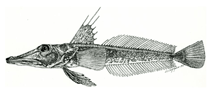 Channichthys richardsoni
Female Foto de Shandikov, G.A.
Imágenes | Google image
Female Foto de Shandikov, G.A.
Clasificación / Nombres Nombres comunes | Sinónimos | Catalog of Fishes(Género, Especie) | ITIS | CoL | WoRMS | Cloffa
> Perciformes/Notothenioidei (Icefishes) > Channichthyidae (Crocodile icefishes)
Etymology: Channichthys: Greek, channe, -es = an anchovy + Greek, ichthys = fish (Ref. 45335); richardsoni: Named for the Scottish naturalist John Richardson, who described the first species of icefishes C. rhinoceratus and established the genus Channichthys.
Eponymy: Sir John Richardson (1787–1865) was a Scottish naval surgeon, naturalist and Arctic explorer. [...] (Ref. 128868), visit book page.
Etymology: Channichthys: Greek, channe, -es = an anchovy + Greek, ichthys = fish (Ref. 45335); richardsoni: Named for the Scottish naturalist John Richardson, who described the first species of icefishes C. rhinoceratus and established the genus Channichthys.
Eponymy: Sir John Richardson (1787–1865) was a Scottish naval surgeon, naturalist and Arctic explorer. [...] (Ref. 128868), visit book page.
Entorno: milieu / zona climática / rango de profundidad / gama de distribución Ecología
marino demersal; rango de profundidad 126 - 310 m (Ref. 90862), usually 126 - ? m (Ref. 90862). Deep-water
Distribución Territorios | Áreas FAO | Ecosistemas | Ocurrencias, apariciones | Mapa de puntos | Introducciones | Faunafri
Southern Ocean, Sub-Antarctic: Kerguelen Islands.
Tamaño / Peso / Edad
Madurez: Lm ? range ? - ? cm
Max length : 37.4 cm TL (female)
Max length : 37.4 cm TL (female)
Descripción breve Claves de identificación | Morfología | Morfometría
Espinas dorsales (total) : 7 - 8; Radios blandos dorsales (total) : 31 - 34; Espinas anales: 0; Radios blandos anales: 29 - 32. This species is characterized by the following D1 VII-VIII, D2 31-34; A 29-32; pectoral 19-20; bony tubular plates (scales) of the dorsal lateral line 61-78 and of the median lateral line 9-23, rounded separated bony plates in the anterior part of the median lateral line 4-28, as a rule, more than 10; number of gill-rakers on the outer side of the lower part of the 1st arch 6-15. This species is further distinguished by the following: interorbital width narrow, 1.0-1.4 times in horizontal orbit diameter, 5.8-7.5 in HL and 2.0-2.4 in head height at level of middle of eye; eye moderate in size, its diameter 5.2-6.3 times in HL and 2.6-3.0 in snout length; supraorbital outer bony edges of frontals noticeably elevated; snout relatively long, approximately equal to or somewhat shorter than half the head length, 2.1-2.2 in HL; tips of jaws aligned or lower jaw slightly protruding, teeth on symphysis not visible; posterior edge of maxillary extending below 1/3-1/2 of the orbit diameter; a row of rakers on lower part of first gill arch on the outer side of ceratobranchial; pectoral fin extending above to anus or origin of first anal fin ray; first dorsal fin high, 3.3-4.7 times in SL, second and third rays longest; fin membrane of D1 not reaching tips of longest rays, its height about 1.4-1.7 times in height of D1; dorsal fins well separated, posterior edge of D1 fin membrane not reaching first ray base of D2; interdorsal distance wide, 10.9-16.4 times in SL or 1.0-1.9 times in length of D1; bony tuberculation well developed on frontals and lacrimals, D1 flexible spines, branchiostegals, pelvic fins and on bony structures of both lateral lines; absent on maxillary and on anterior part of lower jaw (Ref. 90862).
Body shape (shape guide): elongated.
Body shape (shape guide): elongated.
Found on shelf waters of islands and caught in 2 bottom trawls at depths of 126 and 270-310 m, together with C. rhinoceratus, C. rugosus, C. panticapaei, C. bospori, C. irinae and C. mithridatis. Most specimens were caught at depth of 126 m in an area with abundant benthic fauna and the alga Macrocystis pyrifera. Apparently a primarily piscivorous predator (inferred from the single row of gill-rakers and similar to its congeners). Females mature at about 29-31 cm TL (25-27 cm SL); the post-spawning SGM VI-III is clearly detected in females larger than 31 cm TL and the SGM III - in the smaller, firstly maturing ones. The SGM of the males examined varied from stage II to early stage III in the specimen of 32.5 cm TL. Spawning and pre-spawning SGM were absent. Spawning period apparently takes a place from autumn to the beginning of winter (Ref. 90862).
Ciclo vital y comportamiento de apareamiento Madurez | Reproducción | Puesta | Huevos | Fecundidad | Larva
Referencia principal
Suba sus referencias | Referencias | Coordinador | Colaboradores
Shandikov, G.A., 2011. Channichthys richardsoni sp. n., a new Antarctic icefish (Perciformes: Notothenioidei: Channichthyidae) from the Kerguelen Islands area, Indian sector of the Southern Ocean. Journal of V.N. Karazin Kharkiv National University, Series: Biology 2008, 7(814):125-134. (Ref. 90862)
CITES
Not Evaluated
Amenaza para el ser humano
Harmless
Usos humanos
Pesquerías: bycatch
FAO - Publication: search | FishSource |
Más información
Ecología Trófica
Alimentos (presas)
Composición de la dieta
consumo de alimento
Raciones de comida
Despredadores
Alimentos (presas)
Composición de la dieta
consumo de alimento
Raciones de comida
Despredadores
Ecología
Ecología
Ecología
Dinámica de la población
Coeficiente del crecimiento para
Edades / tallas máximas
Longitud-peso rel.
Longitud-longitud rel.
Longitud-frecuencias
Conversión de masas
Reclutamiento
Abundancia
Coeficiente del crecimiento para
Edades / tallas máximas
Longitud-peso rel.
Longitud-longitud rel.
Longitud-frecuencias
Conversión de masas
Reclutamiento
Abundancia
Ciclo de vida
Reproducción
Madurez
Madurez/Gills rel.
Fecundidad
Puesta
Agregaciones de desove
Huevos
Desarrollo de los huevos
Larva
Dinámica larvaria
Reproducción
Madurez
Madurez/Gills rel.
Fecundidad
Puesta
Agregaciones de desove
Huevos
Desarrollo de los huevos
Larva
Dinámica larvaria
Distribución
Territorios
Áreas FAO
Ecosistemas
Ocurrencias, apariciones
Introducciones
BRUVS - Vídeos
Territorios
Áreas FAO
Ecosistemas
Ocurrencias, apariciones
Introducciones
BRUVS - Vídeos
Anatomía
Superficie branquial
Cerebro
Otolito
Superficie branquial
Cerebro
Otolito
Fisiología
Composición corporal
Nutrientes
Consumo del oxígeno
Tipo de natación
Velocidad de natación
Pigmentos visuales
Sonido de peces
Enfermedades y parásitos
Toxicidad (CL50)
Composición corporal
Nutrientes
Consumo del oxígeno
Tipo de natación
Velocidad de natación
Pigmentos visuales
Sonido de peces
Enfermedades y parásitos
Toxicidad (CL50)
Genética
Genoma
Genética
Heterocigosidad
heritabilidad
Diversidad genética
Genoma
Genética
Heterocigosidad
heritabilidad
Diversidad genética
Relacionados con el ser humano
Sistemas de acuicultura
Perfiles de acuicultura
Razas
Ciguatera cases
Sellos, monedas, varios
Sistemas de acuicultura
Perfiles de acuicultura
Razas
Ciguatera cases
Sellos, monedas, varios
Herramientas
Libro electrónico | Guía de campo | Asistente para frecuencias de tallas | Herramienta de ciclo de vida | Mapa de puntos |
Catch-MSY |
Informes especiales
Comprobar el mantenimiento del acuario | Buscar fichas sobre especies | Consulte las hojas informativas sobre acuicultura
Descargar XML
Fuentes de Internet
AFORO (otoliths) | Aquatic Commons | BHL | Cloffa | Websites from users | Check FishWatcher | CISTI | Catalog of Fishes: Género, Especie | DiscoverLife | ECOTOX | FAO - Publication: search | Faunafri | Fishipedia | Fishtrace | GloBI | Google Books | Google Scholar | Google | IGFA World Record | OneZoom | Open Tree of Life | Otolith Atlas of Taiwan Fishes | PubMed | Reef Life Survey | Socotra Atlas | TreeBase | Árbol de la vida | Wikipedia: Go, búsqueda | World Records Freshwater Fishing | Zoobank | Expediente Zoológico
Estimaciones basadas en modelos
Índice de diversidad filogenética (Referencia 82804): PD50 = 0.5020 [Uniqueness, from 0.5 = low to 2.0 = high].
Bayesian length-weight: a=0.00129 (0.00059 - 0.00280), b=3.46 (3.28 - 3.64), in cm total length, based on LWR estimates for this (Sub)family-body shape (Ref. 93245).
Nivel trófico (Referencia 69278): 3.7 ±0.6 se; based on size and trophs of closest relatives
Resiliencia (Referencia 120179): Medio, población duplicada en un tiempo mínimo de 1.4-4.4 años (Preliminary K or Fecundity.).