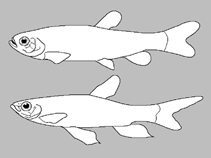
Classification / Names
Noms communs | Synonymes | Catalog of Fishes(Genre, Espèce) | ITIS | CoL | WoRMS | Cloffa
>
Characiformes (Characins) >
Lebiasinidae (Pencilfishes) > Lebiasininae
Etymology: Lebiasina: Derived from Greek, lebias, lebiou = a kind of fish (Ref. 45335); minuta: The specific epithet minuta, meaning small, is in reference to the small size of adult specimens of Lebiasina minuta. Despite the large sample size of this species, no specimen
larger than 6.84 cm SL was collected and most specimens larger than 5.0 cm SL were mature. An adjective.
Environment: milieu / climate zone / profondeur / distribution range
Écologie
; eau douce benthopélagique. Tropical
South America: Rio Curuá (rio Xingu basin) in Serra do Cachimbo, Brazil.
Taille / Poids / Âge
Maturité: Lm ? range ? - ? cm
Max length : 6.8 cm SL mâle / non sexé; (Ref. 91748)
Description synthétique
Clés d'identification | Morphologie | Morphométrie
Rayons mous dorsaux (Total) : 10; Rayons mous anaux: 11 - 12. Can be easily diagnosed from all lebiasinins, except Lebiasina melanoguttata, by the following characters: absence of the primary and secondary stripes, as well as the caudal
blotch; the presence of three longitudinal series of dark blotches at the base of the scales; the pair of foramina on the vomer through which the ramus palatinus of the facial nerve passes; the large laminar extrascapular bone in contact with the fifth infraorbital and overlaying the anterodorsal portion of the opercle; and the nearly equal caudal-fin lobes. Differs from Lebiasina melanoguttata in the presence of a dark blotch at the base of the middle dorsal-fin rays, the second infrapharyngobranchial being edentulous, the yellowish overall coloration of the body, the dark olive green eyes, and the dark blotches of longitudinal series 3 and 4 coalescing where scales of adjacent longitudinal series overlap (vs. dark blotch absent; second infrapharyngobranchial with conical teeth; the reddish overall color of body and eyes; and the dark blotches of longitudinal series not coalescing) (Ref. 91748).
Body shape (shape guide): elongated.
Facultative air-breathing in the genus (Ref. 126274)
Life cycle and mating behavior
Maturité | Reproduction | Frai | Œufs | Fécondité | Larves
Netto-Ferreira, A.L., 2012. Three new species of Lebiasina (Characiformes: Lebiasinidae) from the Brazilian Shield border at Serra do Cachimbo, Pará, Brazil. Neotrop. Ichthyol. 10(3):487-498. (Ref. 91748)
Statut dans la liste rouge de l'IUCN (Ref. 130435: Version 2025-1)
Menace pour l'homme
Harmless
Utilisations par l'homme
Outils
Articles particuliers
Télécharger en XML
Sources Internet
Estimates based on models
Phylogenetic diversity index (Réf.
82804): PD
50 = 0.5000 [Uniqueness, from 0.5 = low to 2.0 = high].
Bayesian length-weight: a=0.00692 (0.00273 - 0.01753), b=3.05 (2.83 - 3.27), in cm total length, based on LWR estimates for this (Sub)family-body shape (Ref.
93245).
Niveau trophique (Réf.
69278): 3.4 ±0.4 se; based on size and trophs of closest relatives
Fishing Vulnerability (Ref.
59153): Low vulnerability (10 of 100).
🛈