Classification / Names
Nombres comunes | Sinónimos | Catalog of Fishes(Género, Especie) | ITIS | CoL | WoRMS | Cloffa
>
Gobiiformes (Gobies) >
Gobiidae (Gobies) > Gobionellinae
Etymology: Gnatholepis: Greek, gnathos = jaw + Greek,lepis = scale (Ref. 45335); knighti: Named for Knight Starr Jordan, the son of David Starr Jordan (Ref. 54834).
Eponymy: Knight Starr Jordan (1888–1947) was the senior author’s son. He was honoured as it was he who first noticed this goby in a pond at Moana Hotel at Waikiki Beach, near Honolulu, Hawaii. (Ref. 128868), visit book page.
More on authors: Jordan & Evermann.
Environment: milieu / climate zone / rango de profundidad / distribution range
Ecología
marino pelagic-neritic; rango de profundidad 0 - 5 m (Ref. 92171). Tropical
Distribución
Países | Áreas FAO | Ecosistemas | Ocurrencias, apariciones | Mapa de puntos | Introducciones | Faunafri
Western Central Pacific: Known only from the Hawaiian island chain.
Tamaño / Peso / Age
Madurez: Lm ? range ? - ? cm
Max length : 6.4 cm SL macho / no sexado; (Ref. 92171); 6.1 cm SL (female)
Short description
Claves de identificación | Morfología | Morfometría
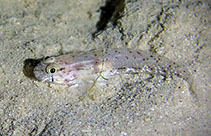
Espinas dorsales (total) : 7 - 8; Radios blandos dorsales (total) : 10 - 12; Espinas anales: 1; Radios blandos anales: 10 - 11. This large stocky Gnatholepis species (up to 64 mm SL) is distinguished by the following characters: cycloid scales on predorsal region, cheek and pectoral fin base; a distinct flap present at end of lower lip; 3 or more dark spots along first spine of first and second dorsal fins, followed by at least 3 rows of dark spots or short streaks; pectoral fin plain translucent to pale brownish; transverse black line crossing upper part of eye usually split in 2; anal fin plain dusky, often with one to several blackish rounded to oval spots posteriorly, or with dark streaks following membrane; D2 and A nearly always I,11; pectoral rays 15-17 (usually 16); lateral scales 25-29 (usually 27); predorsal scales 7-10 (usually 8-9) (Ref. 92171).
Body shape (shape guide): fusiform / normal; Cross section: compressed.
Most specimens have been collected from shallow habitats, tide pools or 'brackish pools', at depths of 0-5 m, from sand and mangrove areas (Ref. 92171).
Life cycle and mating behavior
Madurez | Reproducción | Puesta | Huevos | Fecundidad | Larva
Larson, H.K. and D.J. Buckle, 2012. A revision of the goby genus Gnatholepis Bleeker (Teleostei, Gobiidae, Gobionellinae), with description of a new species. Zootaxa 3529:1-69. (Ref. 92171)
IUCN Red List Status (Ref. 130435: Version 2025-1)
Threat to humans
Harmless
Human uses
Herramientas
Special reports
Download XML
Fuentes de Internet
Estimates based on models
Preferred temperature (Referencia
123201): 24.7 - 29, mean 27.5 °C (based on 139 cells).
Phylogenetic diversity index (Referencia
82804): PD
50 = 0.5010 [Uniqueness, from 0.5 = low to 2.0 = high].
Bayesian length-weight: a=0.00977 (0.00444 - 0.02153), b=3.04 (2.85 - 3.23), in cm total length, based on LWR estimates for this (Sub)family-body shape (Ref.
93245).
Nivel trófico (Referencia
69278): 3.3 ±0.5 se; based on size and trophs of closest relatives
Fishing Vulnerability (Ref.
59153): Low vulnerability (10 of 100).
🛈