



Etheostoma clinton Mayden & Layman, 2012
Beaded darter
Carica il tuo foto e Video
Google image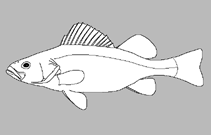 No image available for this species;
drawing shows typical species in Percidae.
Google image
drawing shows typical species in Percidae.
Classificazione / Nomi Nomi Comuni | Sinonimi | Catalog of Fishes(Genere, Specie) | ITIS | CoL | WoRMS | Cloffa
> Perciformes/Percoidei (Perchs) > Percidae (Perches) > Etheostomatinae
Etymology: Etheostoma: Greek, etheo = to strain + Greek, stoma = mouth; Rafinesque said "various mouths", but Jordan and Evermann suggest the name might have been intended as "Heterostoma (Ref. 45335); clinton: Named for President Bill Clinton, the 42nd President of the United States of America, for his lasting environmental accomplishments in creating and expanding national monuments, preserving millions of acres of wilderness areas, his leadership and commitment during challenging economic times, and his continued commitment to global humanitarian issues and needs and peace; noun in apposition.
Eponymy: President William Jefferson ‘Bill’ Clinton né Blyth III was the 42nd President of the USA. He was honoured for his lasting environmental accomplishments. (Ref. 128868), visit book page.
Etymology: Etheostoma: Greek, etheo = to strain + Greek, stoma = mouth; Rafinesque said "various mouths", but Jordan and Evermann suggest the name might have been intended as "Heterostoma (Ref. 45335); clinton: Named for President Bill Clinton, the 42nd President of the United States of America, for his lasting environmental accomplishments in creating and expanding national monuments, preserving millions of acres of wilderness areas, his leadership and commitment during challenging economic times, and his continued commitment to global humanitarian issues and needs and peace; noun in apposition.
Eponymy: President William Jefferson ‘Bill’ Clinton né Blyth III was the 42nd President of the USA. He was honoured for his lasting environmental accomplishments. (Ref. 128868), visit book page.
Ambiente: milieu / zona climatica / distribuzione batimetrica / gamma di distribuzione Ecologia
; acqua dolce benthopelagico. Temperate
Distribuzione Territories | Aree FAO | Ecosistemi | Presenze | Mappa dei ritrovamenti | Introduzioni | Faunafri
North America: United States of America (upper Caddo and upper Ouachita rivers upstream of the Fall Line in the Ouachita Mountains province of Arkansas).
Dimensione / Peso / Età
Maturità: Lm ? range ? - ? cm
Max length : 3.5 cm SL maschio/sesso non determinato; (Ref. 92294); 3.4 cm SL (female)
Max length : 3.5 cm SL maschio/sesso non determinato; (Ref. 92294); 3.4 cm SL (female)
Breve descrizione Chiavi di identificazione | Morfologia | Morfometria
Spine dorsali (totale) : 10 - 13; Raggi dorsali molli (totale) : 10 - 13; Spine anali: 2; Raggi anali molli: 7 - 10. The breeding male of this species, a member of the subgenus Doration. Is distinguished by: the following characters: spinous dorsal fin with blue-green marginal and submedial bands, red-orange medial band, basal band lacking bright orange pigment; soft dorsal, caudal, and pectoral fins without distinct orange spots on rays; soft dorsal and anal fins with bluegreen in base of fin; face and lower head gray with blue or blue-green on operculum, preoperculum, suborbital bar, lips, and mid-gular region; quadrate lateral blue-green blotches with narrow continuous midlateral band of melanophores running through blotches; blue-green wedge on ventral half of caudal fin base but not developed dorsally. In addition, the frenum is absent; lateral line is incomplete, unpored scales modally, greater than 10 (14); cheek is usually naked; presence of palatine teeth; dorsal fin spines modally 11, soft rays modally 11; anal fin soft rays modally 9; pectoral fin rays modally 13-14; principal caudal fin rays modally 15; caudal peduncle scales modally 16; preoperculomandibular canal pores modally 9 (Ref. 92294).
Cross section: oval.
Cross section: oval.
Ciclo vitale e comportamento di accoppiamento Maturità | Riproduzione | Deposizione | Uova | Fecondità | Larve
Riferimento principale
Caricare le referenze | Bibliografia | Coordinatore | Collaboratori
Layman, S.R. and R.L. Mayden, 2012. Morphological diversity and phylogenetics of the darter subgenus Doration (Percidae: Etheostoma), with descriptions of five new species. Bulletin of the Alabama Museum of Natural History 30:1-83. (Ref. 92294)
CITES
Not Evaluated
Minaccia per l'uomo
Harmless
Usi umani
FAO - Publication: search | FishSource |
Informazioni ulteriori
Ecologia trofica
Articoli alimentari (prede)
Alimentazione
Consumo di cibo
Razioni alimentari
Predatori
Articoli alimentari (prede)
Alimentazione
Consumo di cibo
Razioni alimentari
Predatori
Ecologia
Ecologia
Ecologia
Dinamica della popolazione
Parametri di crescita
Età massima / dimensioni massime
Rapporto lunghezza-peso.
Lunghezza-lunghezza rel.
Lunghezza-frequenze
Conversione di massa
Reclutamento
Abbondanza
Parametri di crescita
Età massima / dimensioni massime
Rapporto lunghezza-peso.
Lunghezza-lunghezza rel.
Lunghezza-frequenze
Conversione di massa
Reclutamento
Abbondanza
Ciclo di vita
Riproduzione
Maturità
Maturità/Gli occhielli sono relativi.
Fecondità
Deposizione
Aggregazioni riproduttive
Uova
Sviluppo delle uova
Larve
Dinamica popolazioni larvali
Riproduzione
Maturità
Maturità/Gli occhielli sono relativi.
Fecondità
Deposizione
Aggregazioni riproduttive
Uova
Sviluppo delle uova
Larve
Dinamica popolazioni larvali
Anatomia
Area branchiale
Cervello
Otolite
Area branchiale
Cervello
Otolite
Fisiologia
Composizione corporea
Nutrienti
Consumo di ossigeno
Tipo di nuoto
Velocità di nuoto
Pigmenti visivi
Suono del pesce
Malattie e parassiti
Tossicità (LC50)
Composizione corporea
Nutrienti
Consumo di ossigeno
Tipo di nuoto
Velocità di nuoto
Pigmenti visivi
Suono del pesce
Malattie e parassiti
Tossicità (LC50)
Genetica
Genome
Genetica
Eterozigosi
Ereditarietà
Diversità genetica
Genome
Genetica
Eterozigosi
Ereditarietà
Diversità genetica
Legato all'uomo
Sistemi di acquacoltura
Profili di acquacoltura
Varietà
Casi di Ciguatera
Francobolli, monete, materiale vario.
Sistemi di acquacoltura
Profili di acquacoltura
Varietà
Casi di Ciguatera
Francobolli, monete, materiale vario.
Strumenti
Libro elettronico | Giuda pratica | Generatore frequenze di lunghezza | Strumento Parametri Biologici | Mappa dei ritrovamenti |
Cattura-MSY |
Rapporti speciali
Controllo della manutenzione dell'acquario | Verificare la presenza di schede informative sulle specie | Verifica delle schede informative sull'acquacoltura
Scarica XML
Fonti Internet
AFORO (otoliths) | Aquatic Commons | BHL | Cloffa | Websites from users | Check FishWatcher | CISTI | Catalog of Fishes: Genere, Specie | DiscoverLife | ECOTOX | FAO - Publication: search | Faunafri | Fishipedia | Fishtrace | GloBI | Google Books | Google Scholar | Google | IGFA World Record | OneZoom | Open Tree of Life | Otolith Atlas of Taiwan Fishes | PubMed | Reef Life Survey | Socotra Atlas | TreeBase | Tree of Life | Wikipedia: Go, ricerca | World Records Freshwater Fishing | Zoobank | Record zoologico
Stime basate su modelli
Indice di diversità filogenetica (Fonte Biblio. 82804): PD50 = 0.5000 [Uniqueness, from 0.5 = low to 2.0 = high].
Bayesian length-weight: a=0.00676 (0.00303 - 0.01510), b=3.12 (2.94 - 3.30), in cm total length, based on LWR estimates for this Genus-body shape (Ref. 93245).
Livello trofico (Fonte Biblio. 69278): 3.2 ±0.4 se; based on size and trophs of closest relatives
Resilienza (Fonte Biblio. 120179): Alto, tempo minimo di raddoppiamento della popolazione meno di 15 mesi (Preliminary K or Fecundity.).