Klassifizierung / Names
Namen | Synonyme | Catalog of Fishes(Gattung, Arten) | ITIS | CoL | WoRMS | Cloffa
>
Blenniiformes (Blennies) >
Blenniidae (Combtooth blennies) > Blenniinae
Etymology: Salariopsis: The suffix -opsis, from the ancient Greek 'view, appearance', is added to the epithet "Salaria" to highlight its apparent, but misleading, morphological similarity to the blenniid genus Salaria Forsskål, 1775 (Ref. 128181); atlantica: The species name atlantica has been selected because its range covers the Sebou River basin in Morocco that drains into the Atlantic slope (Ref. 89850).
Environment: milieu / climate zone / Tiefenbereich / distribution range
Ökologie
; süßwasser demersal. Subtropical
Africa: Ouerrha River, Sebou River basin, in Morocco (Ref. 89850, 126071).
Size / Gewicht / Alter
Geschlechtsreife: Lm ? range ? - ? cm
Max length : 5.0 cm SL Männchen/unbestimmt; (Ref. 89850)
Kurzbeschreibung
Bestimmungsschlüssel | Morphologie | Morphometrie
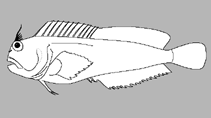
Rückenflossenstacheln (insgesamt) : 12 - 13; Rückenflossenweichstrahlen (insgesamt) : 16 - 17; Afterflossenstacheln: 2; Afterflossenweichstrahlen: 16 - 17; Wirbelzahl: 34. Diagnosis: Salariopsis atlantica differs from other known species of Salariopsis by the following combination of characters: head without diagonal rows of black dots on the cheeks running backwards and downwards from the lower edge of the eye as in S. economidisi and S. fluviatilis; number of teeth 13-15 on upper jaw and 14-16 on lower; supra-temporal canal with 3 cephalic pores; pre-opercular canal with 7-9 cephalic pores; circum-orbital canal with 8-9 cephalic pores (Ref. 89850). Supra-ocular tentacle thick and simple; 16-17 branched rays in the anal fin vs. 16-19 in both S. fluviatilis and S. economidisi; short pre-orbital distance; short anterior region (spiny) of the dorsal fin; 34 vertebrae (Ref. 89850).
Body shape (shape guide): fusiform / normal.
Facultative air-breathing in the genus (Ref. 126274); The species inhabits streams with shallow and running waters and stony substrata (Ref. 89850). Oviparous; eggs are demersal and adhesive (Ref. 205), and are attached to the substrate via a filamentous, adhesive pad or pedestal (Ref. 94114). Larvae are planktonic, often found in shallow, coastal waters (Ref. 94114). The singularity of this species, as one of the two known Atlantic populations within the freshwater representatives of the genus Salaria, and the fact that it is restricted to a single basin, confers to Salaria atlantica the need of effective protection; for this reason it is considered that this species should be included in the IUCN category Endangered (EN), based on IUCN criteria (Ref. 89850).
Life cycle and mating behavior
Geschlechtsreife | Fortpflanzung | Ablaichen | Eier | Fecundity | Larven
Oviparous, distinct pairing (Ref. 205).
Doadrio, I., S. Perea and A. Yahyaoui, 2011. Morphological and molecular analyses of freshwater blennids: A new species of the genus Salaria Forsskål, 1775 (Actinopterygii, Blenniidae) in Morocco. Graellsia 67(2):151-173. (Ref. 89850)
IUCN Rote Liste Status (Ref. 130435: Version 2025-1)
Bedrohung für Menschen
Harmless
Nutzung durch Menschen
Tools
Zusatzinformationen
Download XML
Internet Quellen
Estimates based on models
Phylogenetic diversity index (Ref.
82804): PD
50 = 0.6250 [Uniqueness, from 0.5 = low to 2.0 = high].
Bayesian length-weight: a=0.01047 (0.00434 - 0.02525), b=3.07 (2.86 - 3.28), in cm total length, based on LWR estimates for this (Sub)family-body shape (Ref.
93245).
Trophic level (Ref.
69278): 3.3 ±0.4 se; based on size and trophs of closest relatives
Widerstandsfähigkeit (Ref.
120179): hoch, Verdopplung der Population dauert weniger als 15 Monate. (Preliminary K or Fecundity.).
Fishing Vulnerability (Ref.
59153): Low vulnerability (10 of 100).
🛈