Classification / Names
Noms communs | Synonymes | Catalog of Fishes(Genre, Espèce) | ITIS | CoL | WoRMS | Cloffa
>
Cichliformes (Cichlids, convict blennies) >
Cichlidae (Cichlids) > Pseudocrenilabrinae
Etymology: Lepidiolamprologus: Greek, lepis = scale + Greek, lampros = light + Greek, lagos = hare (Ref. 45335); kamambae: The specific epithet is a genitive based on the name of Kamamba Island at which the type series was collected (Ref. 91764).
Eponymy: This is a toponym referring to Kamamba Island, Lake Tanganyika, Tanzania; the type locality. (Ref. 128868), visit book page.
Environment: milieu / climate zone / profondeur / distribution range
Écologie
; eau douce pélagique. Tropical
Africa: endemic to Lake Tanganyika, known from Kamamba Island and Kerenge Island in Tanzania (Ref. 91764).
Taille / Poids / Âge
Maturité: Lm ? range ? - ? cm
Max length : 13.7 cm SL mâle / non sexé; (Ref. 91764)
Description synthétique
Clés d'identification | Morphologie | Morphométrie
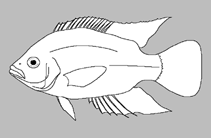
A species characterized by emarginate or truncate caudal fin, small scales (61-74) and presence of dermosphenotic bone combined with absence of other infraorbital ossicles (Ref. 91764). It is similar to Lepidiolamprologus elongatus, L. kendalli and L. mimicus in color pattern composed of three horizontal rows of dark blotches on each side of body; distinguished from all of these species by presence of a broad dark stripe on cheek (Ref. 91764).
Found in transition zone between rocks and sand at 15 m depth; habitat consists of sparsely scattered stones of 0.2-2 m in size on white sand bottom; hunts prey on the open sand floor; feeds mainly on cichlid fish juveniles (Ref. 91764).
Life cycle and mating behavior
Maturité | Reproduction | Frai | Œufs | Fécondité | Larves
Kullander, S.O., M. Karlsson and M. Karlsson, 2012. Lepidiolamprologus kamambae, a new species of cichlid fish (Teleostei: Cichlidae) from Lake Tanganyika. Zootaxa 3492:30-48. (Ref. 91764)
Statut dans la liste rouge de l'IUCN (Ref. 130435: Version 2025-1)
Menace pour l'homme
Harmless
Utilisations par l'homme
Outils
Articles particuliers
Télécharger en XML
Sources Internet
Estimates based on models
Phylogenetic diversity index (Réf.
82804): PD
50 = 0.5010 [Uniqueness, from 0.5 = low to 2.0 = high].
Bayesian length-weight: a=0.01000 (0.00244 - 0.04107), b=3.04 (2.81 - 3.27), in cm total length, based on all LWR estimates for this body shape (Ref.
93245).
Niveau trophique (Réf.
69278): 4.0 ±0.7 se; based on size and trophs of closest relatives
Résilience (Réf.
120179): Haut, temps minimum de doublement de population inférieur à 15 mois (Preliminary K or Fecundity.).
Fishing Vulnerability (Ref.
59153): Low vulnerability (10 of 100).
🛈