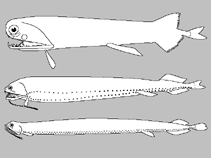
Classification / Names
Nombres comunes | Sinónimos | Catalog of Fishes(Género, Especie) | ITIS | CoL | WoRMS | Cloffa
>
Stomiiformes (Lightfishes and dragonfishes) >
Stomiidae (Barbeled dragonfishes) > Melanostomiinae
Etymology: Photonectes: Greek, photos = light + Greek, nekton = swimmer (Ref. 45335); paxtoni: Named for Dr. John Paxton for his many contributions to the study of mesopelagic fishes and his
encouragement to the authors.
Eponymy: Dr John Richard Paxton (d: 1938) is an American-born Australian ichthyologist. [...] (Ref. 128868), visit book page.
Environment: milieu / climate zone / rango de profundidad / distribution range
Ecología
marino pelagic-oceanic; rango de profundidad 130 - 135 m (Ref. 92891). Tropical
Western Pacific Ocean; Papua New Guinea.
Tamaño / Peso / Age
Madurez: Lm ? range ? - ? cm
Max length : 2.3 cm SL macho / no sexado; (Ref. 92891)
Short description
Claves de identificación | Morfología | Morfometría
Radios blandos dorsales (total) : 16 - 18; Radios blandos anales: 18. This species is distinguished from other members of the subgenus Photonectes in the following set of characters: short barbel with a very enlarged ovoid terminal bulb without terminal appendages; no blue luminous tissue; reduced length of gill filaments on first branchial arch, less than arch depth; VAV photophores 15-16 (vs. 0-15), AC photophores 13 (vs. 9-12), IV photophores 29 (vs. 30-46); bulb is plain (without filaments) and remarkably large. This species is similar to P. ovibarba (synonym of P. braueri) in having an enlarged bulb but is without pectoral fins (vs. present, with 2 rays each), IV photophores 29 (vs. 32-33), AC photophores 13 (vs. 10-12), the bulb has no terminal appendage (vs. bearing a small ovoid appendage); from another species with a large bulb, P. fimbria (synonym of P. parvimanus), IV photophores 29 (vs. 43-49), IP photophores insert halfway along the isthmus, or with gap (vs. insert near mandibular symphysis or no gap), no thick skin (vs. thick skin over dorsal- and anal-fin rays), no flap or terminal appendage; growth change unknown (vs. bulb with terminal flap increasing with growth) (Ref. 92891).
Body shape (shape guide): elongated.
Life cycle and mating behavior
Madurez | Reproducción | Puesta | Huevos | Fecundidad | Larva
Flynn, A.J. and C. Klepadlo, 2012. Two new species of Photonectes (Teleostei: Stomiidae) from the Indo-Pacific, and a re-examination of P. achirus. Memoirs of Museum Victoria 69: 259-267. (Ref. 92891)
IUCN Red List Status (Ref. 130435: Version 2025-1)
Threat to humans
Harmless
Human uses
Herramientas
Special reports
Download XML
Fuentes de Internet
Estimates based on models
Phylogenetic diversity index (Referencia
82804): PD
50 = 0.5000 [Uniqueness, from 0.5 = low to 2.0 = high].
Bayesian length-weight: a=0.00302 (0.00116 - 0.00786), b=3.12 (2.89 - 3.35), in cm total length, based on LWR estimates for this (Sub)family-body shape (Ref.
93245).
Nivel trófico (Referencia
69278): 3.1 ±0.5 se; based on size and trophs of closest relatives
Fishing Vulnerability (Ref.
59153): Low vulnerability (10 of 100).
🛈