>
Ophidiiformes (Cusk eels) >
Ophidiidae (Cusk-eels) > Ophidiinae
Etymology: Lepophidium: Latin, lepus, leporis = rabbit + Greek, ophis = serpent (Ref. 45335); wileyi: Named for Edward O. Wiley.
Eponymy: Dr Edward Orlando Wiley III (d: 1944) is a biologist who is Professor of Systematics and Evolutionary Biology and Curator Emeritus, Ichthyology, Natural History Museum, University of Kansas. [...] (Ref. 128868), visit book page.
Environment: milieu / climate zone / profondeur / distribution range
Écologie
marin benthopélagique; profondeur 60 - 402 m (Ref. 91765), usually 200 - 300 m (Ref. 91765). Tropical; 26°N - 10°N, 95°W - 59°W (Ref. 91765)
Western Atlanic Ocean: from the western edge of the Bahamas and Cuba along the Antillean chain to Trinidad and in the southern, eastern, and western Caribbean Sea; a collection is known from the Gulf of Mexico northwest of the Yucatan Peninsula.
Taille / Poids / Âge
Maturité: Lm ? range ? - ? cm
Max length : 20.9 cm SL mâle / non sexé; (Ref. 91765)
Description synthétique
Clés d'identification | Morphologie | Morphométrie
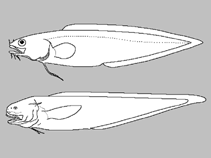
Rayons mous dorsaux (Total) : 124 - 135; Rayons mous anaux: 105 - 117; Vertèbres: 70 - 75. This species is characterized by the following: fringed snout; average snout length 20.9% in HL; average bony interorbit distance 18.6% in HL; average lateral line length 91.5% in SL; average post orbital head length 20.7% in HL; average preanal distance 36.7% in SL; head and body color tan and without pattern; no white spot on symphyseal region of the snout (Ref. 91765).
Body shape (shape guide): eel-like; Cross section: compressed.
Life cycle and mating behavior
Maturité | Reproduction | Frai | Œufs | Fécondité | Larves
Robins, C.R., R.H. Robins and M.E. Brown, 2012. A revision of Lepophidium (Teleoastei, Ophidiidae), with descriptions of eight new species. Bulletin of the Florida Museum of Natural History 52(1):1-94. (Ref. 91765)
Statut dans la liste rouge de l'IUCN (Ref. 130435: Version 2025-1)
Menace pour l'homme
Harmless
Utilisations par l'homme
Outils
Articles particuliers
Télécharger en XML
Sources Internet
Estimates based on models
Preferred temperature (Réf.
123201): 14.1 - 22, mean 18.4 °C (based on 35 cells).
Phylogenetic diversity index (Réf.
82804): PD
50 = 0.5000 [Uniqueness, from 0.5 = low to 2.0 = high].
Bayesian length-weight: a=0.00102 (0.00046 - 0.00225), b=3.06 (2.88 - 3.24), in cm total length, based on all LWR estimates for this body shape (Ref.
93245).
Niveau trophique (Réf.
69278): 3.6 ±0.7 se; based on size and trophs of closest relatives
Résilience (Réf.
120179): Haut, temps minimum de doublement de population inférieur à 15 mois (Preliminary K or Fecundity.).
Fishing Vulnerability (Ref.
59153): Low vulnerability (16 of 100).
🛈