



Hypsolebias sertanejo Costa, 2012
Adicionar o seu Fotografias e vídeos
Imagem do Google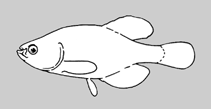 No image available for this species;
drawing shows typical species in Rivulidae.
Imagem do Google
drawing shows typical species in Rivulidae.
Classificação / Nomes Nomes comuns | Sinónimos | Catalog of Fishes(Género, Espécies) | ITIS | CoL | WoRMS | Cloffa
> Cyprinodontiformes (Rivulines, killifishes and live bearers) > Rivulidae (Rivulines) > Cynolebiinae
Etymology: sertanejo: The name sertanejo is a Portuguese word which means something or someone originating in the Sertão, which is a general term designating a vast area of the savannahs of central and north-eastern Brazil, derived from the Portuguese word ‘desertão’ (big desert), in reference to the scarce human occupation of the region in the past, associated with the warm and dry climate. This species occurs in the area that is part of the region described in the famous novel Grande Sertão.
Etymology: sertanejo: The name sertanejo is a Portuguese word which means something or someone originating in the Sertão, which is a general term designating a vast area of the savannahs of central and north-eastern Brazil, derived from the Portuguese word ‘desertão’ (big desert), in reference to the scarce human occupation of the region in the past, associated with the warm and dry climate. This species occurs in the area that is part of the region described in the famous novel Grande Sertão.
Ambiente: milieu / zona climática / intervalo de profundidade / gama de distribuição Ecologia
; Água doce bentopelágico. Tropical
Distribuição Territórios | Áreas FAO | Ecossistemas | Ocorrências | Mapa dos pontos | Introduções | Faunafri
South America: São Francisco River basin, Brazil.
Tamanho / Peso / Idade
Maturidade: Lm ? range ? - ? cm
Max length : 4.8 cm SL macho/indeterminado; (Ref. 89836); 3.9 cm SL (female)
Max length : 4.8 cm SL macho/indeterminado; (Ref. 89836); 3.9 cm SL (female)
Descrição breve Chaves de identificação | Morfologia | Morfometria
Raios dorsais moles (total) : 18 - 25; Raios anais moles: 18 - 23; Vértebras: 28 - 30. Distinguished from all members of the Hypsolebias flavicaudatus complex, except H.
janaubensis and H. nitens, by having elongated bluish white spots on the posterior portion of the dorsal-fin base in males (vs. spots not elongated). Differs from H. nitens by having grey bars of flank in males slightly narrower, equal or slightly wider than the interspace (vs. about
two or three times wider), black spots on the middle of the flank in females larger than pupil (vs. smaller), and dorsal and anal fin filaments in males long, reaching the posterior third of the caudal fin (vs. short, reaching the anterior half of the caudal fin), and from H. janaubensis by having longer dorsal-fin base in males (38.7-43.5% SL vs. 34.4-38.4% SL), and deeper body and caudal peduncle (body depth 39.7-43.2 SL% in males and 37.2-40.8% SL in females vs. 33.9-39.5% SL and 30.7-36.8% SL, respectively; caudal peduncle depth 14.8-16.1% SL in males and 14.4-15.4% SL in females vs. 12.6-14.7% SL and 11.7-13.6% SL, respectively). Also differs from H. flavicaudatus and H. gilbertobrasili by having more grey bars on the flank in males (11-15 vs. 8-10); from H. flavicaudatus, H. gilbertobrasili and H. guanambi by the presence of short bluish white bars on the anterior portion of the dorsal-fin base in males (vs. absence); from H. radiseriatus and H. pterophylus by having shorter dorsal and anal fin filaments (reaching posterior portion of caudal fin, sometimes barely surpassing
posterior caudal-fin margin vs. in much surpassing posterior caudal-fin margin) and fewer dorsal fin filaments (2-3 vs. 4-6); from H. flavicaudatus by narrower head in males (64.1-68.8% of head length vs. 70.4-73.1%); from H. flagellatus, H. radiseriatus and H. gilbertobrasili by smaller black spot on the middle of the flank in females (smaller than eye vs. approximately equal to eye in H. flagellatus and H. radiseriatus, and greater than eye in H. gilbertobrasili). Differs also from other species of the the H. flavicaudatus complex by the rudimentary contact organs often present on the anteroventral part of the flank in males (Ref. 89836).
Body shape (shape guide): short and / or deep.
Body shape (shape guide): short and / or deep.
Occurs in parts of the seasonal pools more exposed to sunlight, but often with dense aquatic vegetation (Ref. 89836).
Ciclo de vida e comportamento de acasalamento Maturidade | Reprodução | Desova | Ovos | Fecundidade | Larvas
Referência principal
Carregar as suas referências | Referências | Coordenador : Costa, Wilson J.E.M. | Colaboradores
Costa, W.J.E.M., P.F. Amorim and J.L. Mattos, 2012. Species delimitation in annual killifishes from the Brazilian Caatinga, the Hypsolebias flavicaudatus complex (Cypriniformes: Rivulidae): implications for taxonomy and conservation. Systematics and Biodiversity 10(1):71-91. (Ref. 89836)
Categoria na Lista Vermelha da IUCN (Ref. 130435: Version 2025-2 (Global))
Preocupação menor (LC) ; Date assessed: 07 November 2018
CITES
Not Evaluated
Ameaça para o homem
Harmless
Utilização humana
FAO - Publication: search | FishSource |
Mais informação
Ecologia Trófica
Produtos alimentares (presas)
Composição da dieta
Consumo alimentar
Rações alimentares
Predadores
Produtos alimentares (presas)
Composição da dieta
Consumo alimentar
Rações alimentares
Predadores
Ecologia
Ecologia
Ecologia
Dinâmica das populações
Parâmetros de crescimento
Idades / tamanhos máximos
Comprimento-peso rel.
Comprimento-comprimento rel.
Frequência de comprimento
Conversão de massa
Recrutamento
Abundância
Parâmetros de crescimento
Idades / tamanhos máximos
Comprimento-peso rel.
Comprimento-comprimento rel.
Frequência de comprimento
Conversão de massa
Recrutamento
Abundância
Ciclo de vida
Reprodução
Maturidade
Maturidade/Rel. das guelras
Fecundidade
Desova
Agregações de desova
Ovos
Desenvolvimento dos ovos
Larvas
Dinâmica larvar
Reprodução
Maturidade
Maturidade/Rel. das guelras
Fecundidade
Desova
Agregações de desova
Ovos
Desenvolvimento dos ovos
Larvas
Dinâmica larvar
Anatomia
Área branquial
Cérebro
Otólitos
Área branquial
Cérebro
Otólitos
Fisiologia
Composição corporal
Nutrientes
Consumo de oxigénio
Tipo de natação
Velocidade de natação
Pigmentos visuais
Som de peixe
Doenças e Parasitas
Toxicidade (LC50s)
Composição corporal
Nutrientes
Consumo de oxigénio
Tipo de natação
Velocidade de natação
Pigmentos visuais
Som de peixe
Doenças e Parasitas
Toxicidade (LC50s)
Genética
genoma
Genética
Heterozigotia
Hereditariedade
Diversidade genética
genoma
Genética
Heterozigotia
Hereditariedade
Diversidade genética
Relacionado com o ser humano
Sistemas de aquacultura
Perfis para aquacultura
Estirpes
Casos de Ciguatera
Selos, moedas, diversos.
Sistemas de aquacultura
Perfis para aquacultura
Estirpes
Casos de Ciguatera
Selos, moedas, diversos.
Ferramentas
E-book | Guia de campo | Ferramenta auxiliar de frequências de comprimento | Ferramenta sobre a história de vida | Mapa dos pontos |
Captura-MSY |
Relatórios especiais
Descarregue XML
Fontes da internet
AFORO (otoliths) | Aquatic Commons | BHL | Cloffa | Websites from users | Consultar FishWatcher | CISTI | Catalog of Fishes: Género, Espécies | DiscoverLife | ECOTOX | FAO - Publication: search | Faunafri | Fishipedia | Fishtrace | GloBI | Google Books | Google Scholar | Google | IGFA World Record | OneZoom | Open Tree of Life | Otolith Atlas of Taiwan Fishes | PubMed | Reef Life Survey | Socotra Atlas | TreeBase | Árvore da vida | Wikipedia: ir para, procurar | World Records Freshwater Fishing | Zoobank | Registo zoológico
Estimativas baseadas em modelos
Índice de diversidade filogenética (Ref. 82804): PD50 = 0.5000 [Uniqueness, from 0.5 = low to 2.0 = high].
Bayesian length-weight: a=0.01995 (0.00906 - 0.04395), b=3.01 (2.83 - 3.19), in cm total length, based on all LWR estimates for this body shape (Ref. 93245).
Nível Trófico (Ref. 69278): 3.2 ±0.4 se; based on size and trophs of closest relatives
Resiliência (Ref. 120179): Elevada, tempo mínimo de duplicação da população menor que 15 meses (Preliminary K or Fecundity.).