



Hepsetus kingsleyae Vreven, Decru & Snoeks, 2013
Carica il tuo foto e Video
Immagini | Google image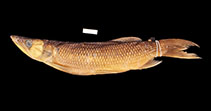 Hepsetus kingsleyae
Immagine di T. Musschoot/RMCA
Immagini | Google image
Immagine di T. Musschoot/RMCA
Classificazione / Nomi Nomi Comuni | Sinonimi | Catalog of Fishes(Genere, Specie) | ITIS | CoL | WoRMS | Cloffa
> Characiformes (Characins) > Hepsetidae (African pikes)
Etymology: Hepsetus: Greek, epsetas, -e, -on = boiled, but there is the following sentence: "oí epsetoi" = certain fishes, and also could be related to "psetta" = grouper (Ref. 45335); kingsleyae: Dedicated to the British explorer Mary Kingsley (1862–1900), who collected several species of fishes in the area, including a few specimens of Hepsetus, as part of her commitment to A. Günther of the British Museum of Natural History (BMNH, London)(Ref. 93279).
Eponymy: Mary Henrietta Kingsley (1862–1900) was an ethnographic and scientific writer and explorer. [...] (Ref. 128868), visit book page.
Etymology: Hepsetus: Greek, epsetas, -e, -on = boiled, but there is the following sentence: "oí epsetoi" = certain fishes, and also could be related to "psetta" = grouper (Ref. 45335); kingsleyae: Dedicated to the British explorer Mary Kingsley (1862–1900), who collected several species of fishes in the area, including a few specimens of Hepsetus, as part of her commitment to A. Günther of the British Museum of Natural History (BMNH, London)(Ref. 93279).
Eponymy: Mary Henrietta Kingsley (1862–1900) was an ethnographic and scientific writer and explorer. [...] (Ref. 128868), visit book page.
Ambiente: milieu / zona climatica / distribuzione batimetrica / gamma di distribuzione Ecologia
; acqua dolce pelagico. Tropical; 0°S - 1°S, 9°E - 11°E
Distribuzione Territories | Aree FAO | Ecosistemi | Presenze | Mappa dei ritrovamenti | Introduzioni | Faunafri
Africa: endemic to the Ogowe River basin in Gabon; known from lakes in contact with the Ogowe main channel, or in rivers close to the lakes; not recorded from the Ngounié (Ref. 93279).
Dimensione / Peso / Età
Breve descrizione Chiavi di identificazione | Morfologia | Morfometria
Diagnosis: distinguished from H. akawo and H. lineata by a narrower head width [26.4–35.6 (mean 33.1) v. 32.8–42.3 (37.0) and 32.8–46.7 (39.4)%HL, respectively] and its narrower internasal distance [15.6–23.3 (mean 20.6) v. 21.9–28.3 (24.7) and 21.5–29.3 (25.1)%HL, respectively]; both characters are positively allometric; distinguished from H. lineata by smaller number of lateral-line scales (45–51 v. 50–64) and higher number of gill rakers [17–23 v. 12–18 (exceptionally 20 in 1 specimen)]; distinguished from H. odoe by smaller number of lateral-line scales [45–51 v. 51–60 (exceptionally 49)] and smaller distance between nostril and lower jaw [33.2–40.9 (mean 38.2) v. 40.4–47.6 (43.1)%HL]; latter character is positively allometric; distinguished from H. cuvieri by higher number of gill rakers (17–23 v. 8–13), lower number of scales between dorsal fin and lateral line (8.5–9.5 v.10.5–11.5), lower number of scales between adipose fin and lateral line (5.5 v. 6.5–7.5) and longer snout [39.3–43.2 (mean 41.0) v. 35.5–38.8 (37.3)%HL]; latter character is positively allometric (Ref. 93279).
Body shape (shape guide): elongated.
Body shape (shape guide): elongated.
Ciclo vitale e comportamento di accoppiamento Maturità | Riproduzione | Deposizione | Uova | Fecondità | Larve
Riferimento principale
Caricare le referenze | Bibliografia | Coordinatore | Collaboratori
Decru, E., E. Vreven and J. Snoeks, 2013. A revision of the Lower Guinean Hepsetus species (Characiformes; Hepsetidae) with the description of Hepsetus kingsleyae sp. nov. J. Fish Biol. 82(4):1351-1375. (Ref. 93279)
Stato della Lista Rossa IUCN (Ref. 130435: Version 2025-2 (Global))
Least Concern (LC) ; Date assessed: 28 July 2019
CITES
Not Evaluated
Minaccia per l'uomo
Harmless
Usi umani
FAO - Publication: search | FishSource |
Informazioni ulteriori
Ecologia trofica
Articoli alimentari (prede)
Alimentazione
Consumo di cibo
Razioni alimentari
Predatori
Articoli alimentari (prede)
Alimentazione
Consumo di cibo
Razioni alimentari
Predatori
Ecologia
Ecologia
Ecologia
Dinamica della popolazione
Parametri di crescita
Età massima / dimensioni massime
Rapporto lunghezza-peso.
Lunghezza-lunghezza rel.
Lunghezza-frequenze
Conversione di massa
Reclutamento
Abbondanza
Parametri di crescita
Età massima / dimensioni massime
Rapporto lunghezza-peso.
Lunghezza-lunghezza rel.
Lunghezza-frequenze
Conversione di massa
Reclutamento
Abbondanza
Ciclo di vita
Riproduzione
Maturità
Maturità/Gli occhielli sono relativi.
Fecondità
Deposizione
Aggregazioni riproduttive
Uova
Sviluppo delle uova
Larve
Dinamica popolazioni larvali
Riproduzione
Maturità
Maturità/Gli occhielli sono relativi.
Fecondità
Deposizione
Aggregazioni riproduttive
Uova
Sviluppo delle uova
Larve
Dinamica popolazioni larvali
Anatomia
Area branchiale
Cervello
Otolite
Area branchiale
Cervello
Otolite
Fisiologia
Composizione corporea
Nutrienti
Consumo di ossigeno
Tipo di nuoto
Velocità di nuoto
Pigmenti visivi
Suono del pesce
Malattie e parassiti
Tossicità (LC50)
Composizione corporea
Nutrienti
Consumo di ossigeno
Tipo di nuoto
Velocità di nuoto
Pigmenti visivi
Suono del pesce
Malattie e parassiti
Tossicità (LC50)
Genetica
Genome
Genetica
Eterozigosi
Ereditarietà
Diversità genetica
Genome
Genetica
Eterozigosi
Ereditarietà
Diversità genetica
Legato all'uomo
Sistemi di acquacoltura
Profili di acquacoltura
Varietà
Casi di Ciguatera
Francobolli, monete, materiale vario.
Sistemi di acquacoltura
Profili di acquacoltura
Varietà
Casi di Ciguatera
Francobolli, monete, materiale vario.
Strumenti
Libro elettronico | Giuda pratica | Generatore frequenze di lunghezza | Strumento Parametri Biologici | Mappa dei ritrovamenti |
Cattura-MSY |
Rapporti speciali
Controllo della manutenzione dell'acquario | Verificare la presenza di schede informative sulle specie | Verifica delle schede informative sull'acquacoltura
Scarica XML
Fonti Internet
AFORO (otoliths) | Aquatic Commons | BHL | Cloffa | Websites from users | Check FishWatcher | CISTI | Catalog of Fishes: Genere, Specie | DiscoverLife | ECOTOX | FAO - Publication: search | Faunafri | Fishipedia | Fishtrace | GloBI | Google Books | Google Scholar | Google | IGFA World Record | OneZoom | Open Tree of Life | Otolith Atlas of Taiwan Fishes | PubMed | Reef Life Survey | Socotra Atlas | TreeBase | Tree of Life | Wikipedia: Go, ricerca | World Records Freshwater Fishing | Zoobank | Record zoologico
Stime basate su modelli
Indice di diversità filogenetica (Fonte Biblio. 82804): PD50 = 0.5312 [Uniqueness, from 0.5 = low to 2.0 = high].
Bayesian length-weight: a=0.00479 (0.00201 - 0.01138), b=3.17 (2.96 - 3.38), in cm total length, based on LWR estimates for this (Sub)family-body shape (Ref. 93245).
Livello trofico (Fonte Biblio. 69278): 3.0 ±0.4 se; based on size and trophs of closest relatives
Resilienza (Fonte Biblio. 120179): Alto, tempo minimo di raddoppiamento della popolazione meno di 15 mesi (Preliminary K or Fecundity.).
Nutrienti (Ref. 124155): Calcium = 184 [75, 446] mg/100g; Iron = 2.27 [1.12, 5.25] mg/100g; Protein = 18.4 [16.3, 20.7] %; Omega3 = 0.371 [0.145, 0.945] g/100g; Selenium = 63 [24, 215] μg/100g; VitaminA = 33.9 [12.3, 90.2] μg/100g; Zinc = 2.32 [1.62, 3.40] mg/100g (wet weight);