Klassifizierung / Names
Namen | Synonyme | Catalog of Fishes(Gattung, Arten) | ITIS | CoL | WoRMS | Cloffa
>
Perciformes/Notothenioidei (Icefishes) >
Artedidraconidae (Barbled plunderfishes)
Etymology: Pogonophryne: Greek, pogon = beard + Greek, phrynos = toad (Ref. 45335); neyelovi: Named for Alexey V. Neyelov, Zoological Institute, Russian Academy of Scienses, St Petersburg, Russia.
Eponymy: Dr Alexei V Neyelov of the Zoological Institute, Russian Academy of Sciences, St Petersburg is a Russian ichthyologist. [...] (Ref. 128868), visit book page.
Environment: milieu / climate zone / Tiefenbereich / distribution range
Ökologie
seewasser bathypelagisch; tiefenbereich 700 - 1390 m (Ref. 93381). Deep-water
Antarctic Pacific: Ross Sea.
Size / Gewicht / Alter
Geschlechtsreife: Lm ? range ? - ? cm
Max length : 35.5 cm TL Männchen/unbestimmt; (Ref. 93381); 35.0 cm TL (female)
Kurzbeschreibung
Bestimmungsschlüssel | Morphologie | Morphometrie
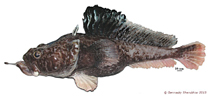
Rückenflossenstacheln (insgesamt) : 2; Rückenflossenweichstrahlen (insgesamt) : 27; Afterflossenweichstrahlen: 18. This species is distinguished from other species of the 'P. mentella' group by the following set of characters: short and tiny mental barbel, light-brownish dorsally, reaching anterior edge of orbit over snout with mouth closed, its length about 9% SL; a very short poorly developed ovaloid terminal expansion composed of bicolored, white and brownish, scale-like and mostly bluntly palmate processes, the length is less than 1/3 of barbel length; lower jaw moderately protruding with weakly visible anterior teeth on symphysis and hidden dorsum of tongue when mouth is closed; the second dorsal fin is high in male (height about 25% SL), without any prominent anterior elevated lobe, with longest rays (1st to 7th) very soft, sinuous distally and branched from about mid-length, this fin is almost entirely black in coloration with bluish insertions in anterior one third and dark basally with light upper margin posteriorly; dorsal surface of head and area anterior to first dorsal fin is covered by dark-brown irregular spots, vermiculations and markings; belly, breast and lower surface of head brown or brownish in general and no distinct dark spots; light mandibular oral valve; pectoral fin vertically dark-striped in its anterior part and uniformly lightish in posterior part (Ref. 93381).
Cross section: oval.
Life cycle and mating behavior
Geschlechtsreife | Fortpflanzung | Ablaichen | Eier | Fecundity | Larven
Shandikov, G.A. and R.R. Eakin, 2013. Pogonophryne neyelovi, a new species of Antarctic shortbarbeled plunderfish (Perciformes, Notothenioidei, Artedidraconidae) from the deep Ross Sea. ZooKeys 296:59-77. (Ref. 93381)
IUCN Rote Liste Status (Ref. 130435: Version 2025-1)
Bedrohung für Menschen
Harmless
Nutzung durch Menschen
Tools
Zusatzinformationen
Download XML
Internet Quellen
Estimates based on models
Phylogenetic diversity index (Ref.
82804): PD
50 = 0.5000 [Uniqueness, from 0.5 = low to 2.0 = high].
Bayesian length-weight: a=0.00501 (0.00240 - 0.01046), b=3.13 (2.94 - 3.32), in cm total length, based on LWR estimates for this (Sub)family-body shape (Ref.
93245).
Trophic level (Ref.
69278): 3.4 ±0.5 se; based on size and trophs of closest relatives
Fishing Vulnerability (Ref.
59153): Low to moderate vulnerability (26 of 100).
🛈