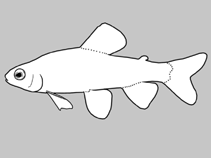
klasifikasi / Names
Nama-nama umum | Sinonim (persamaan) | Catalog of Fishes(Marga, Jenis) | ITIS | CoL | WoRMS | Cloffa
>
Characiformes (Characins) >
Crenuchidae (South American darters) > Characidiinae
Etymology: Characidium: Diminutive of Charax, -akos = a fish without identification (Ref. 45335); mirim: The specific epithet mirim comes from the Tupi, meaning small, and is given in reference to the minute size of the new species, which represents the smallest known species of Characidium. A noun in apposition.
Environment: milieu / climate zone / kisaran kedalaman / distribution range
Ekologi
; air tawar pelagis, permukaan. Tropical; 15°S - 16°S
South America: Brazil, Mato Grosso, rio das Mortes (Ref. 93569).
Size / Weight / umur
Kematangan: Lm ? range ? - ? cm
Max length : 2.3 cm SL jantan/; (Ref. 104008)
deskripsi pendek
Kunci identifiaksi (pengenalan) | Morfologi | Morfometrik
Characidium mirim is distinguished from all congeners, except Characidium bahiensis, C. interruptum, C. nupelia, C. rachovii, C. stigmosum, and C. xavante by having an incomplete lateral line with 5–7 perforated scales (vs. lateral line with more than 15 perforated scales). The new species is further distinguished from all congeners, except C. nupelia, C. stigmosum, C. vestigipinne, and C. xavante by lacking an adipose fin. Characidium mirim is distinguished from Characidium nupelia and C. xavante by having a conspicuous dark midlateral stripe (vs. midlateral stripe absent or represented by a thin and inconspicuous dark line), nine to 11 dark transverse bars on the dorsum not extending ventrally onto side of body (vs. 12 to 18 dark transverse bars on dorsum and side of body) and lacking a dark blotch on the caudal peduncle (vs. dark blotch present). Characidium mirim is further distinguished from C. xavante by having 12 series of scales around the caudal peduncle (vs. 10). Characidium mirim is distinguished from C. stigmosum by having a conspicuous dark midlateral stripe (vs. stripe absent), the side of body without dark blotches (vs. dark blotches present), the fins hyaline (vs. generally dark), and 12 circumpeduncular scales (vs. 14). The new species differs from C. vestigipinne by the absence of blotches on pelvic and anal fins (vs. blotches present). (Ref. 93569).
Body shape (shape guide): fusiform / normal; Cross section: compressed.
Life cycle and mating behavior
Kematangan | Reproduksi, perkembang biakan | Pemijahan | telur-telur | Fecundity | Larva
Netto-Ferreira, A.L., J.L.O. Birindelli and P.A. Buckup, 2013. A new miniature species of Characidium Reinhardt (Ostariophysi: Characiformes: Crenuchidae) from the headwaters of the rio Araguaia, Brazil. Zootaxa 3664(3):361-368. (Ref. 93569)
Status IUCN Red List (Ref. 130435: Version 2025-1)
ancaman kepada manusia
Harmless
penggunaan manusia
Alat, peralatan
laporan khas
muat turun XML
Sumber internet
Estimates based on models
Phylogenetic diversity index (Acuan
82804): PD
50 = 0.5000 [Uniqueness, from 0.5 = low to 2.0 = high].
Bayesian length-weight: a=0.01122 (0.00514 - 0.02450), b=3.04 (2.87 - 3.21), in cm total length, based on all LWR estimates for this body shape (Ref.
93245).
Trophic level (Acuan
69278): 3.1 ±0.3 se; based on size and trophs of closest relatives
Fishing Vulnerability (Ref.
59153): Low vulnerability (10 of 100).
🛈