Klassifizierung / Names
Namen | Synonyme | Catalog of Fishes(Gattung, Arten) | ITIS | CoL | WoRMS | Cloffa
>
Characiformes (Characins) >
Characidae (Characins; tetras) > Cheirodontinae
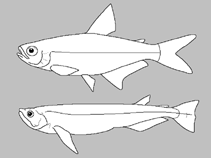
Etymology: pristis: From the Greek prister, meaning saw, in reference to the projected ventral procurrent caudal-fin rays along the ventral margin of the caudal peduncle.
Environment: milieu / climate zone / Tiefenbereich / distribution range
Ökologie
; süßwasser benthopelagisch. Tropical
South America: Rio Tocantins drainage.
Size / Gewicht / Alter
Geschlechtsreife: Lm ? range ? - ? cm
Max length : 3.3 cm SL Männchen/unbestimmt; (Ref. 91049); 3.4 cm SL (female)
Kurzbeschreibung
Bestimmungsschlüssel | Morphologie | Morphometrie
Rückenflossenweichstrahlen (insgesamt) : 11. Can be diagnosed from other species of the Cheirodontinae other than those in the Cheirodontini by having 16-19 ventral procurrent caudal-fin rays and anterior ventral procurrent caudal-fin rays of males projected through the muscles and skin and forming a keel along ventral margin of caudal peduncle. Differs from other species of the Cheirodontini by possessing the following characters: first through fourth or fifth branched anal-fin rays of mature males being slab-shaped and more expanded in the sagittal plane than the remaining anal-fin rays or the comparable rays in females and immature; the anterior expansion of the base of the proximal lepidotrichia in the slab-shaped anal-fin rays; presence of a large ligament attached to an anterior expansion of the proximal segment of the lepidotrichia and to the posterior face of the proximal segment of the lepidotrichia of the following expanded anal-fin ray; presence of well-developed hooks only on the slab-shaped anal-fin rays; and arrangement of the anal-fin hooks which are bilaterally asymmetrical and unpaired relative to the contra-lateral segments of the lepidotrichia. Distinguished from all members of the Cheirodontini by the sagittal expansion of anal-fin rays being restricted to the first 4 or 5 branched rays, presence of 1 to 3 hooks in each contra-lateral segment of lepidotrichia; complete lateral line; and conical distal tip of the ventral procurrent caudal-fin rays in adult males (Ref. 91049).
Body shape (shape guide): fusiform / normal.
Occurs in clear water over a sand and gravel bottom with a slow current and no vegetation (Ref. 91049).
Life cycle and mating behavior
Geschlechtsreife | Fortpflanzung | Ablaichen | Eier | Fecundity | Larven
Malabarba, L.R. and F.C. Jerep, 2012. A new genus and species of cheirodontine fish from South America (Teleostei: Characidae). Copeia 2012(2):243-250. (Ref. 91049)
IUCN Rote Liste Status (Ref. 130435: Version 2025-1)
Bedrohung für Menschen
Harmless
Nutzung durch Menschen
Tools
Zusatzinformationen
Download XML
Internet Quellen
Estimates based on models
Phylogenetic diversity index (Ref.
82804): PD
50 = 1.0000 [Uniqueness, from 0.5 = low to 2.0 = high].
Bayesian length-weight: a=0.01349 (0.00511 - 0.03560), b=3.05 (2.83 - 3.27), in cm total length, based on LWR estimates for this (Sub)family-body shape (Ref.
93245).
Trophic level (Ref.
69278): 2.6 ±0.5 se; based on size and trophs of closest relatives
Fishing Vulnerability (Ref.
59153): Low vulnerability (10 of 100).
🛈