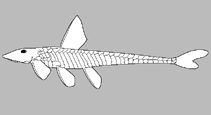
Classification / Names
Nombres comunes | Sinónimos | Catalog of Fishes(Género, Especie) | ITIS | CoL | WoRMS | Cloffa
>
Siluriformes (Catfishes) >
Loricariidae (Armored catfishes) > Hypoptopomatinae
Etymology: Parotocinclus: Greek, para in the side of + greek, ous, otis = ear + Greek, kygklos, ou = a fish (Ref. 45335); jequi: The specific name jequi is from the native Tupi language ye’kei, a type of fish trap, and part of the name of Rio Jequitinhonha, which means field of the river traps: jequi (fish trap), ty (water, river), and nhum (field). A noun in apposition.
Environment: milieu / climate zone / rango de profundidad / distribution range
Ecología
; agua dulce demersal. Tropical
South America: headwaters of the Rio Jequitinhonha, Brazil.
Tamaño / Peso / Age
Madurez: Lm ? range ? - ? cm
Max length : 5.4 cm SL macho / no sexado; (Ref. 94247)
Short description
Claves de identificación | Morfología | Morfometría
Espinas dorsales (total) : 1; Radios blandos dorsales (total) : 7; Radios blandos anales: 6; Vértebra: 30 - 31. Can be diagnosed from other species of Parotocinclus, except P. prata and P. robustus, by its lack of abdominal plates between the pectoral girdle and the anus. Differs from these species by having smaller cleithral width (16.7-20.7 vs. 20.8- 27.6% SL in P. prata and 25.9-28.8% SL in P. robustus). Can be further distinguished from P. prata by the ventral surface of head, behind the lower lip, smooth and unwrinkled in adults (vs. wrinkled and rugose), and by the tip of adpressed pectoral fin not reaching to middle of pelvic fin (vs. pectoral fin reaching to middle of pelvic fin); also from P. robustus by the lack of dark brown dots on body (vs. presence in large specimens of many dark brown dots on dorsal and lateral region of head and trunk). Distinguished also from most other congeners (except P. arandai, P. bahiensis, P. prata, P. robustus, and P. spilurus) by having the rostral plate not visible ventrally (vs. visible in ventral view); and except for P. cearensis, P. cesarpintoi, P. jumbo, P. prata, P. robustus, P. spilosoma, and P. spilurus, by having the pectoral girdle covered by thick skin medially and exposed supporting odontodes only laterally (vs. pectoral girdle exposed and supporting odontodes medially and laterally). Can be further separated from all congeners from the Amazon and Orinoco basins and the Guianas coastal drainages (except P. collinsae), by the absence of a triangular patch of dark pigmentation on the anterior dorsal-fin base (vs. presence). Differs from P. collinsae by the absence of accessory teeth on the premaxilla and dentary (vs. presence) (Ref. 94247).
Body shape (shape guide): elongated.
Facultative air-breathing in the genus (Ref. 126274); Inhabits headwater creek with clear water, depth of 0.3 to 1.2 m, substrate composed of rocks and pebbles, and marginal vegetation (Ref. 94247).
Life cycle and mating behavior
Madurez | Reproducción | Puesta | Huevos | Fecundidad | Larva
Lehmann, A.P., B. Koech Braun, E.H.L. Pereira and R.E. Reis, 2013. A new species of the Hypoptopomatinae catfish Parotocinclus (Siluriformes: Loricariidae), from the headwaters of the Rio Jequitinhonha, Brazil. Copeia 2013(3):435-440. (Ref. 94247)
IUCN Red List Status (Ref. 130435: Version 2025-1)
Threat to humans
Harmless
Human uses
Herramientas
Special reports
Download XML
Fuentes de Internet
Estimates based on models
Phylogenetic diversity index (Referencia
82804): PD
50 = 0.5000 [Uniqueness, from 0.5 = low to 2.0 = high].
Bayesian length-weight: a=0.00851 (0.00374 - 0.01935), b=3.09 (2.90 - 3.28), in cm total length, based on LWR estimates for this (Sub)family-body shape (Ref.
93245).
Resiliencia (Referencia
120179): Alto, población duplicada en un tiempo mínimo inferior a 15 meses (Preliminary K or Fecundity.).
Fishing Vulnerability (Ref.
59153): Low vulnerability (10 of 100).
🛈