>
Gobiiformes (Gobies) >
Gobiidae (Gobies) > Gobiinae
Etymology: Gobiodon: Latin, gobius = gudgeon + Greek, odous = teeth (Ref. 45335); aoyagii: Named for Hyoji Aoyagi (1912-1971), a Japanese ichthyologist.
Eponymy: Dr Hyoji Aoyagi (1912–1971) was a Japanese ichthyologist. [...] (Ref. 128868), visit book page.
Environment: milieu / climate zone / نطاق العمق / distribution range
البيئة
بحري قاعية التغذية و المعيشة; نطاق العمق 2 - 10 m (Ref. 94251). Subtropical
Western Pacific: Japan to Australia, including the Philippines, East Indies (Cocos Is. Or Indonesia) and Papua New Guinea.
الحجم / وزن / العمر
النضج: Lm ? range ? - ? cm
Max length : 3.5 cm SL ذكر/ مختلط الجنس; (Ref. 94251)
وصف مختصر
مفاتيح التعريف | الوصف الخارجي | قياسات المظهر الخارجي
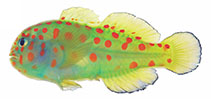
الأشواك الظهرية (المجموع) : 7; الأشعة الظهرية الناعمة (المجموع) : 9 - 11; شوكة شرجية: 1; أشعه شرجية لينه: 8 - 9; فقرات: 25 - 27. This species is distinguished by the following characters: many reddish spots/stripes on a yellow-green or sky-blue body; when alive or freshly-collected, it differs from similar reddish-spotted/lined congeners, G. erythrospilus and G. histrio, by having the following unique coloration: 2 reddish circular spots (rather than linear spots) on pectoral-fin base (vs. reddish markings on pectoral-fin base usually forming vertical bars in G. erythrospilus and G. histrio, except for small specimens of the former with discontinuous bars); reddish spots on ventral surface of head (vs. none); reddish crescent-like bar along bases of pectoral fin rays absent (vs. present); in in alcohol-preserved specimens, all reddish spots are largely or entirely faded, but this species can be readily identified by having its unique squamation, i.e., 3-4 rows of weakly ctenoid and/or cycloid scales on caudal peduncle (vs. no scales or a single row of minute cycloid scales on caudal peduncle in the congeners); with a deep, inflected interopercular-isthmus groove; unsegmented caudal-fin rays, upper with 5-6, lower with 4-6; no distinct dusky spot at dorsoposterior corner of operculum (Ref. 94251).
Body shape (shape guide): short and / or deep; Cross section: oval.
Facultative air-breathing in the genus (Ref. 126274); Observed in protected bays and reef edges and slopes of Japan, in the interstices among branches of corals of the genus Acropora. In Papua New Guinea and the Great Barrier Reef, it is reported to almost totally be confined to Acropora tenuis (Ref. 94251).
Life cycle and mating behavior
النضج | التكاثر | وضع البيض | بيض | الخصوبة | Larvae
Shibukawa, K., Suzuki, T. and M. Aizawa, 2013. Gobiodon aoyagii, a new coral goby (Actinopterygii, Gobiidae, Gobiinae) from the West Pacific, with redescription of a similarly colored Congener Gobiodon erythrospilus Bleeker, 1875. Bull. Nat. Mus. Nat. Sci. 39(3):143-165. (Ref. 94251)
IUCN Red List Status (Ref. 130435: Version 2025-1)
استخدامات بشرية
أدوات
تقارير خاصة
Download XML
مصادر علي الأنترنت
Estimates based on models
Preferred temperature (مرجع
123201): 24.9 - 29.3, mean 28.6 °C (based on 1154 cells).
Phylogenetic diversity index (مرجع
82804): PD
50 = 0.5000 [Uniqueness, from 0.5 = low to 2.0 = high].
Bayesian length-weight: a=0.01995 (0.00906 - 0.04395), b=3.01 (2.83 - 3.19), in cm total length, based on all LWR estimates for this body shape (Ref.
93245).
مستوى غذائي (مرجع
69278): 3.3 ±0.4 se; based on size and trophs of closest relatives
المرونه (مرجع
120179): عالي, الحد الزمني الأدني لتضاعف عدد أفراد المجتمع أقل من 15 شهر (Preliminary K or Fecundity.).
Fishing Vulnerability (Ref.
59153): Low vulnerability (10 of 100).
🛈