Classification / Names
Nombres comunes | Sinónimos | Catalog of Fishes(Género, Especie) | ITIS | CoL | WoRMS | Cloffa
>
Cyprinodontiformes (Rivulines, killifishes and live bearers) >
Rivulidae (Rivulines) > Rivulinae
Etymology: ottonii: Named for the ichthyologist Felipe Ottoni for his constant enthusiasm and friendship, and important participation during expeditions to northern Brazil.
Eponymy: Dr Felipe Polivanov Ottoni is a Brazilian ichthyologist who is Professor of Zoology and head of the laboratory at Universidade Federal do Maranhão. [...] (Ref. 128868), visit book page.
Environment: milieu / climate zone / rango de profundidad / distribution range
Ecología
; agua dulce bentopelágico. Tropical
South America: Caurés river drainage, a tributary of the Negro river, Amazonas river basin in Brazil.
Tamaño / Peso / Age
Madurez: Lm ? range ? - ? cm
Max length : 2.2 cm SL macho / no sexado; (Ref. 94717); 2.3 cm SL (female)
Short description
Claves de identificación | Morfología | Morfometría
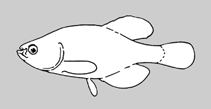
Radios blandos dorsales (total) : 6 - 7; Radios blandos anales: 11 - 12; Vértebra: 30 - 31. This species differs from all other members of the Anablepsoides ornatus group by having a unique color pattern in the caudal fin in males, consisting of dorsal portion of fin white with dark reddish brown spots, contrasting with the ventral portion that is hyaline with dark grey dots and short lines (vs. never a similar color pattern). It can be diagnosed from other members of this species group, except A. henschelae, by the lack of teeth on the second pharyngobranchial bone (vs. present); and can be distinguished from A. henschelae by the absence of a longitudinal two of red dots on the ventral part of the flank in males (vs. presence). It is also distinguished from all species of the A. ornatus group, except A. ornatus, by having caudal fin pointed in larger specimens (vs. elliptical) and reddish brown spots on the dorsal portion of the caudal fin; also differs from A. ornatus by the red pigmentation of ventral portion of caudal peduncle not extending on caudal fin (vs. extending over whole ventral portion of the fin) and dorsal portion of caudal fin white (vs. yellow) (Ref. 94717).
Body shape (shape guide): elongated.
Life cycle and mating behavior
Madurez | Reproducción | Puesta | Huevos | Fecundidad | Larva
Costa, W.J.E.M., P.H.N. Bragança and P.F. Amorim, 2013. Five new species of the killifish genus Anablepsoides from the Brazilian Amazon (Cyprinodontiformes: Rivulidae). Verteb. Zool. 63(3):283-293. (Ref. 94717)
IUCN Red List Status (Ref. 130435: Version 2025-1)
Threat to humans
Harmless
Human uses
Herramientas
Special reports
Download XML
Fuentes de Internet
Estimates based on models
Phylogenetic diversity index (Referencia
82804): PD
50 = 0.5000 [Uniqueness, from 0.5 = low to 2.0 = high].
Bayesian length-weight: a=0.00891 (0.00368 - 0.02159), b=3.11 (2.92 - 3.30), in cm total length, based on LWR estimates for this Genus-body shape (Ref.
93245).
Nivel trófico (Referencia
69278): 3.1 ±0.4 se; based on size and trophs of closest relatives
Resiliencia (Referencia
120179): Alto, población duplicada en un tiempo mínimo inferior a 15 meses (Preliminary K or Fecundity.).
Fishing Vulnerability (Ref.
59153): Low vulnerability (10 of 100).
🛈