Classification / Names
Noms communs | Synonymes | Catalog of Fishes(Genre, Espèce) | ITIS | CoL | WoRMS | Cloffa
>
Cyprinodontiformes (Rivulines, killifishes and live bearers) >
Rivulidae (Rivulines) > Rivulinae
Etymology: gamae: Named for Cecile Gama in recognition of her pioneering ichthyological field studies in the Amapá state, Brazilian Amazon.
Eponymy: Cecile de Souza Gama is a Brazilian ichthyologist researching at the Institute of Scientific and Technical Research of Amapa State, Brazilian amazon. [...] (Ref. 128868), visit book page.
Environment: milieu / climate zone / profondeur / distribution range
Écologie
; eau douce benthopélagique. Tropical
South America: Jari river drainage, lower Amazonas river basin in Brazil.
Taille / Poids / Âge
Maturité: Lm ? range ? - ? cm
Max length : 2.2 cm SL mâle / non sexé; (Ref. 94717); 2.2 cm SL (female)
Description synthétique
Clés d'identification | Morphologie | Morphométrie
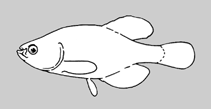
Rayons mous dorsaux (Total) : 6 - 7; Rayons mous anaux: 10 - 11; Vertèbres: 29 - 30. Differs from all species of Anablepsoides, except A. amanan, by the color pattern of the caudal fin and anal fin in males, consisting of dorsal portion of caudal fin orangish red with dorsal margin white and narrow black outer border (vs. never a similar color pattern), middle portion of caudal fin black with bright greenish blue stripe extending from caudal peduncle to posterior portion of fin (vs. never a similar color pattern), anal fin yellow with transverse red stripes on the posterior portion (vs. never a similar color pattern) and by having a continuous row of 6 neuromasts on the mandibular series (vs. 3 or 4 neuromasts on an anterior section and a single isolated posterior neuromast). Distinguished from A. amanan and all other members of the A. ornatus group by having a unique color pattern of flank in adult males, in which there are pairs of oblique rows of dark red dots, the dots of each posterior pair row being connected to form dark red oblique bars and each dot of the anterior pair row being usually connected to the posterior adjacent row (vs. never a similar color pattern) and by a unique color pattern on the head in females, consisting of a distinctive not pigmented area between a zone of small brownish grey spots on the post-orbital region and an oblique black bar crossing the middle of opercle (vs. side of head pigmented, with small dark grey to black spots overlapped over opercular, post-orbital and infra-orbital region). Can be diagnosed also from A. amanan by having a longer pre-dorsal distance in males 81.3-84.6 % SL (vs. 77.4-79.7 % SL) (Ref. 94717).
Body shape (shape guide): elongated.
Life cycle and mating behavior
Maturité | Reproduction | Frai | Œufs | Fécondité | Larves
Costa, W.J.E.M., P.H.N. Bragança and P.F. Amorim, 2013. Five new species of the killifish genus Anablepsoides from the Brazilian Amazon (Cyprinodontiformes: Rivulidae). Verteb. Zool. 63(3):283-293. (Ref. 94717)
Statut dans la liste rouge de l'IUCN (Ref. 130435: Version 2025-1)
Menace pour l'homme
Harmless
Utilisations par l'homme
Outils
Articles particuliers
Télécharger en XML
Sources Internet
Estimates based on models
Phylogenetic diversity index (Réf.
82804): PD
50 = 0.5000 [Uniqueness, from 0.5 = low to 2.0 = high].
Bayesian length-weight: a=0.00891 (0.00368 - 0.02159), b=3.11 (2.92 - 3.30), in cm total length, based on LWR estimates for this Genus-body shape (Ref.
93245).
Niveau trophique (Réf.
69278): 3.1 ±0.4 se; based on size and trophs of closest relatives
Résilience (Réf.
120179): Haut, temps minimum de doublement de population inférieur à 15 mois (Preliminary K or Fecundity.).
Fishing Vulnerability (Ref.
59153): Low vulnerability (10 of 100).
🛈