This website uses cookies to enhance your browsing experience and ensure the functionality of our site. For more detailed information about the types of cookies we use and how we protect your privacy, please visit our Privacy Information page..
×
Cookie Settings
This website uses different types of cookies to enhance your experience. Please select your preferences below:
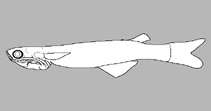
No image available for this species; drawing shows typical species in Phallostethidae.
分类 / Names 俗名 | 同种异名 | Catalog of Fishes(属, 种) | ITIS | CoL | WoRMS | Cloffa
Teleostei > Atheriniformes (Silversides) > Phallostethidae (Priapiumfishes)
Etymology: Neostethus:Greek,neos = new + Greek, stetho, stethion = brest; literal = to prick a little breast (Ref. 45335); geminus:From the Latin geminus for twin or double referring to the close morphological similarity of the new species to its inferred sister species, Neostethus bicornis, and to the paired or double ctenactinia in both species.
Environment: milieu / climate zone / 深度上下限 / distribution range 生态学
臀鳍软条: 15 - 16; 脊椎骨: 35 - 37. Neostethus geminus is most closely related to N. bicorni. Both species differ from all congeners by having two elongate curved ctenactinia (vs. one elongate and one short ctenactinium) in mature males and a brown blotch on the pelvic-fin rays of the proctal side of immature males, and a fleshy, hood-like fold in females that includes the anus and genital and urinary pores. Neostethus geminus is distinguished from N. bicornis in being smaller (reaching no more than 2.57 cm SL vs. 3.1cm SL), and having a relatively compact priapium with a foreshortened, broad aproctal axial bone that meets but does not overlap the pulvinular appendage (vs. a relatively elongate priapium with a long and narrow aproctal axial bone that overlaps the pulvinular appendage medially); thin, nearly translucent, broad papillary bone expanded distally into a tab (vs. a short papillary bone), and females with a thickened fleshy, hood-like fold that includes the anus, genital pore and urinary pore (vs. a thin fold of skin), and a thickened ridge just posterior to the fold and separated from it by a gap (vs. lacking a ridge and a gap) (Ref. 95599). Body shape (shape guide): elongated.
At the type locality, this species was collected together with other fishes: Ambassis sp., Scatophagus argus, Tetraodon leiurus, Gobiopterus brachypterus, and Brachygobius doriae and Neostethus borneensis. The brackish water was clear and brown (Ref. 95599).
Life cycle and mating behavior 成熟度 | 繁殖 | 产卵场 | 卵 | 孕卵数 | 仔鱼
Parenti, L.R., 2014. A new species of Neostethus (Teleostei; Atherinomorpha; Phallostethidae) from Brunei Darussalam, with comments on northwestern Borneo as an area of endemism. Raffles Bull. Zool. 62:175-187. (Ref. 95599)
Phylogenetic diversity index (参考文献 82804): PD50 = 0.5002 [Uniqueness, from 0.5 = low to 2.0 = high].
Bayesian length-weight: a=0.00389 (0.00180 - 0.00842), b=3.12 (2.94 - 3.30), in cm total length, based on all LWR estimates for this body shape (Ref. 93245).
营养阶层 (参考文献 69278): 3.0 ±0.3 se; based on size and trophs of closest relatives
Fishing Vulnerability (Ref. 59153): Low vulnerability (10 of 100). 🛈