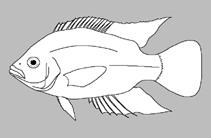
Classificação / Nomes
Nomes comuns | Sinônimos | Catalog of Fishes(Gênero, Espécies) | ITIS | CoL | WoRMS | Cloffa
>
Cichliformes (Cichlids, convict blennies) >
Cichlidae (Cichlids) > Pseudocrenilabrinae
Etymology: Neolamprologus: Greek, neos = new + Greek,lampros = torch + Greek, lagos = hare (Ref. 45335); timidus: The species name is a Latin adjective meaning shy, with reference to the elusive or shy behaviour of this species in the natural habitat (Ref. 95525).
Environment: milieu / Zona climática / intervalo de profundidade / distribution range
Ecologia
; Água doce bentopelágico; intervalo de profundidade 2 - 40 m (Ref. 95525). Tropical
Africa: endemic to Lake Tanganyika, along Tanzanian coast from Kolwe Point south to Kisi Island (Ref. 95525).
Tamanho / Peso / Idade
Maturidade: Lm ? range ? - ? cm
Max length : 10.0 cm SL macho/indeterminado; (Ref. 95525)
Descrição suscinta
Chaves de identificação | Morfologia | Morfometria
Espinhos dorsais (total) : 19 - 21; Raios dorsais (total) : 7 - 8; Espinhos anais: 0; Raios anais : 12. Diagnosis: Neolamprologus timidus is distinguished from the most similar species, Neolamprologus furcifer, in scaled cheek vs. naked; first soft ray of pelvic fin longer than second vs. second ray longer than first; pectoral fin reaching beyond base of first anal-fin spine vs. shorter; absence of dark spot at caudal-fin base in adults vs. presence; longer head, 34.2-35.5% of standard length vs. 31.2-33.8%; longer pectoral fin, 29.3-353.7% of standard length vs. 23.4-31.3%; and pectoral fin in life light yellow or transparent vs. orange (Ref. 95525). It is distinguished from all other lamprologin species except Lepidiolamprologus profundicola, Neolamprologus ventralis and N. leloupi in fully scaled cheek vs. scales absent from cheek or present only posterodorsally (Ref. 95525). It is distinguished from Neolamprologus leloupi by the shape of the caudal fin, which is deeply emarginate, with long streamers vs. posterior margin concave, streamers absent; colour overall dark, with indistinct darker horizontal stripes vs. overall light, with faint brown zigzag lines along side; 49-62 scales in a longitudinal row vs. about 30; dorsal-fin rays XIX-XXI,7-8 vs. XVII,9; and gill rakers 11-13 vs. 6 (Ref. 95525). It is distinguished from Neolamprologus ventralis by caudal-fin shape deeply emarginate, with long streamers vs. rounded, subtruncate or slightly emarginate with rounded lobes; colour overall dark with indistinct darker horizontal stripes vs. overall light, scales with light brown margins; unpaired fin dark, with few, indistinct spots vs. numerous light spots all over unpaired fins; and 49-62 scales in a longitudinal row vs. 34-37 (Ref. 95525). It is distinguished from Lepidiolamprologus profundicolaby caudal-fin shape deeply emarginate with long streamers vs. truncate or slightly emarginate; longer pectoral fin, reaching beyond base of first anal-fin spine vs. not reaching vent; single neurocranial lateral line foramen 0 vs. double; dermosphenotic absent vs. present; and labial cartilage not ossified vs. ossified (Ref. 95525).
Body shape (shape guide): elongated.
This shy species is observed at depths varying from 2 to 40 m in a dark rocky biotope, and encountered in pairs defending a territory over a dark cave difficult to access; the territory was often located to a large rock or boulder, which, if large enough was inhabited also by other species like Neolamprologus furcifer and Julidochromis regani; almost always found upside down in cave with belly close to substrate (Ref. 95525).
Ciclo de vida ou comportamento de acasalamento
Maturidade | Reprodução | Desova | Ovos | Fecundidade | Larvas
Kullander, S.O., M. Norén, M. Karlsson and M. Karlsson, 2014. Description of Neolamprologus timidus, new species, and review of N. furcifer from Lake Tanganyika (Teleostei: Cichlidae). Ichthyol. Explor. Freshwat. 24(4):301-328. (Ref. 95525)
Status na Lista Vermelha da UICN (Ref. 130435: Version 2025-1)
Ameaça para os humanos
Harmless
Uso pelos humanos
Ferramentas
Relatórios especiais
Baixar XML
Fontes da internet
Estimates based on models
Índice de diversidade filogenética (Ref.
82804): PD
50 = 0.5000 [Uniqueness, from 0.5 = low to 2.0 = high].
Bayesian length-weight: a=0.01000 (0.00244 - 0.04107), b=3.04 (2.81 - 3.27), in cm total length, based on all LWR estimates for this body shape (Ref.
93245).
Nível Trófico (Ref.
69278): 3.6 ±0.5 se; based on size and trophs of closest relatives
Resiliência (Ref.
120179): Elevada, tempo mínimo de duplicação da população menor que 15 meses (Preliminary K or Fecundity.).
Fishing Vulnerability (Ref.
59153): Low vulnerability (10 of 100).
🛈