



Esox aquitanicus Denys, Dettai, Persat, Hautecoeur & Keith, 2014
Aquitanian pike
Envoyez vos Photos et vidéos
Images Google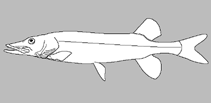 No image available for this species;
drawing shows typical species in Esocidae.
Images Google
drawing shows typical species in Esocidae.
Classification / Noms Noms communs | Synonymes | Catalog of Fishes(Genre, Espèce) | ITIS | CoL | WoRMS | Cloffa
> Esociformes (Pikes and mudminnows) > Esocidae (Pikes)
Etymology: Esox: From Greek, isox and also related with the Celtic root, eog, ehawc = salmon (Ref. 45335); aquitanicus: The specific name aquitanicus is the adjective of Aquitania referring to the region of southwestern France, Aquitaine, where the species was discovered. For this reason, the vernacular name chosen is "Aquitanian pike" ("brochet aquitain" in French).
Etymology: Esox: From Greek, isox and also related with the Celtic root, eog, ehawc = salmon (Ref. 45335); aquitanicus: The specific name aquitanicus is the adjective of Aquitania referring to the region of southwestern France, Aquitaine, where the species was discovered. For this reason, the vernacular name chosen is "Aquitanian pike" ("brochet aquitain" in French).
Environnement : milieu / zone climatique / profondeur / gamme de distribution Écologie
; eau douce benthopélagique. Temperate; 43°N - 46°N, 2°W - 1°E
Distribution Territoires | Zones FAO | Écosystèmes | Occurrences | Carte par point | Introductions | Faunafri
Europe: France. Present in the Charente, Dordogne, Eyre, and Adour basins. Lake Mouriscot constitutes its currently known most southern location. Considering the biogeographical history of Atlantic French drainages, it should occur in the Garonne basin too, but the population could have regressed following the introduction of the Northern Pike E. lucius. There are still higher probabilities to encounter the Aquitanian pike in small tributaries, where humans do not stock Northern Pike, than in larger streams. It might be present in the "Sèvre niortaise" basin, but no specimen was captured, and in the Loire drainage, but we captured only E. lucius individuals. It is possible that Aquitanian pike is stocked and sold as E. lucius by fish farmers of southwestern France, in order to restock waterbodies in France or abroad for sport fishing. Additional investigations to characterize the limits of the distribution area are necessary. (Ref. 97279)
Taille / Poids / Âge
Maturité: Lm ? range ? - ? cm
Max length : 41.6 cm SL mâle / non sexé; (Ref. 97279); 37.2 cm SL (female)
Max length : 41.6 cm SL mâle / non sexé; (Ref. 97279); 37.2 cm SL (female)
E. aquitanicus should have similar ecological characteristics as E. lucius in terms of habitat, behavior, and predation, because no difference were mentioned about ecological traits between Aquitanian and the other French pike populations, except an earlier spawning in February instead of March-April. Its size can exceed 1000 mm TL (Dégrave, pers. comm.) A pike of 1370 mm was mentioned by Laporte in Lake Cazeau, right in the heart of the distribution area of E. aquitanicus. However, we cannot exclude early stockings of E. lucius. When there is cohabitation between the two species, the Aquitanian pike is able to hybridize with the northern pike (present study) (Ref. 97279)
Cycle de vie et comportement reproducteur Maturité | Reproduction | Frai | Œufs | Fécondité | Larves
Référence principale
Téléchargez vos références | Références | Coordinateur | Collaborateurs
Denys, G., A. Dettai, H. Persat, M. Hautecoeur and P. Keith, 2014. Morphological and molecular evidence of three species of pikes Esox spp. (Actinopterygii, Esocidae) in France, including the description of a new species. CRASS3-3284. In press. (Ref. 97279)
Statut dans la liste rouge de l'IUCN (Ref. 130435: Version 2025-2 (Global))
Quasi-menacé (NT) (A2ce); Date assessed: 20 December 2023
CITES
Not Evaluated
Menace pour l'homme
Harmless
Utilisations par l'homme
FAO - Publication: search | FishSource |
Plus d'informations
Écologie trophique
Aliments (proies)
Composition du régime alimentaire
Consommation alimentaire
Rations alimentaires
Prédateurs
Aliments (proies)
Composition du régime alimentaire
Consommation alimentaire
Rations alimentaires
Prédateurs
Écologie
Écologie
Écologie
Dynamique des populations
Paramètres de croissance
Âges / tailles maximales
Longueur-poids rel.
Rel. longueur-longueur.
Fréquences de longueurs
Conversion de masse
Recrutement
Abondance
Paramètres de croissance
Âges / tailles maximales
Longueur-poids rel.
Rel. longueur-longueur.
Fréquences de longueurs
Conversion de masse
Recrutement
Abondance
Cycle de vie
Reproduction
Maturité
Maturité/épines rel.
Fécondité
Frai
Agrégats de frai
Œufs
Développement de l'œuf
Larves
Dynamique des populations larvaires
Reproduction
Maturité
Maturité/épines rel.
Fécondité
Frai
Agrégats de frai
Œufs
Développement de l'œuf
Larves
Dynamique des populations larvaires
Anatomie
Surface branchiale
Cerveau
Otolithe
Surface branchiale
Cerveau
Otolithe
Physiologie
Composition corporelle
Nutriments
Consommation d'oxygène
Type de natation
Vitesse de nage
Pigments visuels
Son de poisson
Maladies et parasites
Toxicité (CL50)
Composition corporelle
Nutriments
Consommation d'oxygène
Type de natation
Vitesse de nage
Pigments visuels
Son de poisson
Maladies et parasites
Toxicité (CL50)
Génétique
génôme
Génétique
Hétérozygotie
Héritabilité
Diversité génétique
génôme
Génétique
Hétérozygotie
Héritabilité
Diversité génétique
Liées à l'homme
Systèmes d'aquaculture
Profils d'aquaculture
Souches
Cas de ciguatera
Timbres, pièces de monnaie, divers
Systèmes d'aquaculture
Profils d'aquaculture
Souches
Cas de ciguatera
Timbres, pièces de monnaie, divers
Outils
E-book | Guide de terrain | Générateur de fréquences de longueur | Outil de dynamique de population | Carte par point |
Capture-MSY |
Articles particuliers
Télécharger en XML
Sources Internet
AFORO (otoliths) | Aquatic Commons | BHL | Cloffa | Websites from users | FishWatcher | CISTI | Catalog of Fishes: Genre, Espèce | DiscoverLife | ECOTOX | FAO - Publication: search | Faunafri | Fishipedia | Fishtrace | GloBI | Google Books | Google Scholar | Google | IGFA World Record | OneZoom | Open Tree of Life | Otolith Atlas of Taiwan Fishes | Aquariums publics | PubMed | Reef Life Survey | Socotra Atlas | TreeBase | Arbre de Vie | Wikipedia: aller à, chercher | World Records Freshwater Fishing | Zoobank | Zoological Record
Estimations basées sur des modèles
Indice de diversité phylogénétique (Réf. 82804): PD50 = 0.5157 [Uniqueness, from 0.5 = low to 2.0 = high].
Bayesian length-weight: a=0.00513 (0.00223 - 0.01182), b=3.07 (2.89 - 3.25), in cm total length, based on LWR estimates for this Genus-body shape (Ref. 93245).
Niveau trophique (Réf. 69278): 3.8 ±0.4 se; based on size and trophs of closest relatives
Résilience (Réf. 120179): Milieu, temps minimum de doublement de population : 1,4 à 4,4 années (Preliminary K or Fecundity.).