



Stiphodon niraikanaiensis Maeda, 2013
muatnaik fotos/gambar dan video
imej Google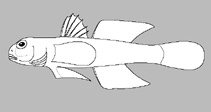 No image available for this species;
drawing shows typical species in Gobiidae.
imej Google
drawing shows typical species in Gobiidae.
klasifikasi / Nama Nama-nama umum | Sinonim (persamaan) | Catalog of Fishes(Marga, Jenis) | ITIS | CoL | WoRMS | Cloffa
> Gobiiformes (Gobies) > Gobiidae (Gobies) > Sicydiinae
Etymology: Stiphodon: Greek, stiphos, -eos, -oys = mass + Greek, odous = teeth (Ref. 45335); niraikanaiensis: Named after the okinawan mythical place, Niraikanai, and Latin suffix ensis.
Etymology: Stiphodon: Greek, stiphos, -eos, -oys = mass + Greek, odous = teeth (Ref. 45335); niraikanaiensis: Named after the okinawan mythical place, Niraikanai, and Latin suffix ensis.
Lingkungan: lingkungan / zona iklim / kisaran kedalaman / jangkauan distribusi Ekologi
; air tawar bentopelagis; amphidromus; kisaran kedalaman ? - 1 m (Ref. 95104). Subtropical
Penyebaran Wilayah | Daerah-daerah FAO | Ekosistem | Kemunculan | peta titik | Introduksi | Faunafri
Northwestern Pacific: Japan.
Ukuran / Berat / umur
deskripsi pendek Kunci identifiaksi (pengenalan) | Morfologi | Morfometrik
Duri punggung (Keseluruhan (total)) : 7; duri punggung lunak (Keseluruhan (total)) : 9; Duri dubur: 1; Sirip dubur lunak: 10. This species is distinguished by the following set of characters: D2 9, first dorsal fin pointed with elongate fourth spine in male; pectoral-fin rays 16; premaxilla 46-50 tricuspid teeth; dentary 4 (male) or 1 (female) symphyseal teeth and 40-46 unicuspid horizontal teeth in 2.7-3.6 cm SL; scales in longitudinal row 30-32; nape and posterior half of occipital region with cycloid scales; males without white patch behind pectoral-fin base and a broad black band along distal margin of second dorsal fin, the lateral side of body and dorsal and caudal fins often tinged with vivid orange; females with 11 or 12 dusky transverse bars laterally on trunk and tail, intersecting with the mid-lateral longitudinal band and has several conspicuous black spots on each of the spines and soft rays on the first and second dorsal, and caudal fins; anal fin lacking remarkable marking; pectoral-fin rays with 2-5 and 1-4 black spots, respectively, for male and female (Ref. 95104).
Body shape (shape guide): elongated; Cross section: oval.
Body shape (shape guide): elongated; Cross section: oval.
The species was observed in a small pool less than 1 m deep and a rapid just below the pool, located 1.5 km from the stream mouth, no major barrier to upstream migration between the stream mouth and this site. The individuals were often shoaled with the abundant S. percnopterygionus and observed scratching on the rock surface for feeding with them. Single individuals of S. atropurpureus and S. multisquamus were also observed at the same site. Other abundant fishes found on the site were amphidromous gobies, such as Sicyopterus japonicus (Tanaka 1909), Awaous melanocephalus (Bleeker 1849), Rhinogobius nagoyae Jordan and Seale 1906, and Tridentiger kuroiwae Jordan and Tanaka 1927, amphidromous pipefish, Microphis leiaspis (Bleeker 1854), and catadromous flagtail, Kuhlia marginata (Cuvier 1829) (Ref. 95104).
Siklus hidup dan perilaku kawin Kematangan | Reproduksi, perkembang biakan | Pemijahan | telur-telur | Fekunditas | Larva
rujukan utama
Unggah referensi Anda | Acuan | Koordinator | mitra
Maeda, K., 2014. Stiphodon niraikanaiensis, a new species of sicydiine goby from Okinawa Island (Gobiidae: Sicydiinae). Ichthyol. Res.61(2):99-107. (Ref. 95104)
CITES
Not Evaluated
ancaman kepada manusia
Harmless
penggunaan manusia
Perikanan: tidak ada kepentingan
FAO - Publication: search | FishSource |
informasi lanjut
Ekologi trofik
Item makanan (mangsa)
Komposisi makanan
Konsumsi makanan
Ransum makanan
Pemangsa
Item makanan (mangsa)
Komposisi makanan
Konsumsi makanan
Ransum makanan
Pemangsa
Ekologi
Ekologi
Ekologi
Dinamika populasi
Parameter pertumbuhan
Maks. usia / ukuran
Panjang-berat rel.
Panjang-panjang rel.
ukuran frekuensi
Konversi massa
pemulihan
Kelimpahan
Parameter pertumbuhan
Maks. usia / ukuran
Panjang-berat rel.
Panjang-panjang rel.
ukuran frekuensi
Konversi massa
pemulihan
Kelimpahan
Siklus hidup
Reproduksi, perkembang biakan
Kematangan
Kedewasaan / insang rel.
Fekunditas
Pemijahan
Agregasi pemijahan
telur-telur
pekembangan telor
Larva
Dinamika larva
Reproduksi, perkembang biakan
Kematangan
Kedewasaan / insang rel.
Fekunditas
Pemijahan
Agregasi pemijahan
telur-telur
pekembangan telor
Larva
Dinamika larva
Anatomi
Area insang
Otak
Otolith
Area insang
Otak
Otolith
Fisiologi
Komposisi tubuh
Nutrisi
Konsumsi oksigen
Jenis renang
Kecepatan berenang
Pigmen visual
Suara ikan
Penyakit & Parasit
Toksisitas (LC50)
Komposisi tubuh
Nutrisi
Konsumsi oksigen
Jenis renang
Kecepatan berenang
Pigmen visual
Suara ikan
Penyakit & Parasit
Toksisitas (LC50)
Genetika
genom
Genetika
Heterozigositas
Diturunkan
Keanekaragaman Genetik
genom
Genetika
Heterozigositas
Diturunkan
Keanekaragaman Genetik
Yang berhubungan dengan manusia
Sistem akuakultur
profil budidaya air
Strain
Kasus Ciguatera
Perangko, koin, dll.
Sistem akuakultur
profil budidaya air
Strain
Kasus Ciguatera
Perangko, koin, dll.
Alat, peralatan
E-book | Penuntun lapangan | tanda freqkuenci panjang | peringkat sejarah hidup | peta titik |
Tangkap-MSY |
laporan khas
muat turun XML
Sumber internet
AFORO (otoliths) | Aquatic Commons | BHL | Cloffa | Websites from users | semak peneliti ikan | CISTI | Catalog of Fishes: Marga, Jenis | DiscoverLife | ECOTOX | FAO - Publication: search | Faunafri | Fishipedia | Fishtrace | GloBI | Google Books | Google Scholar | Google | IGFA World Record | OneZoom | Open Tree of Life | Otolith Atlas of Taiwan Fishes | PubMed | Reef Life Survey | Socotra Atlas | TreeBase | Tree of Life | Wikipedia: pergi, Cari | World Records Freshwater Fishing | Zoobank | Catatan Zoologi
Estimasi berdasarkan model
Indeks keanekaragaman filogenetik (Acuan 82804): PD50 = 0.5000 [Uniqueness, from 0.5 = low to 2.0 = high].
Bayesian length-weight: a=0.00389 (0.00180 - 0.00842), b=3.12 (2.94 - 3.30), in cm total length, based on all LWR estimates for this body shape (Ref. 93245).
Daya lenting (Acuan 120179): Tinggi, Waktu penggandaan populasi minimum kurang dari 15 bulan (Preliminary K or Fecundity.).