Classification / Names
Noms communs | Synonymes | Catalog of Fishes(Genre, Espèce) | ITIS | CoL | WoRMS | Cloffa
>
Characiformes (Characins) >
Characidae (Characins; tetras) > Characinae
Etymology: Charax: Charax, -akos = a fish without identification (Ref. 45335); delimai: Named for Flávio César Thadeu de Lima for his great contributions to the knowledge of neotropical freshwater fishes and for collecting most of the specimens that served as the basis for the species description.
Eponymy: Dr Flávio César Thadeo de Lima (d: 1974) is a Brazilian zoologist and ichthyologist who is a specialist in the systematics of freshwater Neotropical fish of the order Characiformes. [...] (Ref. 128868), visit book page.
Environment: milieu / climate zone / profondeur / distribution range
Écologie
; eau douce benthopélagique. Tropical
South America: Rio Tiquié, rio Negro basin in Brazil.
Taille / Poids / Âge
Maturité: Lm ? range ? - ? cm
Max length : 10.2 cm SL mâle / non sexé; (Ref. 96861); 12.1 cm SL (female)
Description synthétique
Clés d'identification | Morphologie | Morphométrie
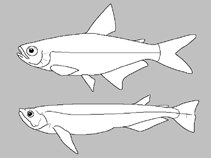
Rayons mous dorsaux (Total) : 11; Vertèbres: 34 - 35. Charax delimai together with C. tectifer, C. metae and some specimens of C. gibbosus, C. rupununi and C. condei are the only members of the genus bearing teeth on the ectopterygoid. It can be distinguished from C. condei in having the lateral line complete (vs. incomplete); from C. gibbosus and C. rupununi in having anal-fin origin on vertical or slightly posterior to dorsal-fin origin (vs. anal-fin origin anterior to the vertical through the dorsal-fin origin); from C. tectifer in having (vs. absence) superficial neuromasts on body, with neuromasts dorso-ventrally arranged on trunk scales except those on the lateral line where neuromasts are absent; and from C. metae in having 3-15 ectopterygoid teeth (vs. 20-50), 10-12 transverse scale rows between the humeral spot and the supracleithrum (vs. 7-9) and the humeral spot distance 48-51% of SL (vs. 41.6-47% of SL) (Ref. 96861).
Body shape (shape guide): elongated.
Life cycle and mating behavior
Maturité | Reproduction | Frai | Œufs | Fécondité | Larves
Menezes, N.A. and C.A.S. de Lucena, 2014. A taxonomic review of the species of Charax Scopoli, 1777 (Teleostei: Characidae: Characinae) with description of a new species from the rio Negro bearing superficial neuromasts and on body scales, Amazon bazin, Brazil. Neotrop. Ichthyol. 12(2):193-228. (Ref. 96861)
Statut dans la liste rouge de l'IUCN (Ref. 130435: Version 2025-1)
Menace pour l'homme
Harmless
Utilisations par l'homme
Outils
Articles particuliers
Télécharger en XML
Sources Internet
Estimates based on models
Phylogenetic diversity index (Réf.
82804): PD
50 = 0.5000 [Uniqueness, from 0.5 = low to 2.0 = high].
Bayesian length-weight: a=0.00661 (0.00301 - 0.01449), b=3.11 (2.93 - 3.29), in cm total length, based on LWR estimates for this (Sub)family-body shape (Ref.
93245).
Niveau trophique (Réf.
69278): 3.8 ±0.6 se; based on size and trophs of closest relatives
Fishing Vulnerability (Ref.
59153): Low vulnerability (10 of 100).
🛈