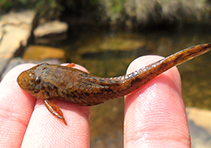
Classification / Names
Κοινά ονόματα | Συνώνυμα | Catalog of Fishes(Γένος, Είδη) | ITIS | CoL | WoRMS | Cloffa
>
Siluriformes (Catfishes) >
Loricariidae (Armored catfishes) > Hypoptopomatinae
Etymology: Pareiorhina: Greek, pareia = jaw + Greek, rhinos = nose (Ref. 45335); pelicicei: Named for Dr. Fernando Mayer Pelicice, from Universidade Federal do Tocantins.
Eponymy: Fernando Mayer Pelicice of the Universidade Federal do Tocantins, Brazil, was honoured in the binomial for his scientific contributions to fish ecology and the impacts of dams on Neotropical fishes. [...] (Ref. 128868), visit book page.
Environment: milieu / climate zone / εύρος βάθους / distribution range
Οικολογία
; Γλυκού νερού Πελαγικό(ά). Tropical
South America: Brazil.
Μέγεθος / Βάρος / Age
Γεννητική Ωρίμανση: Lm ? range ? - ? cm
Max length : 4.7 cm SL αρσενικό/απροσδιόριστο; (Ref. 100791); 4.2 cm SL (female)
Short description
Κλείδες προσδιορισμού | Μορφολογία | Μορφομετρία
Μαλακές ραχιαίες ακτίνες (συνολικά) : 7; Μαλακές εδρικές ακτίνες: 5; Σπόνδυλοι: 29. This species is distinguished from P. carrancas and P. hyptiorhachis by the absence of a postdorsal ridge (vs. presence of a postdorsal ridge); differs from all its congeners, except P. hyptiorhachis, by having less vertebrae, 29 (vs. 30 in P. brachyrhyncha and P. cepta; 31 in P. carrancas and P. rudolphi); differs from P. carrancas, P. hyptiorhachis and P. rudolphi by having teeth with a minute lateral cusp (vs. unicuspid teeth); differs from P. brachyrhyncha and P. hyptiorhachis by having the anterior profile of the head elliptical in dorsal view (vs. rounded); differs from P. brachyrhyncha by having the tip of the snout naked (vs. the tip of the snout completely covered with small odontodes), a lower predorsal length (41.0-44.8 mm SL vs. 45.6-48.9 mm SL), higher number of premaxillary teeth (35-48 vs. 28-36), and higher number of dentary teeth (33-49 vs. 26-36); differs from P. cepta by lacking small plates distributed on the thorax and abdomen (Ref. 100791).
Body shape (shape guide): elongated; Cross section: oval.
This species was collected in a stream with clear water, on bedrock and gravel, and with partially submerged riparian vegetation. Usually, individuals were always found in lotic environments associated with rocks, never in lentic (i.e., pools that formed on stretches of the creek). Some areas of the gallery forest were partially preserved, and penetration of light was scarce. Another species sampled syntopically were Astyanax scabripinnis group and Trichomycterus spp. Also observed were amphibian larvae, spiders, leeches, aquatic insects (Coleoptera; Hemiptera) and larval stages of insects (Diptera; Trichoptera; Megaloptera) (Ref. 100791).
Life cycle and mating behavior
Γεννητική Ωρίμανση | Αναπαραγωγή | Γεννοβολία | Αβγά | Γονιμότητα | Προνύμφες
Azevedo-Santos, V.M. and F.F. Roxo, 2015. A new species of the genus Pareiorhina (Teleostei: Siluriformes: Loricariidae) from the upper rio Paraná basin, southeastern Brazil. Zootaxa 3937(2):377-384. (Ref. 100791)
IUCN Red List Status (Ref. 130435: Version 2025-1)
Threat to humans
Harmless
Human uses
Εργαλεία
Special reports
Download XML
Διαδικτυακές πηγές
Estimates based on models
Phylogenetic diversity index (Αναφ.
82804): PD
50 = 0.5078 [Uniqueness, from 0.5 = low to 2.0 = high].
Bayesian length-weight: a=0.00851 (0.00374 - 0.01935), b=3.09 (2.90 - 3.28), in cm total length, based on LWR estimates for this (Sub)family-body shape (Ref.
93245).
Ελαστικότητα (Αναφ.
120179): Υψηλό, ελάχιστος χρόνος για διπλασιασμό πληθυσμού < 15 μήνες (Preliminary K or Fecundity.).
Fishing Vulnerability (Ref.
59153): Low vulnerability (10 of 100).
🛈