Classification / Names
Nombres comunes | Sinónimos | Catalog of Fishes(Género, Especie) | ITIS | CoL | WoRMS | Cloffa
>
Cyprinodontiformes (Rivulines, killifishes and live bearers) >
Rivulidae (Rivulines) > Rivulinae
Etymology: ribeirensis: The specific names is in reference to the occurrence of the new species in the Ribeira de Iguape river basin, southeastern Brazil.
Environment: milieu / climate zone / rango de profundidad / distribution range
Ecología
; agua dulce bentopelágico. Tropical
South America: Ribeira de Iguape river basin in Brazil.
Tamaño / Peso / Age
Madurez: Lm ? range ? - ? cm
Max length : 2.9 cm SL macho / no sexado; (Ref. 102354); 3.4 cm SL (female)
Short description
Claves de identificación | Morfología | Morfometría
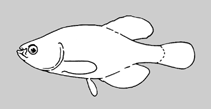
Radios blandos dorsales (total) : 8 - 10; Radios blandos anales: 14 - 17; Vértebra: 33 - 35. i>Atlantirivulus ribeirensis can be diagnosed from all its congeners by the following combination of characters: lateral line divided into two sections (vs. single); lateral line with one neuromast by scale (vs. lateral line often interrupted by scales without neuromasts); caudal fin oval in both sexes (vs. sub-truncate at least in males); caudal fin in males with narrow dark grey stripe along whole fin margin (vs. never a similar color pattern); venter yellow; caudal-fin spot always conspicuous in females (vs. spot pale or absent in females above 2.8 cm SL) (Ref. 102354).
Occurs in shallow streams, 10 cm deep or less, within or close to dense forests of the Ribeira de Iguape river basin. These streams are characterized by light yellow or tea-like colored water. The bottom is composed of litter and sand. This is the only fish encountered in these streams (Ref. 102354).
Life cycle and mating behavior
Madurez | Reproducción | Puesta | Huevos | Fecundidad | Larva
Costa, W.J.E.M., 2014. Four new species of the genus Atlantirivulus (Cyprinodontiformes: Rivulidae) from the Brazilian Atlantic Forest. Verteb. Zool. 64(1):9-21. (Ref. 102354)
IUCN Red List Status (Ref. 130435: Version 2025-1)
Threat to humans
Harmless
Human uses
Herramientas
Special reports
Download XML
Fuentes de Internet
Estimates based on models
Phylogenetic diversity index (Referencia
82804): PD
50 = 0.5000 [Uniqueness, from 0.5 = low to 2.0 = high].
Bayesian length-weight: a=0.01122 (0.00514 - 0.02450), b=3.04 (2.87 - 3.21), in cm total length, based on all LWR estimates for this body shape (Ref.
93245).
Nivel trófico (Referencia
69278): 3.2 ±0.4 se; based on size and trophs of closest relatives
Resiliencia (Referencia
120179): Alto, población duplicada en un tiempo mínimo inferior a 15 meses (Preliminary K or Fecundity.).
Fishing Vulnerability (Ref.
59153): Low vulnerability (10 of 100).
🛈