



Uploaden van uw Foto's en video's
Google afbeelding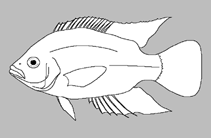 No image available for this species;
drawing shows typical species in Cichlidae.
Google afbeelding
drawing shows typical species in Cichlidae.
Classificatie / Namen Lokale namen | Synoniemen | Catalog of Fishes(Genus, Soort(en)) | ITIS | CoL | WoRMS | Cloffa
> Cichliformes (Cichlids, convict blennies) > Cichlidae (Cichlids) > Geophaginae
Etymology: Geophagus: Greek, gea = the earth + Greek, phagein = to eat (Ref. 45335); mirabilis: Named from the the Latin adjective mirabilis, meaning extraordinary, marvelous, admirable, in reference to the unique color pattern that includes the row of black spots on the flanks and the iridescent spots and vermiculations on the side of the head in living individuals.
Etymology: Geophagus: Greek, gea = the earth + Greek, phagein = to eat (Ref. 45335); mirabilis: Named from the the Latin adjective mirabilis, meaning extraordinary, marvelous, admirable, in reference to the unique color pattern that includes the row of black spots on the flanks and the iridescent spots and vermiculations on the side of the head in living individuals.
Milieu: milieu / Klimaatzone / Diepte / verspreidingsgebied Ecologie
; zoet water benthopelagisch. Tropical
Verspreiding Gebieden | FAO regio's | Ecosystemen | Voorkomen | Verspreidingskaart | Introducties | Faunafri
South America: Rio Aripuanã drainage in Brazil.
Grootte / Gewicht / Leeftijd
Maturiteit: Lm ? range ? - ? cm
Max length : 16.2 cm SL mannelijk / geslacht onbekend; (Ref. 102658)
Max length : 16.2 cm SL mannelijk / geslacht onbekend; (Ref. 102658)
Korte beschrijving Determinatiesleutels | Morfologie | Morfometrie
Dorsale stekels (totaal) : 15 - 17; Dorsale zachte stralen (totaal) : 9 - 12; Anale stekels: 3; Anale zachte stralen: 7 - 8. Geophagus mirabilisis distinguished from all congeners by having 2-6 black spots in a longitudinal row along middle of flank in specimens larger than 8.0 cm SL (vs. a single midlateral spot or spots absent from flank in individuals of G. altifrons), but spots other than midlateral spot absent in occasional specimens up to approximately 8.0 cm SL; live coloration of adults consists of rich pattern of iridescent blue, round or vermiculate marks on the side of head, unique for the genus; 4½-5½ scales between first dorsal-fin spine and upper caudal fin of adults with only one series of scales on each inter-radial membrane of ventral lobe, not imbricating with neighboring series and not completely covering base ofrays (vs. two series of scales on each inter-radial membrane of ventral lobe, imbricating both with one another and with neighboring rows and completely covering base of rays, in all other species in Geophagus). It differs from congeners except G. camopiensis and G. crocatus by having 7 scale rows around the caudal peduncle below lateral line (vs. 8-11); from G. camopiensis by having a narrower lower lip fold, not covering any of dentary lateralis foramina (vs. broader lower lip fold, covering at least dentary lateralis foramen 1, in some specimens also dentary lateralis foramen 2, by having light horizontal stripes on the posterior half of caudal fin (vs. only light dots) and by the inter-radial scales series on caudal fin not imbricated (vs. imbricated); from G. crocatus by the absence of preopercular mark(vs. presence). The following additional characters are useful to diagnose from subsets of Geophagus species: absence of a dark stripe across the cheek at all sizes (vs. present in G. argyrostictus, G. gottwaldi, G. grammepareius, G. harreri, and G. taeniopareius); absence of dark spot at the corner of the preopercle (preopercular mark) (vs. presence in G. brachybranchus, G. crocatus, G. dicrozoster, G. proximus and G. winemilleri; skin fold covering external gill filaments along first ceratobranchial narrow in comparison with filaments (vs. wide in G. brachybranchus, G. harreri and G. surinamensis; E1 scales 29-31 (vs. 33-35 in G. abalios, 33-36 in G. altifrons, 32-34 in G. argyrostictus, 32-33 in G. brachybranchus, 32-34 in G. brokopondo, 34-38 in G. dicrozoster, 34-36 in G. gottwaldi, 32-34 in G. megasema, 32-34 in G. proximus, 32-34 in G. surinamensis, 33-35 in G. sveni and 32-35 in G. winemilleri) (Ref. 102658).
Levenscyclus en paargedrag Maturiteit | Voortplanting | Paaien | Eieren | Fecunditeit | Larven
Hoofdreferentie
Upload uw referenties | Referenties | Coördinator : Kullander, Sven O. | Medewerkers
Deprá, G.C., S.O. Kullander, C.S. Pavanelli and W.J. da Graça, 2014. A new colorful species of Geophagus (Teleostei: Cichlidae), endemic to the rio Aripuanã in the Amazon basin of Brazil. Neotrop. Ichthyol. 12(4):737-746. (Ref. 102658)
CITES
Not Evaluated
Gevaar voor de mens
Harmless
Gebruik door de mens
FAO - Publication: search | FishSource |
Meer informatie
Trofische ecologie
Voedsel (prooien)
Dieetsamenstelling
Voedselconsumptie
Voedselrantsoenen
Predatoren
Voedsel (prooien)
Dieetsamenstelling
Voedselconsumptie
Voedselrantsoenen
Predatoren
Populatiedynamica
Groeiparameters
Max. leeftijden / maten
Lengte-gewicht rel.
Lengte-lengte rel.
Lengtefrequenties
Massaconversie
Rekrutering
Abundantie
Groeiparameters
Max. leeftijden / maten
Lengte-gewicht rel.
Lengte-lengte rel.
Lengtefrequenties
Massaconversie
Rekrutering
Abundantie
Levenscyclus
Voortplanting
Maturiteit
Rijpheid/kieuwen rel.
Fecunditeit
Paaien
Paaibestanden
Eieren
Ontwikkeling van de eieren
Larven
Larvale populatiedynamiek
Voortplanting
Maturiteit
Rijpheid/kieuwen rel.
Fecunditeit
Paaien
Paaibestanden
Eieren
Ontwikkeling van de eieren
Larven
Larvale populatiedynamiek
Anatomie
Kieuwoppervlak
Hersenen
Otoliet
Kieuwoppervlak
Hersenen
Otoliet
Fysiologie
Lichaamssamenstelling
Voedingsstoffen
Zuurstofverbruik
Type zwemmen
Zwemsnelheid
Visuele pigmenten
Vis geluid
Ziekten en parasieten
Toxiciteit (LC50)
Lichaamssamenstelling
Voedingsstoffen
Zuurstofverbruik
Type zwemmen
Zwemsnelheid
Visuele pigmenten
Vis geluid
Ziekten en parasieten
Toxiciteit (LC50)
Genetica
genoom
Genetica
Heterozygositeit
Erfelijkheid
Genetische diversiteit
genoom
Genetica
Heterozygositeit
Erfelijkheid
Genetische diversiteit
Menselijk gerelateerd
Aquacultuursystemen
Aquacultuurprofielen
Kweeklijnen
Ciguatera gevallen
Postzegels, munten, diversen.
Aquacultuursystemen
Aquacultuurprofielen
Kweeklijnen
Ciguatera gevallen
Postzegels, munten, diversen.
Tools
Speciale rapporten
Bekijk gegevens voor het houden in een aquarium | Bekijk Fact Sheets voor de soort | Bekijk Aquacultuur Fact Sheets
Download XML
Internetbronnen
AFORO (otoliths) | Aquatic Commons | BHL | Cloffa | Websites from users | Bekijk FishWatcher | CISTI | Catalog of Fishes: Genus, Soort(en) | DiscoverLife | ECOTOX | FAO - Publication: search | Faunafri | Fishipedia | Fishtrace | GloBI | Google Books | Google Scholar | Google | IGFA World Record | OneZoom | Open Tree of Life | Otolith Atlas of Taiwan Fishes | PubMed | Reef Life Survey | Socotra Atlas | TreeBase | Tree of Life | Wikipedia: ga naar, zoek | World Records Freshwater Fishing | Zoobank | Zoological Record
Schattingen op basis van modellen
Fylogenetische diversiteitsindex (Ref. 82804): PD50 = 0.5000 [Uniqueness, from 0.5 = low to 2.0 = high].
Bayesian length-weight: a=0.02399 (0.01144 - 0.05029), b=3.01 (2.83 - 3.19), in cm total length, based on LWR estimates for this (Sub)family-body shape (Ref. 93245).
Trofisch niveau (Ref. 69278): 2.3 ±0.1 se; based on size and trophs of closest relatives
Weerstandsvermogen (Ref. 120179): Hoog, minimale populatieverdubbelingstijd minder dan 15 maanden (Preliminary K or Fecundity.).