>
Perciformes/Percoidei (Perchs) >
Percidae (Perches) > Etheostomatinae
Etymology: Percina: Latin, diminutive of perch = perch (Ref. 45335).
Eponymy: Dr Bruce Alan Thompson (1946–2007) was, for nearly three decades, an Associate Professor at the Louisiana State University and researcher at the Coastal Fisheries Institute. [...] (Ref. 128868), visit book page.
Environment: milieu / climate zone / rango de profundidad / distribution range
Ecología
; agua dulce bentopelágico. Temperate
North America: endemic to the Ouachita River system in the Ouachita Highlands Arkansas, USA.
Tamaño / Peso / Age
Madurez: Lm ? range ? - ? cm
Max length : 9.0 cm SL macho / no sexado; (Ref. 102809); 8.2 cm SL (female)
Short description
Claves de identificación | Morfología | Morfometría
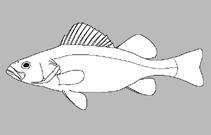
Espinas dorsales (total) : 11 - 14; Radios blandos dorsales (total) : 12 - 15; Espinas anales: 2; Radios blandos anales: 8 - 11; Vértebra: 39 - 41. A species of the subgenus Swainia but distinguished from all other species of Swainia by having the following combination of characters: snout depth is less than snout length; the ratio of snout length to SL is greater than 7.5%; more than 72 pored lateral line scales (mode 76-80); breast is unscaled or partially scaled in males and females; lateral pigmentation on body with 12 to 15 vertically elongated distinct blotches, with seven or more of these blotches between the insertion of the second dorsal fin and the hypural plate; and usually 12 branchiostegal rays (6 on each side).
Body shape (shape guide): elongated.
Observed to seasonally occupy two different types of habitats. In spring season, breeding individuals typically occurs in gravelbottomed and cobble substrate riffle areas and swift chutes and runs of up to approximately 1 m deep. Inhabits deeper pool habitats for the remainder of the year. Also reported to inhabit deep, swift riffle areas with rocky substrates
and thick growths of Podostemon heterophyllum in spring. During fall, a single specimen was collected from a sluggish siltbottom pool at the confluence of the Ouachita River and Lake Ouachita. Also observed to have preference for a late-summer microhabitat of upstream edges of runs that invariably included slight surface agitation and a high
percentage of cobble substrate.
Life cycle and mating behavior
Madurez | Reproducción | Puesta | Huevos | Fecundidad | Larva
Robison, H.W., R.C. Cashner, M.E. Raley and T.J. Near, 2014. A new species of darter from the Ouachita Highlands in Arkansas related to Percina nasuta (Percidae: Etheostomatinae). Bull. Peabody Mus. Nat. Hist. 55(2):237-252. (Ref. 102809)
IUCN Red List Status (Ref. 130435: Version 2025-1)
Threat to humans
Harmless
Human uses
Pesquerías: sin interés
Herramientas
Special reports
Download XML
Fuentes de Internet
Estimates based on models
Phylogenetic diversity index (Referencia
82804): PD
50 = 0.5000 [Uniqueness, from 0.5 = low to 2.0 = high].
Bayesian length-weight: a=0.00575 (0.00268 - 0.01234), b=3.13 (2.95 - 3.31), in cm total length, based on LWR estimates for this (Sub)family-body shape (Ref.
93245).
Nivel trófico (Referencia
69278): 3.4 ±0.4 se; based on size and trophs of closest relatives
Resiliencia (Referencia
120179): Alto, población duplicada en un tiempo mínimo inferior a 15 meses (Preliminary K or Fecundity.).
Fishing Vulnerability (Ref.
59153): Low vulnerability (10 of 100).
🛈