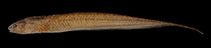
Classification / Names
Noms communs | Synonymes | Catalog of Fishes(Genre, Espèce) | ITIS | CoL | WoRMS | Cloffa
>
Gymnotiformes (Knifefishes) >
Hypopomidae (Bluntnose knifefishes)
Etymology: Microsternarchus: Greek, mikros = small + Greek, sternon = breast + Greek, archos = anus (Ref. 45335); brevis: Named for its overall size and caudal filament (Latin 'brevis' for short).
Environment: milieu / climate zone / profondeur / distribution range
Écologie
; eau douce pélagique; pH range: 4.0 - 5.0; profondeur 0 - 2 m (Ref. 104297). Tropical; 25°C - 26°C (Ref. 104297)
South America: Brazil.
Taille / Poids / Âge
Maturité: Lm ? range ? - ? cm
Max length : 5.3 cm TL mâle / non sexé; (Ref. 104297); 5.3 cm TL (female)
Description synthétique
Clés d'identification | Morphologie | Morphométrie
This species is distinguished by the following characters: short caudal filament 12.8-20.9% of TL; size of body small 3.75-5.32 cm SL; slightly inferior mouth 1.34-2.42 cm HL; pigmentation on body uniformly distributed along the entire area, including head; it also lacks a well delineated dark area on the pseudotympanum, where the anterior end of the posterior lateral line nerve branches with the dorsal ramus of the posterior lateral line nerve (Ref. 104297).
Body shape (shape guide): eel-like; Cross section: compressed.
This species is collected in shallow areas from 0.5-1.5 m in the dry season or at the beginning of the rainy season. It also occurs in black-water streams along the middle part of the rio Negro Basin (Amazon). Along stream margins, it occurs in well oxygnated waler and prefers weak current with abundant submerged vegetation, roots and leaf litter. In areas with stronger current, this species tends to inhabit submerged trees and tangled roots of epiphytic plants. Variation of physico-chemical water parameters taken in 2002-2007: conductivity 9.0-22.2 µS/cm, temperature 25-26°C, ph 4.01-5.0 and dissolved oxygen 4.12-7.10 mg/L. Stomach contents of one specimen contains parts of zooplankton. Associated genera of gymnotiforms species collected in the area were Brachypopomus and Hypopgus (Ref. 104297).
Life cycle and mating behavior
Maturité | Reproduction | Frai | Œufs | Fécondité | Larves
Cox Fernandes, C., A. Nogueira, A. Williston and J.A. Alves-Gomes, 2015. A new species of electric knifefish from the rio Negro, Amazon basin (Gymnotiformes: Hypopomidae, Microsternarchini). Proc. Acad. Nat. Sci. Phil. 164(1):213-227. (Ref. 104297)
Statut dans la liste rouge de l'IUCN (Ref. 130435: Version 2025-1)
Menace pour l'homme
Harmless
Utilisations par l'homme
Outils
Articles particuliers
Télécharger en XML
Sources Internet
Estimates based on models
Phylogenetic diversity index (Réf.
82804): PD
50 = 0.5312 [Uniqueness, from 0.5 = low to 2.0 = high].
Bayesian length-weight: a=0.00102 (0.00046 - 0.00225), b=3.06 (2.88 - 3.24), in cm total length, based on all LWR estimates for this body shape (Ref.
93245).
Niveau trophique (Réf.
69278): 3.1 ±0.4 se; based on size and trophs of closest relatives
Fishing Vulnerability (Ref.
59153): Low vulnerability (10 of 100).
🛈