



Salmo multipunctatus Doadrio, Perea & Yahyaoui, 2015
Draa trout
Загрузить свой Фото и Видео
Изображение на Google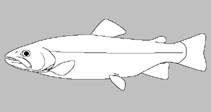 No image available for this species;
drawing shows typical species in Salmonidae.
Изображение на Google
drawing shows typical species in Salmonidae.
Классификация / Имена народные названия | синонимы | Catalog of Fishes(род, виды) | ITIS | CoL | WoRMS | Cloffa
> Salmoniformes (Salmons) > Salmonidae (Salmonids) > Salmoninae
Etymology: Salmo: Latin, salmo, Plinius = salmon (Ref. 45335); multipunctatus: The species name multipunctata [to be corrected in multipunctatus refers to its diagnostic pigmentation pattern, which is consttuted by numerous spots and marks along the body (Ref. 107622).
Etymology: Salmo: Latin, salmo, Plinius = salmon (Ref. 45335); multipunctatus: The species name multipunctata [to be corrected in multipunctatus refers to its diagnostic pigmentation pattern, which is consttuted by numerous spots and marks along the body (Ref. 107622).
Окружающая среда: среда / климатическая зона / пределы глубины / диапазон распространения экология
; пресноводный пелагический. Subtropical
распространение Территории | регионы FAO | Экосистемы | места находок | карта точек | интродукции | Faunafri
Africa: Draa basin in southern Morocco (Ref. 107622).
Размер / Вес / Возраст
Краткое описание определительные ключи | морфология | морфометрия
позвонки: 53 - 55. Diagnosis: It differs from other known species of the genus Salmo in the numerous irregular narrow parr marks, usually more than or equal to 14, in the lateral line; upper row of parr marks more than or equal to 10; lower row of parr marks variable, usually more than or equal to 5; two conspicuous black spots placed at the right and left sides of the iris and two less visible spots at the upper and lower sides of the iris; numerous black, small spots at the upper side of the body and several red ocellated and non-ocellated spots placed in the middle of the body; black spots sometimes extended to the opercular region and the caudal fin; ethmoid bone with a characteristic T shape; premaxilla bone with small and inclined upper process; from 14-16 scales from base of adipose fin to lateral line; from 12-14 dorsal fin pterygophores; and 9 molecular autopomorphies in MT-CYTB gene in the nucleotide positions 60, 216,474, 504, 732, 849, 915, 990, 1090 (Ref. 107622).
Body shape (shape guide): fusiform / normal; Cross section: oval.
Body shape (shape guide): fusiform / normal; Cross section: oval.
This species inhabits small and shallow streams with clear and cold waters (Ref. 107622). The habitat of this species suffers catastrophic seasonal floods that influence dramatically the demography of the population; the continuous deforestation of the Atlas Mountains and the disappearance of the riparian vegetation, increase the adverse effect of the overflows over the small Atlas rivers; overfishing is also a problem for a small population ; therefore this species should be included in the IUCN category of endangered (Ref. 107622).
Жизненный цикл и брачное поведение половая зрелость | размножение | нерест | икра | Плодовитость | личинки
Основная ссылка
Загрузите свои рекомендации | ссылки | координатор | соавторы
Doadrio, I., S. Perea and A. Yahyaoui, 2015. Two new species of Atlantic trout (Actinopterygii, Salmonidae) from Morocco. Graellsia 71(2,e039):1-26. (Ref. 107622)
CITES
Not Evaluated
Угроза для людей
Harmless
Использование человеком
рыболовство: коммерческий
FAO - Publication: search | FishSource |
дополнительная информация
Трофическая экология
Пищевые предметы (добыча)
состав пищи
потребление пищи
Продовольственные пайки
хищники
Пищевые предметы (добыча)
состав пищи
потребление пищи
Продовольственные пайки
хищники
Динамика численности населения
Параметры роста
Макс. возраст / размер
Отношение длины к весу.
Отношение длины к длине.
Размерный состав
Преобразование массы
пополнение
численность
Параметры роста
Макс. возраст / размер
Отношение длины к весу.
Отношение длины к длине.
Размерный состав
Преобразование массы
пополнение
численность
Жизненный цикл
размножение
половая зрелость
Зрелость/Жиры относительно.
Плодовитость
нерест
Нерестовые скопления
икра
Развитие икры
личинки
динамика численности личинок
размножение
половая зрелость
Зрелость/Жиры относительно.
Плодовитость
нерест
Нерестовые скопления
икра
Развитие икры
личинки
динамика численности личинок
Анатомия
жаберная область
Мозг
Отолит
жаберная область
Мозг
Отолит
Физиология
Состав тела
Питательные вещества
Потребление кислорода
Тип плавания
Скорость плавания
Зрительные пигменты
Звук рыбы
Болезни и паразиты
Токсичность (LC50s)
Состав тела
Питательные вещества
Потребление кислорода
Тип плавания
Скорость плавания
Зрительные пигменты
Звук рыбы
Болезни и паразиты
Токсичность (LC50s)
генетика
Геном
генетика
Гетерозиготность
наследуемость
Генетическое разнообразие
Геном
генетика
Гетерозиготность
наследуемость
Генетическое разнообразие
Связанные с человеком
Системы аквакультуры
особенности рыбоводства
степень растяжения
Случаи заболевания сигуатерой
Марки, монеты и прочее.
Системы аквакультуры
особенности рыбоводства
степень растяжения
Случаи заболевания сигуатерой
Марки, монеты и прочее.
инструменты
Специальные отчеты
Проверить содержание в аквариумах | Проверить опубликованные видовые данные | Проверить опубликованные данные по аквакультуре
Скачать в формате XML
ресурсы в Интернет
AFORO (otoliths) | Aquatic Commons | BHL | Cloffa | Websites from users | Проверить FishWatcher | CISTI | Catalog of Fishes: род, виды | DiscoverLife | ECOTOX | FAO - Publication: search | Faunafri | Fishipedia | Fishtrace | GloBI | Google Books | Google Scholar | Google | IGFA World Record | OneZoom | Open Tree of Life | Otolith Atlas of Taiwan Fishes | PubMed | Reef Life Survey | Socotra Atlas | TreeBase | Tree of Life | Wikipedia: Вперёд, поиск | World Records Freshwater Fishing | Зоологическая летопись
Оценки, основанные на моделях
Индекс филогенетического разнообразия (ссылка 82804): PD50 = 0.5000 [Uniqueness, from 0.5 = low to 2.0 = high].
Bayesian length-weight: a=0.01047 (0.00486 - 0.02255), b=3.03 (2.86 - 3.20), in cm total length, based on LWR estimates for this Genus-body shape (Ref. 93245).
Трофический уровень (ссылка 69278): 3.4 ±0.4 se; based on size and trophs of closest relatives
устойчивость к внешним воздействиям (ссылка 120179): высокий, минимальное время удвоения популяции до 15 месяцев (Preliminary K or Fecundity.).