Elasmobranchii (haaien en roggen) (sharks and rays) >
Squaliformes (Sleeper and dogfish sharks) >
Squalidae (Dogfish sharks)
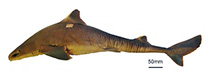
Etymology: Squalus: Genus name from Latin 'squalus' meaning shark (Ref. 6885, 27436); quasimodo: Named for the hunchback of Notre-Dame (19th Century novel by Victor Hugo), referring to its most noticeable character - body conspicuously robust and humped dorsally.
Eponymy: Not a true eponym but the name of the title character in Victor Hugo’s: The Hunchback of Notre Dame, referring to the prominent dorsal profile of these species. (Ref. 128868), visit book page.
Environment: milieu / Klimaatzone / Diepte / distribution range
Ecologie
marien pelagic-oceanic. Tropical
Southwest Atlantic: known as an endemic species in southern Brazil.
Grootte / Gewicht / Leeftijd
Maturiteit: Lm ? range ? - ? cm
Max length : 85.0 cm TL (female)
Korte beschrijving
Determinatiesleutels | Morfologie | Morfometrie
Wervels: 116 - 121. This species can be distinguished from its congeners through the following set of characters: body which is conspicuously robust and humped dorsally; second dorsal fin is upright and markedly tall (height 4.0%, 4.7%-5.3% TL); first and second dorsal-fin spines are elongated (first dorsal-fin spine length 4.3%, 3.3%-4.3% TL and second dorsal-fin spine length 4.4%, 3.9%-4.3% TL), and broad at base (first spine base length 0.9%, 0.7%-1.0% TL; second spine base length 1.0%, 0.8%-0.9% TL); caudal fin have a conspicuous rectangular dorsal lobe; the dermal denticles are tricuspid, markedly imbricate and broad at crown; differs from S. bahiensis by having a larger pectoral-fin anterior margin length, 15.9%, 15.5%-16.0% TL (vs. 14.3%, 14.4%-14.5% TL) and more elongate first dorsal-fin spine, its length 4.3%, 3.3%-4.3% TL (vs. 2.8%, 2.9%-3.0% TL), has a larger first dorsal fin with greater anterior margin length, 11.2%, 10.8%-11.4% TL (vs. 10.5%, 10.3%-10.6% TL) and fin base (length 8.2%, 7.7%-8.5% TL vs. 7.5%, 7.2%-7.3% TL, respectively); differs from S. lobularis by having a greater interdorsal distance, 26.4%, 24.0%-25.8% TL (vs. 22.3%, 21.9%-23.6% TL) (Ref. 109601).
Body shape (shape guide): fusiform / normal; Cross section: angular.
Levenscyclus en paargedrag
Maturiteit | Voortplanting | Paaien | Eieren | Fecunditeit | Larven
Viana, S.T.d.F., M.R. De Carvalho and U.L. Gomes, 2016. Taxonomy and morphology of species of the genus Squalus Linnaeus, 1758 from the Southwestern Atlantic Ocean (Chondrichthyes: Squaliformes: Squalidae). Zootaxa 4133(1):1-89. (Ref. 109601)
Status op de Rode Lijst van het IUCN (Ref. 130435: Version 2025-1)
Gevaar voor de mens
Harmless
Gebruik door de mens
Visserij: van potentieel belang
Tools
Speciale rapporten
Download XML
Internetbronnen
Estimates based on models
Fylogenetische diversiteitsindex (Ref.
82804): PD
50 = 0.5000 [Uniqueness, from 0.5 = low to 2.0 = high].
Bayesian length-weight: a=0.00933 (0.00350 - 0.02485), b=3.03 (2.80 - 3.26), in cm total length, based on LWR estimates for this (Sub)family-body shape (Ref.
93245).
Trofisch niveau (Ref.
69278): 4.3 ±0.4 se; based on size and trophs of closest relatives
Weerstandsvermogen (Ref.
120179): Zeer laag, minimale populatieverdubbelingstijd meer dan 14 jaar (Preliminary K or Fecundity.).
Fishing Vulnerability (Ref.
59153): Moderate to high vulnerability (54 of 100).
🛈