Классификация / Names
народные названия | синонимы | Catalog of Fishes(род, виды) | ITIS | CoL | WoRMS | Cloffa
>
Cyprinodontiformes (Rivulines, killifishes and live bearers) >
Rivulidae (Rivulines) > Rivulinae
Etymology: Papiliolebias: Latin, papilio, -onis = butterfly + Greek, lebias, ou = a kind of small fish (Ref. 45335); ashleyae: Named for the the daughter of Dr. Roger Brousseau, Ashley Kimberly Brousseau, who collected the first specimen of the species.
Eponymy: Ashley Kimberly Brousseau is the daughter of the second author Dr Roger Brousseau, who collected the first specimen of the species. (Also see Brousseau) (Ref. 128868), visit book page.
Environment: milieu / climate zone / пределы глубины / distribution range
экология
; пресноводный донно-пелагический; pH range: 6.9 - ?. Tropical; 31°C - 35°C (Ref. 94790)
South America: Rio Mamoré basin, Rio Madeira drainage in Bolivia.
Size / Вес / Возраст
половая зрелость: Lm ? range ? - ? cm
Max length : 3.6 cm SL самец/пол неопределен; (Ref. 94790); 2.9 cm SL (female)
Краткое описание
определительные ключи | морфология | морфометрия
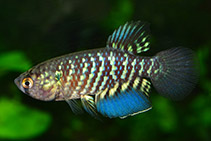
членистые (мягкие) лучи спинного плавника (общее число) : 10 - 12; членистые (мягкие) лучи анального плавника: 15 - 18; позвонки: 25 - 28. Papiliolebias ashleyae is distinguished from all other congeners by the following characters: lower prepelvic length in males 43.6-44.7% SL (vs. 44.9- 51.5% SL); lower pre-pelvic length in females 43.3-46.8% SL (vs. 48.2-51.7% SL); and color pattern of males consisting of an overall redbrownish coloration, including the dorsal, caudal and pelvic fins basis (vs. overall color pattern dark blue, but never red-brown). Additional characters useful to distinguished from other species include a reddishbrown stripe on the basis of the dorsal and anal fins, with whitish blotches, and distal portion of anal- and caudal-fins bluish (vs. absence of reddish- brown stripe in the remaining species of the genus, where the caudal and anal-fin basis possess white and black spots); dorsal-fin origin at vertical through base of anal-fin rays 9th-10th (vs. 7th-8th in P. bitteri and 6th-9th in P. hatinne); body with brownish-red background and iridescent greenishblue scales, forming slender, oblique, ladder-like stripes (vs. oblique thick lines arranged parallel to each other); pelvic-fin red, with three spots (from basal to distal portion of fin): white, dark red and white (vs. dark blue without spots); third pelvic fin-rays transformed into a filament (vs. third pelvic-fin ray not transformed into a filament), and pelvic-fin separated by a small 4 mm interspace (vs. not separated) (Ref. 94790).
Body shape (shape guide): elongated.
Inhabits temporary pool with about 250 meters length and 20 meters width. Collected at the center of the pool, with water depth of 120 cm. Water temperature at the surface of the pool was 34.5°C while at the marginal area of the pool, at depth of 20 cm, was 31° C. Syntopic with exclusively annual rivulid fishes such as females of an unidentified Neofundulus species, Spectrolebias brousseaui and an undescribed Trigonectes species. Other animals found at the temporary pool include Phylomedusa sp. tadpoles, clams and freshwaters crabs. The pool has abundant and dense aquatic vegetation, with unidentified species belonging to the genera Echinodorus, Utricularia and Nymphaea. The eggs are small measuring about 0.90 mm in diameter and have long filaments at the surface of the chorium (Ref. 94790).
Life cycle and mating behavior
половая зрелость | размножение | нерест | икра | Fecundity | личинки
Nielsen, D.T.B. and R. Brousseau, 2014. Description of a new annual fish, Papiliolebias ashleyae (Cyprinodontiformes: Rivulidae) from the upper Rio Mamoré basin, Bolivia. aqua, Int. J. Ichthyol. 20(1):53-59. (Ref. 94790)
Статус Красного Списка МСОП (Ref. 130435: Version 2025-1)
Угроза для людей
Harmless
Использование человеком
дополнительная информация
инструменты
Специальные отчеты
Скачать в формате XML
ресурсы в Интернет
Estimates based on models
Phylogenetic diversity index (ссылка
82804): PD
50 = 0.5625 [Uniqueness, from 0.5 = low to 2.0 = high].
Bayesian length-weight: a=0.01122 (0.00514 - 0.02450), b=3.04 (2.87 - 3.21), in cm total length, based on all LWR estimates for this body shape (Ref.
93245).
Trophic level (ссылка
69278): 3.2 ±0.4 se; based on size and trophs of closest relatives
устойчивость к внешним воздействиям (ссылка
120179): высокий, минимальное время удвоения популяции до 15 месяцев (Preliminary K or Fecundity.).
Fishing Vulnerability (Ref.
59153): Low vulnerability (10 of 100).
🛈