



Adicionar o seu Fotografias e vídeos
Imagem do Google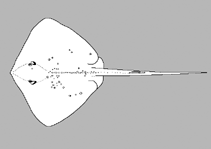 No image available for this species;
drawing shows typical species in Dasyatidae.
Imagem do Google
drawing shows typical species in Dasyatidae.
Classificação / Nomes Nomes comuns | Sinónimos | Catalog of Fishes(Género, Espécies) | ITIS | CoL | WoRMS | Cloffa
Elasmobranchii (tubarões e raias) (sharks and rays) > Myliobatiformes (Stingrays) > Dasyatidae (Stingrays) > Urogymninae
Etymology: Himantura: Greek, iman, imantos = thong, strap + Greek, oura = tail (Ref. 45335); australis: Named for the tropical Southern Hemisphere distribution of this species; noun in apposition.
Etymology: Himantura: Greek, iman, imantos = thong, strap + Greek, oura = tail (Ref. 45335); australis: Named for the tropical Southern Hemisphere distribution of this species; noun in apposition.
Ambiente: milieu / zona climática / intervalo de profundidade / gama de distribuição Ecologia
marinhas demersal; intervalo de profundidade ? - 45 m (Ref. 110363). Tropical; 5°S - 29°S, 111°E - 155°E (Ref. 114953)
Distribuição Territórios | Áreas FAO | Ecossistemas | Ocorrências | Mapa dos pontos | Introduções | Faunafri
Western Central Pacific: confined to the Australasian Plate, from off Papua New Guinea and northern Australia, from Shark Bay (off Western Australia) to Brisbane (off Queensland) (Ref. 110363). Also Ref. 114953.
Tamanho / Peso / Idade
Maturidade: Lm ? range ? - ? cm
Max length : 140.0 cm WD (female)
Max length : 140.0 cm WD (female)
Descrição breve Chaves de identificação | Morfologia | Morfometria
This species is distinguished by the following set of characters: the disc is weakly rhomboidal; preorbital snout is moderately short, its length 19-22% DW and rather broad, angle 117-127°, with a distinct apical lobe; lateral apices are narrowly rounded; the orbits moderately large, usually strongly protruding (particularly in young); 1-2, mostly heart-shaped suprascapular denticles which are not preceded before and after by a row of smaller primary denticles; secondary denticle band is developed before birth; dorsal surface of juveniles (smaller than 370 mm DW) are dark spotted or with spots and weak reticulations, subadults and adults (exceeding 390 mm DW) are more strongly reticulated; dorsal tail of juveniles has 3 rows of spots before caudal sting, faint dark saddles beyond sting (no alternating black and white bands on tail); tail uniformly dark ventrally; 146-152 pectoral-fin radials; 123 vertebral centra (excluding synarcual), 24 including synarcual 124 (Ref. 110363)
Body shape (shape guide): other (see remarks); Cross section: flattened.
Body shape (shape guide): other (see remarks); Cross section: flattened.
Depth distribution is not well documented, but this species is primarily in shallow water from near the shore to at least 45 m depth (Ref. 110363). Enters estuaries and brackish water. Most serious injuries to humans come from stingray groups (Ref. 114953). The largest specimen (140 cm WD) is a pregnant female with 2 embryos (30 cm WD) (data not year published); the smallest confirmed adult male is 112 cm WD (Ref. 110363); born at ca. 29 cm WD. Produces litters up to 4 pups (Ref. 114953).
Ciclo de vida e comportamento de acasalamento Maturidade | Reprodução | Desova | Ovos | Fecundidade | Larvas
Referência principal
Carregar as suas referências | Referências | Coordenador : McEachran, John | Colaboradores
Last, P.R., W.T. White and G. Naylor, 2016. Three new stingrays (Myliobatiformes: Dasyatidae) from the Indo-West Pacific. Zootaxa 4147(4):377-402. (Ref. 110363)
Categoria na Lista Vermelha da IUCN (Ref. 130435: Version 2025-2 (Global))
Preocupação menor (LC) ; Date assessed: 09 February 2021
CITES
Not Evaluated
Ameaça para o homem
Traumatogenic (Ref. 114953)
Utilização humana
Pescarias: pouco comercial
FAO - Publication: search | FishSource |
Mais informação
Ecologia Trófica
Produtos alimentares (presas)
Composição da dieta
Consumo alimentar
Rações alimentares
Predadores
Produtos alimentares (presas)
Composição da dieta
Consumo alimentar
Rações alimentares
Predadores
Ecologia
Ecologia
Ecologia
Dinâmica das populações
Parâmetros de crescimento
Idades / tamanhos máximos
Comprimento-peso rel.
Comprimento-comprimento rel.
Frequência de comprimento
Conversão de massa
Recrutamento
Abundância
Parâmetros de crescimento
Idades / tamanhos máximos
Comprimento-peso rel.
Comprimento-comprimento rel.
Frequência de comprimento
Conversão de massa
Recrutamento
Abundância
Ciclo de vida
Reprodução
Maturidade
Maturidade/Rel. das guelras
Fecundidade
Desova
Agregações de desova
Ovos
Desenvolvimento dos ovos
Larvas
Dinâmica larvar
Reprodução
Maturidade
Maturidade/Rel. das guelras
Fecundidade
Desova
Agregações de desova
Ovos
Desenvolvimento dos ovos
Larvas
Dinâmica larvar
Anatomia
Área branquial
Cérebro
Otólitos
Área branquial
Cérebro
Otólitos
Fisiologia
Composição corporal
Nutrientes
Consumo de oxigénio
Tipo de natação
Velocidade de natação
Pigmentos visuais
Som de peixe
Doenças e Parasitas
Toxicidade (LC50s)
Composição corporal
Nutrientes
Consumo de oxigénio
Tipo de natação
Velocidade de natação
Pigmentos visuais
Som de peixe
Doenças e Parasitas
Toxicidade (LC50s)
Genética
genoma
Genética
Heterozigotia
Hereditariedade
Diversidade genética
genoma
Genética
Heterozigotia
Hereditariedade
Diversidade genética
Relacionado com o ser humano
Sistemas de aquacultura
Perfis para aquacultura
Estirpes
Casos de Ciguatera
Selos, moedas, diversos.
Sistemas de aquacultura
Perfis para aquacultura
Estirpes
Casos de Ciguatera
Selos, moedas, diversos.
Ferramentas
E-book | Guia de campo | Ferramenta auxiliar de frequências de comprimento | Ferramenta sobre a história de vida | Mapa dos pontos |
Captura-MSY |
Relatórios especiais
Descarregue XML
Fontes da internet
AFORO (otoliths) | Aquatic Commons | BHL | Cloffa | Websites from users | Consultar FishWatcher | CISTI | Catalog of Fishes: Género, Espécies | DiscoverLife | ECOTOX | FAO - Publication: search | Faunafri | Fishipedia | Fishtrace | GloBI | Google Books | Google Scholar | Google | IGFA World Record | OneZoom | Open Tree of Life | Otolith Atlas of Taiwan Fishes | PubMed | Reef Life Survey | Socotra Atlas | TreeBase | Árvore da vida | Wikipedia: ir para, procurar | World Records Freshwater Fishing | Zoobank | Registo zoológico
Estimativas baseadas em modelos
Índice de diversidade filogenética (Ref. 82804): PD50 = 0.5002 [Uniqueness, from 0.5 = low to 2.0 = high].
Bayesian length-weight: a=0.01023 (0.00482 - 0.02174), b=3.06 (2.86 - 3.26), in cm total length, based on LWR estimates for this (Sub)family-body shape (Ref. 93245).
Nível Trófico (Ref. 69278): 3.6 ±0.5 se; based on size and trophs of closest relatives