



Urogymnus acanthobothrium Last, White & Kyne, 2016
Mumburarr whipray
Προσθέστε την παρατήρησή σας στο Fish Watcher
| Native range | All suitable habitat | Point map | Year 2050 |

|
| This map was computer-generated and has not yet been reviewed. |
| Urogymnus acanthobothrium AquaMaps Data sources: GBIF OBIS |
Ανεβάστε το φωτογραφίες και Βίντεο
Google image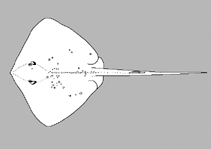 No image available for this species;
drawing shows typical species in Dasyatidae.
Google image
drawing shows typical species in Dasyatidae.
Ταξινόμηση / Ονόματα Κοινά ονόματα | Συνώνυμα | Catalog of Fishes(Γένος, Είδη) | ITIS | CoL | WoRMS | Cloffa
Ελασμοβράγχιοι (καρχαρίες και σαλάχια) (sharks and rays) > Myliobatiformes (Stingrays) > Dasyatidae (Stingrays) > Urogymninae
Etymology: Urogymnus: Greek, oura = tail + Greek, gymnos = naked (Ref. 45335); acanthobothrium: Named for the cestode parasites (genus Acanthobothrium) found in this species; noun in apposition.
Etymology: Urogymnus: Greek, oura = tail + Greek, gymnos = naked (Ref. 45335); acanthobothrium: Named for the cestode parasites (genus Acanthobothrium) found in this species; noun in apposition.
Περιβάλλον: περιβάλλον / κλιματική ζώνη / εύρος βάθους / εύρος διανομής Οικολογία
Θαλασσινό(ά); Υφάλμυρο βενθοπελαγικό; εύρος βάθους 2 - 20 m (Ref. 110274). Tropical
Κατανομή Εδάφη | Περιοχές FAO | Οικοσυστήματα | Παρουσίες | Σημειακός χάρτης | Εισαγωγές | Faunafri
Western Pacific: western Australia and Papua New Guinea.
Μέγεθος / Βάρος / Ηλικία
Γεννητική Ωρίμανση: Lm ? range ? - ? cm
Max length : 103 cm WD αρσενικό/απροσδιόριστο; (Ref. 110274); 161.0 cm WD (female)
Max length : 103 cm WD αρσενικό/απροσδιόριστο; (Ref. 110274); 161.0 cm WD (female)
Σύντομη περιγραφή Κλείδες προσδιορισμού | Μορφολογία | Μορφομετρία
This species is distinguished by the following set of characters: elongate disc suboval with the snout tip to axis of maximum width 53% DW; anterior disc margin not truncated, it is almost straight with lateral apices broadly rounded; preorbital snout broadly angular, its angle 114° and with a very small apical lobe; preorbit long, its length 26% TL, 2.1 times interorbital length; orbits are small and protruded slightly; spiracle is very large, 8.6% DW, 1.9 in orbit diameter; internasal distance is 2.0 in prenasal length, 2.8 times nostril length; preoral snout length is 2.6 times mouth width, 2.5 times internarial distance; caudal sting very large with its length more than a 30% DW; mid-scapular denticles are very small and inconspicuous; secondary denticles are very small, rather widely spaced, band delimited but margin not sharply defined, band truncate forward of eye; presence of minute upright tertiary denticles, barely visible; with a low and short-based ventral tail fold; dorsal disc colour is variable, juveniles plain dark greyish brown to yellowish brown, while in adults very finely and faintly mottled greyish white to yellowish brown; its ventral surface is largely white, posterior disc without regular dark margins; tail beyond sting white in young, while in adults it is unknown but possibly paler than anterior tail; propterygial radials 66, 3 times the number of mesopterygial radials; 151 total vertebral segments (excluding synarcual) (Ref. 110274).
Body shape (shape guide): other (see remarks); Cross section: flattened.
Body shape (shape guide): other (see remarks); Cross section: flattened.
Juveniles were recorded from lower reaches of rivers at depths of 2.2-8.7 m; salinity 14.6-33.1; turbidity 367->1000 NTU. Subadult specimens were from depths of 10-20 m. An adult female (161.0 cm DW, 174.0 cm disc length) aborted a late embryo which was estimated to be ca. 26.5 cm DW on capture. Juveniles (5) measured 39.o - 67.2 cm DW, 43.0-72.0 cm DL, while a late adolescent male measured 103.0 cm DW, This stingray could be traditionally hunted for food and the caudal sting can be used as a traditional knife. (Ref. 110274).
Κύκλος ζωής και συμπεριφορά ζευγαρώματος Γεννητική Ωρίμανση | Αναπαραγωγή | Γεννοβολία | Αβγά | Γονιμότητα | Προνύμφες
Κύρια αναφορά
Ανεβάστε τις αναφορές σας | Αναφορές | Συντονιστής : McEachran, John | Συνεργάτες
Last, P.R., W.T. White and P.M. Kyne, 2016. Urogymnus acanthobothrium sp. nov., a new euryhaline whipray (Myliobatiformes: Dasyatidae) from Australia and Papua New Guinea. Zootaxa 4147(2):162-176. (Ref. 110274)
Κατάσταση Κόκκινου Καταλόγου IUCN (Ref. 130435: Version 2025-2 (Global))
Data deficient (DD) ; Date assessed: 22 April 2021
CITES
Not Evaluated
Απειλή για τον άνθρωπο
Harmless
Ανθρώπινες χρήσεις
FAO - Publication: search | FishSource |
Περισσότερες πληροφορίες
Τροφική Οικολογία
Τρόφιμα (θηράματα)
Σύσταση δίαιτας
Κατανάλωση τροφής
Μερίδες τροφίμων
Θηρευτές
Τρόφιμα (θηράματα)
Σύσταση δίαιτας
Κατανάλωση τροφής
Μερίδες τροφίμων
Θηρευτές
Οικολογία
Οικολογία
Οικολογία
Πληθυσμιακή δυναμική
Παράμετροι Αύξησης
Μέγιστες ηλικίες / μεγέθη
Μήκος-βάρος σχετ.
Μήκος-μήκος rel.
Μήκος-συχνότητες
Μετατροπή μάζας
Στρατολόγηση
Αφθονία
Παράμετροι Αύξησης
Μέγιστες ηλικίες / μεγέθη
Μήκος-βάρος σχετ.
Μήκος-μήκος rel.
Μήκος-συχνότητες
Μετατροπή μάζας
Στρατολόγηση
Αφθονία
Κύκλος ζωής
Αναπαραγωγή
Γεννητική Ωρίμανση
Ωριμότητα / Gills rel.
Γονιμότητα
Γεννοβολία
Συγκεντρώσεις αναπαραγωγής
Αβγά
Ανάπτυξη αυγών
Προνύμφες
Δυναμική προνυμφών
Αναπαραγωγή
Γεννητική Ωρίμανση
Ωριμότητα / Gills rel.
Γονιμότητα
Γεννοβολία
Συγκεντρώσεις αναπαραγωγής
Αβγά
Ανάπτυξη αυγών
Προνύμφες
Δυναμική προνυμφών
Ανατομία
Επιφάνεια βραγχίων
Εγκέφαλος
Ωτόλιθος
Επιφάνεια βραγχίων
Εγκέφαλος
Ωτόλιθος
Φυσιολογία
Σύνθεση σώματος
Θρεπτικά συστατικά
Κατανάλωση οξυγόνου
Τύπος κολύμβησης
Ταχύτητα κολύμβησης
Οπτικές χρωστικές ουσίες
Ήχος ψαριών
Ασθένειες & παράσιτα
Τοξικότητα (LC50)
Σύνθεση σώματος
Θρεπτικά συστατικά
Κατανάλωση οξυγόνου
Τύπος κολύμβησης
Ταχύτητα κολύμβησης
Οπτικές χρωστικές ουσίες
Ήχος ψαριών
Ασθένειες & παράσιτα
Τοξικότητα (LC50)
Γενετική
Γονιδίωμα
Γενετική
Ετεροζυγωτία
Κληρονομικότητα
Γενετική ποικιλομορφία
Γονιδίωμα
Γενετική
Ετεροζυγωτία
Κληρονομικότητα
Γενετική ποικιλομορφία
Ανθρώπινη σχέση
Συστήματα υδατοκαλλιέργειας
Προφίλ υδατοκαλλιεργειών
Στελέχοι
Περιπτώσεις Ciguatera
Γραμματόσημα, νομίσματα, διάφορα.
Συστήματα υδατοκαλλιέργειας
Προφίλ υδατοκαλλιεργειών
Στελέχοι
Περιπτώσεις Ciguatera
Γραμματόσημα, νομίσματα, διάφορα.
Εργαλεία
Ηλεκτρονικό βιβλίο | Οδηγός πεδίου | Ανάλυση κατά μήκος συνθέσεων | Εργαλείο ιστορίας ζωής | Σημειακός χάρτης |
Catch-MSY |
Ειδικές εκθέσεις
Έλεγχος για συντήρηση ενυδρείου | Ελέγξτε για ενημερωτικά δελτία ειδών | Ελέγξτε για ενημερωτικά δελτία υδατοκαλλιέργειας
Λήψη XML
Διαδικτυακές πηγές
AFORO (otoliths) | Aquatic Commons | BHL | Cloffa | Websites from users | Check FishWatcher | CISTI | Catalog of Fishes: Γένος, Είδη | DiscoverLife | ECOTOX | FAO - Publication: search | Faunafri | Fishipedia | Fishtrace | GloBI | Google Books | Google Scholar | Google | IGFA World Record | OneZoom | Open Tree of Life | Otolith Atlas of Taiwan Fishes | PubMed | Reef Life Survey | Socotra Atlas | TreeBase | Δέντρο Ζωής | Wikipedia: Go, αναζήτηση | World Records Freshwater Fishing | Zoobank | Zoological Record
Εκτιμήσεις βάσει μοντέλων
Δείκτης φυλογενετικής ποικιλότητας (Αναφ. 82804): PD50 = 0.5156 [Uniqueness, from 0.5 = low to 2.0 = high].
Bayesian length-weight: a=0.01023 (0.00482 - 0.02174), b=3.06 (2.86 - 3.26), in cm total length, based on LWR estimates for this (Sub)family-body shape (Ref. 93245).
Τροφικό Επίπεδο (Αναφ. 69278): 3.5 ±0.4 se; based on size and trophs of closest relatives