Klassifizierung / Names
Namen | Synonyme | Catalog of Fishes(Gattung, Arten) | ITIS | CoL | WoRMS | Cloffa
>
Cichliformes (Cichlids, convict blennies) >
Cichlidae (Cichlids) > Geophaginae
Etymology: Apistogramma: Greek, apisto = uncertain + Greek, gramma = graphic signal (Ref. 45335); wolli: Named for Wolfgang 'Wolli' Friedrich, one of the most notable and skilled professional German fish breeders of recent decades until he finally closed down his facility in early 2014. This is in recognition for his long-term work in breeding cichlid fishes which has substantially contributed to the present knowledge of this family of the Teleostei. A noun in apposition.
Wolfgang.
Eponymy: Wolfgang ‘Wolli’ Friedrich is a German aquarist and tropical fish breeder. [...] (Ref. 128868), visit book page.
Environment: milieu / climate zone / Tiefenbereich / distribution range
Ökologie
; süßwasser benthopelagisch; pH range: 6.3 - ?. Tropical; 25°C - ? (Ref. 104987)
South America: Peru.
Size / Gewicht / Alter
Geschlechtsreife: Lm ? range ? - ? cm
Max length : 5.1 cm SL Männchen/unbestimmt; (Ref. 104987)
Kurzbeschreibung
Bestimmungsschlüssel | Morphologie | Morphometrie
Rückenflossenstacheln (insgesamt) : 16 - 17; Rückenflossenweichstrahlen (insgesamt) : 3 - 6; Afterflossenstacheln: 3; Afterflossenweichstrahlen: 5 - 7; Wirbelzahl: 23 - 24. Apistogramma wolli can be distinguished by the following characters: medium-sized
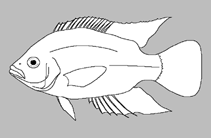
(males to 62 mm, females to 40 mm SL); laterally compressed; moderately high-backed and elongate; and pronounced sexual dimorphism and dichromatism. It differs from all known congeners by a combination of the following characters: massive jaws and hypertrophied yellow lips in adult males; dorsal fin with serrated membranes, truncated in females; small (but in females large) squarish lateral spot on center of vertical bar 3; large round, in females upright oval, caudal spot; caudal fin lyrate, in females rounded, with red marginal band to upper and lower lobes (Ref. 104987).
Body shape (shape guide): fusiform / normal.
Collected in a few small, shallow blackwater rainforest streams along both sides of the border between Ecuador and Peru. Observed usually hiding among the leaf litter, which (apart from scarce driftwood) is the main substrate covering the sandy bottom (Ref. 104987).
Life cycle and mating behavior
Geschlechtsreife | Fortpflanzung | Ablaichen | Eier | Fecundity | Larven
Römer, U., D.P. Soares, C.R.G. Dávila, F. Duponchelle, J.-F. Renno and I. Hahn, 2015. Re-description of Apistogramma payaminonis Kullander, 1986, with descriptions of two new cichlid species of the genus Apistogramma (Teleostei, Perciformes, Geopha-ginae) from northern Peru. Vert. Zool. 65(3):287-314. (Ref. 104987)
IUCN Rote Liste Status (Ref. 130435: Version 2025-1)
Bedrohung für Menschen
Harmless
Nutzung durch Menschen
Tools
Zusatzinformationen
Download XML
Internet Quellen
Estimates based on models
Phylogenetic diversity index (Ref.
82804): PD
50 = 0.5000 [Uniqueness, from 0.5 = low to 2.0 = high].
Bayesian length-weight: a=0.01820 (0.00845 - 0.03919), b=2.99 (2.82 - 3.16), in cm total length, based on LWR estimates for this Genus-body shape (Ref.
93245).
Trophic level (Ref.
69278): 3.3 ±0.4 se; based on size and trophs of closest relatives
Widerstandsfähigkeit (Ref.
120179): hoch, Verdopplung der Population dauert weniger als 15 Monate. (Preliminary K or Fecundity.).
Fishing Vulnerability (Ref.
59153): Low vulnerability (10 of 100).
🛈