>
Cypriniformes (Carps) >
Gobionidae (Gudgeons)
Etymology: Coreoleuciscus: Greek, kore, -es = pupil and also with themenaing of "maid" + Greek, leykos = white (Ref. 45335); aeruginos: The specific name 'aeruginos' from Latin refers to the bluish-green coloring, like verdigris.
Environment: milieu / climate zone / rango de profundidad / distribution range
Ecología
; agua dulce bentopelágico. Tropical
Asia: Seomjin and Nakdong rivers in South Korea.
Tamaño / Peso / Age
Madurez: Lm ? range ? - ? cm
Max length : 13.2 cm TL macho / no sexado; (Ref. 122737); peso máximo publicado: 20.15 g (Ref. 122737)
Short description
Claves de identificación | Morfología | Morfometría
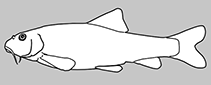
Radios blandos dorsales (total) : 10; Radios blandos anales: 9; Vértebra: 39 - 40. Coreoleuciscus aeruginos differs from C. splendidus by the following body coloration and shape and/or presence of black bands on dorsal, anal and caudal fin rays: bluish-green line above the luteous line (vs. golden line immediately above a luteous line that runs along a lateral line on side of body); a luteous line immediately above a black line present during the spawning season (vs. bright yellow line immediately above a violet and bluish line running along lateral line on side body during spawning season); dorsal fin with a thin and continuous band both distally and basally (vs. a thick and discontinuous distal band and a thick and continuous basal band); anal fin with thin and relatively short distal band and without basal band (vs. anal fin with quite thick and long distal dark band and short basal band); and caudal fin with with three stripes in centrosymmetric structure, a thick and continuously band distally across lobes, one pair of two thick bands separated into two lobes medially, and a thick and short one at the basal part (vs. seven bands in centrosymmetric structure, three pairs of six thin bands separated into two lobes at medial and distal-most areas and a thin basal band extending outwards (Ref. 100736).
Body shape (shape guide): elongated.
Usually occurs in rapids of streams (Ref. 100736).
Life cycle and mating behavior
Madurez | Reproducción | Puesta | Huevos | Fecundidad | Larva
Song, H.-Y. and I.-C. Bang, 2015. Coreoleuciscus aeruginos (Teleostei: Cypriniformes: Cyprinidae), a new species from the Seomjin and Nakdong rivers, Korea. Zootaxa 3931(1):140-150. (Ref. 100736)
IUCN Red List Status (Ref. 130435: Version 2025-1)
Threat to humans
Harmless
Human uses
Herramientas
Special reports
Download XML
Fuentes de Internet
Estimates based on models
Phylogenetic diversity index (Referencia
82804): PD
50 = 0.7500 [Uniqueness, from 0.5 = low to 2.0 = high].
Bayesian length-weight: a=0.00955 (0.00551 - 0.01656), b=3.21 (3.06 - 3.36), in cm total length, based on LWR estimates for this species & (Sub)family-body (Ref.
93245).
Nivel trófico (Referencia
69278): 3.2 ±0.4 se; based on size and trophs of closest relatives
Resiliencia (Referencia
120179): Medio, población duplicada en un tiempo mínimo de 1.4-4.4 años (Preliminary K or Fecundity.).
Fishing Vulnerability (Ref.
59153): Low vulnerability (10 of 100).
🛈