Élasmobranches (requins et raies) (sharks and rays) >
Myliobatiformes (Stingrays) >
Dasyatidae (Stingrays) > Urogymninae
Etymology: Brevitrygon: Name from Latin 'brevis' meaning short and 'trygṓn' meaning stingray, referring to the short, semi-rigid tails of these stingrays; heterura: Name from Greek 'héteros', meaning different and 'ourá' for tail, referring to the posterior half of tail which is considerably thicker in the middle as compared to B. walga; an adjective (Ref. 130662).
Environment: milieu / climate zone / profondeur / distribution range
Écologie
marin démersal; profondeur 25 - 50 m (Ref. 114953). Tropical
Indo-West Pacific (Indo-Malay Archipelago): Indonesia to Vietnam, including Thailand Malaysia, Singapore, Brunei, and possibly Cambodia.
Taille / Poids / Âge
Maturité: Lm ? range ? - ? cm
Max length : 20.6 cm WD mâle / non sexé; (Ref. 114953); 24.3 cm WD (female)
Description synthétique
Clés d'identification | Morphologie | Morphométrie
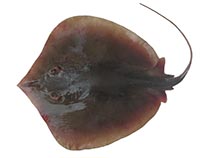
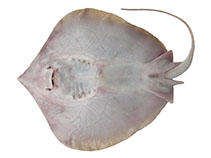
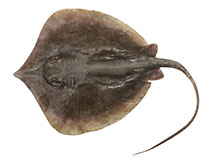
This species is distinguished by the following characters: a very small whipray, oval disc, pointed snout, adults with broad almost rectangular denticle band, no enlarged mid-shoulder denticles, tail short (with bulbous tip in adult females) with median row of enlarged spear�shaped thorns, skin folds on tail absent, and dorsal surface plain coloured; disc slightly longer than wide, length ca. 1–1.1 times DW, pectoral-fin apex is broadly rounded; snout rather long, broad, with apical lobe narrowly rounded, anterior margins moderately concave; eyes small, protruding slightly, orbit length and spiracle ca. 2.9–3.1 in snout length, the interorbital space rather broad, 1.2–2.1 times orbit length; mouth is moderately arched, 2-3 well-developed oral papillae (well separated),
lower jaw arched with central concavity; nasal curtain is skirt�shaped, broad, posterior margin finely fringed; mid-shoulder denticle is weak, the denticle band expanded over abdomen in
adults, converging forward of orbits and tail, and constricted beside spiracles, skin is smooth outside denticle band; thorns in median row on tail 4-6 and enlarged with convex crowns; tail
short to moderately elongate, its length 1–1.7 times DW, depressed, stout at base but filamentous beyond caudal sting in young and adult males while bulbous with short filamentous tip in large females, with 1 or 2 caudal stings (Ref. 114953).
Cross section: flattened.
Life cycle and mating behavior
Maturité | Reproduction | Frai | Œufs | Fécondité | Larves
Last, P.R., S. Weigmann and G.J.P. Naylor, 2023. The Indo-Pacific stingray genus Brevitrygon (Myliobatiformes: Dasyatidae): clarification of historical names and description of a new species, B. manjajiae sp. nov., from the western Indian Ocean. Diversity 15: 1-75. (Ref. 130662)
Statut dans la liste rouge de l'IUCN (Ref. 130435: Version 2025-1)
Menace pour l'homme
Harmless
Utilisations par l'homme
Outils
Articles particuliers
Télécharger en XML
Sources Internet
Estimates based on models
Phylogenetic diversity index (Réf.
82804): PD
50 = 0.5312 [Uniqueness, from 0.5 = low to 2.0 = high].
Bayesian length-weight: a=0.01023 (0.00486 - 0.02155), b=3.06 (2.87 - 3.25), in cm total length, based on LWR estimates for this (Sub)family-body shape (Ref.
93245).
Niveau trophique (Réf.
69278): 3.5 ±0.5 se; based on size and trophs of closest relatives
Fishing Vulnerability (Ref.
59153): Very high vulnerability (90 of 100).
🛈