>
Perciformes/Uranoscopoidei (Sand dwellers) >
Pinguipedidae (Sandperches)
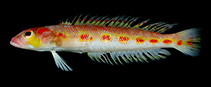
Etymology: Parapercis: Greek, para = the side of + Greek, perke = perch (Ref. 45335); soliorta: Name from Latin 'solis ortus' for sunrise; referring to the brilliant yellow-edged red spots along the sides of the body.
Environment: milieu / climate zone / rango de profundidad / distribution range
Ecología
marino asociado a arrecife. Tropical
Distribución
Países | Áreas FAO | Ecosistemas | Ocurrencias, apariciones | Mapa de puntos | Introducciones | Faunafri
Western Pacific: Philippines.
Tamaño / Peso / Age
Madurez: Lm ? range ? - ? cm
Max length : 11.3 cm SL macho / no sexado; (Ref. 116166)
Short description
Claves de identificación | Morfología | Morfometría
Espinas dorsales (total) : 5; Radios blandos dorsales (total) : 21; Espinas anales: 1; Radios blandos anales: 17; Vértebra: 30. This species is distinguished by the following characters: D V,21; A I,17; pectoral fin rays 17; lateral line scales 55; gill rakers 7+11=18; predorsal scales 10; cycloid scales on cheek; canine teeth 6 in outer row at front of lower jaw; vomer with 2 rows of teeth, robust and conical, with anterior row much enlarged; palatines without teeth; margin of preopercle and subopercle smooth except the angle; vertebrae with 10 abdominal and 20 caudal; pelvic fins barely
reaching the vent; colouration with a series of 9 large oval-shaped and yellow-ringed red spots that are midlateral on body and caudal fin (Ref. 116166).
Body shape (shape guide): elongated; Cross section: oval.
No available data re habitat or depth of capture, it is likely to be relatively rare and occupy at least moderately deep habitats (Ref. 116166).
Life cycle and mating behavior
Madurez | Reproducción | Puesta | Huevos | Fecundidad | Larva
Johnson, J.W. and H. Motomura, 2017. Five new species of Parapercis (Perciformes: Pinguipedidae) from southeast Asia and northwest Australia. Zootaxa 4320:121-145. (Ref. 116166)
IUCN Red List Status (Ref. 130435: Version 2025-1)
Threat to humans
Harmless
Human uses
Herramientas
Special reports
Download XML
Fuentes de Internet
Estimates based on models
Phylogenetic diversity index (Referencia
82804): PD
50 = 0.5000 [Uniqueness, from 0.5 = low to 2.0 = high].
Bayesian length-weight: a=0.00692 (0.00314 - 0.01524), b=3.06 (2.88 - 3.24), in cm total length, based on LWR estimates for this Genus-body shape (Ref.
93245).
Nivel trófico (Referencia
69278): 3.5 ±0.4 se; based on size and trophs of closest relatives
Resiliencia (Referencia
120179): Alto, población duplicada en un tiempo mínimo inferior a 15 meses (Preliminary K or Fecundity.).
Fishing Vulnerability (Ref.
59153): Low vulnerability (10 of 100).
🛈