This website uses cookies to enhance your browsing experience and ensure the functionality of our site. For more detailed information about the types of cookies we use and how we protect your privacy, please visit our Privacy Information page..
×
Cookie Settings
This website uses different types of cookies to enhance your experience. Please select your preferences below:
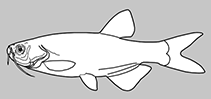
No image available for this species; drawing shows typical species in Danionidae.
分類 / Names 共通名の | 類義語 | Catalog of Fishes(部類, 種) | ITIS | CoL | WoRMS | Cloffa
> Cypriniformes (Carps) > Danionidae (Danios) > Chedrinae
Etymology: Engraulicypris:Greek, eggraulis, -eos = anchovy + Greek, kypris = the name of Aphrodite, proceeding from Kypris, (Cyprus), Greek, kyprinos = carp (Ref. 45335); ngalala:In the Cyao language spoken in the Niassa region of northern Mozambique, the name 'ngalala' denotes any, small, compressed, silvery fish, including Mesobola and species of Brycinus and Hemigrammopetersius; the epithet is treated as a nominative singular noun in apposition (Ref. 116496).
Environment: milieu / climate zone / 深さの範囲 / distribution range 生態学
背面の脊椎 (合計) : 0; 背鰭 (合計) : 9 - 10; 肛門の骨: 0; 臀鰭: 16 - 19; 脊つい: 38 - 39. Diagnosis: Operculum shiny only on ventral posterior edge and small area at posterior edge of orbit, not entire area; body midline black, not silver; head with tubercles along lower jaw and lower head in breeding males; snout rounded, not pointed; iris white to light grey, not dark grey, with a few melanophores; pelvic fin melanophores present, dark and widely dispersed (Ref. 116496).
Body shape (shape guide): fusiform / normal.
This species is found in ecological conditions very similar to those characteristic of Engraulicypris gariepinus; it favours big rivers, gathering in slack, turbid and shallow regions with sandy, rocky or muddy substrates; in Lake Chiuta specimens were caught in reed beds along the margins (Ref. 116496).
Life cycle and mating behavior 成熟 | 繁殖 | 放精 | 卵 | 生産力 | 幼生
Phylogenetic diversity index (参照 82804): PD50 = 0.5039 [Uniqueness, from 0.5 = low to 2.0 = high].
Bayesian length-weight: a=0.01000 (0.00244 - 0.04107), b=3.04 (2.81 - 3.27), in cm total length, based on all LWR estimates for this body shape (Ref. 93245).
栄養段階 (参照 69278): 3.0 ±0.3 se; based on size and trophs of closest relatives
回復力 (参照 120179): 高い, 15か月以下の倍増期間の最小個体群 (Preliminary K or Fecundity.).
Fishing Vulnerability (Ref. 59153): Low vulnerability (10 of 100). 🛈