Classification / Names
Κοινά ονόματα | Συνώνυμα | Catalog of Fishes(Γένος, Είδη) | ITIS | CoL | WoRMS | Cloffa
>
Cypriniformes (Carps) >
Nemacheilidae (Brook loaches)
Etymology: Schistura: Greek, schizein = to divide + Greek, oura = tail; an allusion to forked caudal fins (Ref. 45335); wanlainensis: Named after Wan Lain Dam village where the fish were collected, and whose inhabitants have established a fish conservation zone. An adjective.
Environment: milieu / climate zone / εύρος βάθους / distribution range
Οικολογία
; Γλυκού νερού βενθικό(ς). Tropical
Asia: Mon Lan Chaung, a tributary of Mali Hka, in Myanmar.
Μέγεθος / Βάρος / Age
Γεννητική Ωρίμανση: Lm ? range ? - ? cm
Max length : 9.2 cm SL αρσενικό/απροσδιόριστο; (Ref. 116725)
Short description
Κλείδες προσδιορισμού | Μορφολογία | Μορφομετρία
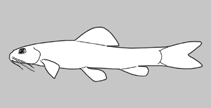
Μαλακές ραχιαίες ακτίνες (συνολικά) : 12; Μαλακές εδρικές ακτίνες: 8. Schistura wanlainensis is distinguished from all its congeners in Southeast Asia by its unique color pattern consisting of a pale yellowish to pale grey background with 18-32 narrow, regularly shaped black bars, extending from dorsal midline and reaching downwards to below level of pectoral fin, continuous over back with contralaterals in most specimens, wider than interspaces
anteriorly, narrower than interspaces on caudal peduncle; some of anterior bars fused at their dorsal extremity. Other useful but non-unique diagnostic characters include the following: base of caudal fin with black pattern made of a vertically elongated blotch at middle of base, and a
smaller blotch at its dorsal and ventral extremities (blotches contiguous in one specimen); dorsal fin with 8½ branched rays; caudal fin forked; caudal peduncle depth 1.2-1.5 times in its length; very low dorsal and ventral crests on caudal peduncle; lips thick, fleshy; upper lip with median notch; lower lip with narrow median interruption, with numerous furrows; processus dentiformis present, feebly marked, very wide (more than half of mouth gape); and a suborbital slit present in females (males unknown but expected to have a suborbital flap) (Ref. 116725).
Body shape (shape guide): elongated.
Inhabits Mon Lan Chaung, a large river with approximately 50 m width and very fast water flowing over a stone and boulders bottom. Syntopic with Garra cf. dulongensis, Garra sp., Neolissochilus compressus, Oreinus meridionalis, Semiplotus cirrhosus (Cyprinidae), Acanthocobitis sp., Schistura malaisei (Nemacheilidae), Amblyceps murraystuarti (Amblycipitidae), Glyptothorax sp., Oreoglanis sp. (Sisoridae) and Mastacembelus armatus (Mastacembelidae) (Ref. 116725).
Life cycle and mating behavior
Γεννητική Ωρίμανση | Αναπαραγωγή | Γεννοβολία | Αβγά | Γονιμότητα | Προνύμφες
Kottelat, M., 2017. A new genus and three new species of nemacheilid loaches from northern Irrawaddy drainage, Myanmar (Teleostei: Cypriniformes). Raffles Bull. Zool. 65:80-99. (Ref. 116725)
IUCN Red List Status (Ref. 130435: Version 2025-1)
Threat to humans
Harmless
Human uses
Εργαλεία
Special reports
Download XML
Διαδικτυακές πηγές
Estimates based on models
Phylogenetic diversity index (Αναφ.
82804): PD
50 = 0.5000 [Uniqueness, from 0.5 = low to 2.0 = high].
Bayesian length-weight: a=0.00692 (0.00310 - 0.01545), b=3.02 (2.85 - 3.19), in cm total length, based on LWR estimates for this Genus-body shape (Ref.
93245).
Τροφικό Επίπεδο (Αναφ.
69278): 3.0 ±0.3 se; based on size and trophs of closest relatives
Ελαστικότητα (Αναφ.
120179): Μεσαίο(α), ελάχιστος χρόνος για διπλασιασμό πληθυσμού 1,4 - 4,4 έτη (Preliminary K or Fecundity.).
Fishing Vulnerability (Ref.
59153): Low vulnerability (10 of 100).
🛈