This website uses cookies to enhance your browsing experience and ensure the functionality of our site. For more detailed information about the types of cookies we use and how we protect your privacy, please visit our Privacy Information page.
×
Cookie Settings
This website uses different types of cookies to enhance your experience. Please select your preferences below:
> Acropomatiformes (Oceanic basses) > Pempheridae (Sweepers)
Etymology: Pempheris:Greek, pempheris = the name of a fish (Ref. 45335); eatoni:Named for Patrick Eaton who collected the holotype and five other adult specimens for this study. Eponymy: Patrick Eaton, about whom we have failed to find more information than is contained in the original text. [...] (Ref. 128868), visit book page.
Meio ambiente: milieu / Zona climática / intervalo de profundidade / faixa de distribuição Ecologia
marinhas associadas(os) a recifes; intervalo de profundidade 1 - 15 m (Ref. 97766). Tropical
Western Indian Ocean: South Africa and Mozambique.
Tamanho / Peso / Idade
Maturidade: Lm? range ? - ? cm Max length : 14.0 cm SL macho/indeterminado; (Ref. 97766)
Descrição suscinta Chaves de identificação | Morfologia | Morfometria
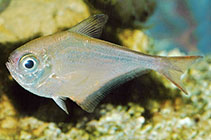
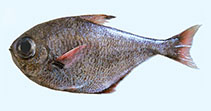
Espinhos dorsais (total) : 6; Raios dorsais (total) : 9 - 10; Espinhos anais: 3; Raios anais : 38 - 44; Vértebras: 25. This species is distinguished by the following characters: D VI,9-10 (usually 9); A III,38-44; pectoral rays 17-19; lateral-line scales 53-60; chest entirely with ctenoid scales; caudal fin scaled on about basal fourth; gill rakers 28-33; body depth 2.2-2.35 in SL; head length 3.3-3.4 in SL; orbit diameter 7.15-7.7 in SL; longest dorsal ray 3.7-4.05 in SL; pectoral-fin length 3.3-3.55 in SL; colour in alcohol gray-brown, scale edges narrowly gray, the dorsal fin brownish gray with an apical black spot, the color of anal fin like body basally, with a broad blackish middle zone, the margin narrowly whitish, the caudal fin is yellowish gray, paired fins are pale yellowish, the pectorals with a dark brown band across base, the iris is grayish blue (Ref. 97766). Body shape (shape guide): short and / or deep; Cross section: compressed.
Occurs in exposed rocky shores and often in small groups that shelter in caves or beneath ledges by day from depths as little as 1-2 m to at least 15 m. It has been observed to venture out of shelter at night to feed on planktonic invertebrates and larval fishes. It was also reported to have an extensive spawning season, judging from seeing shoals of juveniles through
most of the year. The gonads of adults were noted to be nearly always mature regardless of the time of year. It was also observed to swim slowly, when not stressed, propelling itself mainly by characteristic ‘sweeps’ of the pectoral fins (hence the common name sweeper). Smallest fully mature female specimen, 11.6 cm SL (Ref. 97766).
Ciclo de vida ou comportamento de acasalamento Maturidade | Reprodução | Desova | Ovos | Fecundidade | Larvas
Randall, J.E. and B.C. Victor, 2014. Four new fishes of the genus Pempheris (Perciformes: Pempheridae) from the western Indian Ocean. J. Ocean Sci. Found. 12:61-83. (Ref. 97766)
Status na Lista Vermelha da UICN (Ref. 130435: Version 2025-2 (Global))
Ecologia Trófica Itens alimentares (presas) Composição da dieta Consumo alimentar Rações alimentares Predadores
Ecologia Ecologia
Dinâmica populacional Parâmetros de crescimento Idade máxima / tamanhos Relação comprimento-peso. Relação comprimento-comprimento. Frequências de comprimento Conversão de massa Recrutamento Abundância
Ciclo de vida Reprodução Maturidade Maturidade/Rel. das guelras Fecundidade Desova Agregações de desova Ovos Desenvolvimento dos ovos Larvas Dinâmica larval
Fisiologia Composição corporal Nutrientes Consumo de oxigênio Tipo de natação Velocidade de natação Pigmentos visuais Som de peixe Doenças e Parasitas Toxicidade (LC50s)
Índice de diversidade filogenética (Ref. 82804): PD50 = 0.5000 [Uniqueness, from 0.5 = low to 2.0 = high].
Bayesian length-weight: a=0.01380 (0.00586 - 0.03254), b=3.01 (2.82 - 3.20), in cm total length, based on LWR estimates for this Genus-body shape (Ref. 93245).
Nível Trófico (Ref. 69278): 3.5 ±0.5 se; based on size and trophs of closest relatives
Resiliência (Ref. 120179): Elevada, tempo mínimo de duplicação da população menor que 15 meses (Preliminary K or Fecundity.).
Vulnerabilidade da pesca (Ref. 59153): Low vulnerability (10 of 100). 🛈