>
Gymnotiformes (Knifefishes) >
Hypopomidae (Bluntnose knifefishes)
Etymology: Brachyhypopomus: Greek, brachys, eia = short + Greek, hypo = under + Greek, poma, -atos = cover (Ref. 45335); hendersoni: Named for Peter A. Henderson, British fish biologist, and doctoral co-advisor of WGRC, for his
contributions to Amazonian aquatic ecology.
Eponymy: Dr Peter Alan Henderson (d: 1954) is a British fish biologist. [...] (Ref. 128868), visit book page.
Environment: milieu / climate zone / rango de profundidad / distribution range
Ecología
; agua dulce bentopelágico; pH range: 5.3 - 6.7. Tropical; 29°C - 33°C (Ref. 116763)
South America: central Amazon and lower Negro in Brazil; and Essequibo drainage in Guyana.
Tamaño / Peso / Age
Madurez: Lm ? range ? - ? cm
Max length : 19.5 cm TL macho / no sexado; (Ref. 116763); 20.3 cm TL (female)
Short description
Claves de identificación | Morfología | Morfometría
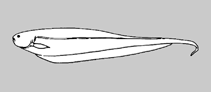
Radios blandos anales: 192 - 210. Brachyhypopomus hendersoni is distinguished from other species of the genus Brachyhypopomus by the following combination of characters: caudal filament length 32.3-64.5% length to end of anal fin (vs. 7.4-31.6% in B. alberti, B. arrayae, B. batesi, B. belindae, B. benjamini, B. bennetti, B. bombilla, B. hamiltoni, B. occidentalis, B. palenque, B. provenzanoi, B. regani, B. sullivani, and B. verdii); 15-17 precaudal vertebrae (vs. 18-25 in B. beebei, B. brevirostris, B. draco, B. flavipomus, B. gauderio, B. janeiroensis, B. jureiae, and B. pinnicaudatus); head width at occiput 39.2-47.8% HL (vs. 49.5-70.4% in B. bullocki, B. diazi, and B. menezesi); and dorsal rami of the recurrent branch of the anterior lateral line nerve not visible (vs. visible in B. cunia and B. walteri) (Ref. 116763).
Body shape (shape guide): elongated.
Facultative air-breathing in the genus (Ref. 126274); In the type locality region, this species occurs usually in marginal emergent plants (mainly wild rice, Oryza spp.), rafts of floating macrophytes (including grasses, e.g., Paspalum, and water hyacinths, Eichhornia spp.), and decaying plant matter along the edges of low-conductivity blackwater floodplain ria lakes (e.g., lago Tefé, lago Amanã, and lago Caiambé), and along river and oxbow lake margins. Feeds on aquatic insect larvae (primarily Chironomidae), and other
small aquatic invertebrates in the type locality. Spawns in floating macrophytes during the rising and high water period (Ref. 116763).
Life cycle and mating behavior
Madurez | Reproducción | Puesta | Huevos | Fecundidad | Larva
Crampton, W.G.R., C.D. de Santana, J.C. Waddell and N.R. Lovejoy, 2017. A taxonomic revision of the Neotropical electric fish genus Brachyhypopomus (Ostariophysi: Gymnotiformes: Hypopomidae), with descriptions of 15 new species. Neotrop. ichthyol. 14(4):e150146. (Ref. 116763)
IUCN Red List Status (Ref. 130435: Version 2025-1)
Threat to humans
Harmless
Human uses
Pesquerías: sin interés
Herramientas
Special reports
Download XML
Fuentes de Internet
Estimates based on models
Phylogenetic diversity index (Referencia
82804): PD
50 = 0.5000 [Uniqueness, from 0.5 = low to 2.0 = high].
Bayesian length-weight: a=0.00372 (0.00139 - 0.00994), b=3.06 (2.83 - 3.29), in cm total length, based on LWR estimates for this (Sub)family-body shape (Ref.
93245).
Nivel trófico (Referencia
69278): 3.2 ±0.4 se; based on size and trophs of closest relatives
Fishing Vulnerability (Ref.
59153): Low vulnerability (10 of 100).
🛈