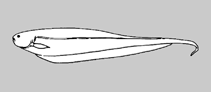
Classification / Names
Noms communs | Synonymes | Catalog of Fishes(Genre, Espèce) | ITIS | CoL | WoRMS | Cloffa
>
Gymnotiformes (Knifefishes) >
Hypopomidae (Bluntnose knifefishes)
Etymology: Brachyhypopomus: Greek, brachys, eia = short + Greek, hypo = under + Greek, poma, -atos = cover (Ref. 45335); sullivani: Named for John P. Sullivan, American (USA) ichthyologist, for his contributions to gymnotiform biology. A noun in the genitive case.
Eponymy: Dr John P Sullivan (d: 1965) is an ichthyologist who is (2013–present) a Curatorial Affiliate at Cornell University, Museum of Vertebrates Ithaca, NY, USA where he had previously been a visiting fellow (2009–2013). [...] (Ref. 128868), visit book page.
Environment: milieu / climate zone / profondeur / distribution range
Écologie
; eau douce benthopélagique. Tropical
South America: Bolivia, Brazil, Colombia, Ecuador, Guyana, Peru, and Venezuela.
Taille / Poids / Âge
Maturité: Lm ? range ? - ? cm
Max length : 15.2 cm TL mâle / non sexé; (Ref. 116763); 12.7 cm TL (female)
Facultative air-breathing in the genus (Ref. 126274); Occurs only in gently flowing, normoxic, low-conductivity streams and small rivers in closed canopy rainforest and savanna, where it is typically encountered in or near aquatic vegetation, root mass, or leaf litter. Feeds on aquatic insect larvae (primarily Chironomidae), and other small aquatic invertebrates in the type locality, stream near Jenaro Herrera, río Ucayali, Amazonas drainage. Spawns during the rainy season, approximately December-April, both in the type locality and in the vicinity of Tefé, Brazil (Ref. 116763).
Life cycle and mating behavior
Maturité | Reproduction | Frai | Œufs | Fécondité | Larves
Crampton, W.G.R., C.D. de Santana, J.C. Waddell and N.R. Lovejoy, 2017. A taxonomic revision of the Neotropical electric fish genus Brachyhypopomus (Ostariophysi: Gymnotiformes: Hypopomidae), with descriptions of 15 new species. Neotrop. ichthyol. 14(4):e150146. (Ref. 116763)
Statut dans la liste rouge de l'IUCN (Ref. 130435: Version 2025-1)
Menace pour l'homme
Harmless
Utilisations par l'homme
Pêcheries: sans intérêt
Outils
Articles particuliers
Télécharger en XML
Sources Internet
Estimates based on models
Phylogenetic diversity index (Réf.
82804): PD
50 = 0.5000 [Uniqueness, from 0.5 = low to 2.0 = high].
Bayesian length-weight: a=0.00372 (0.00139 - 0.00994), b=3.06 (2.83 - 3.29), in cm total length, based on LWR estimates for this (Sub)family-body shape (Ref.
93245).
Niveau trophique (Réf.
69278): 3.1 ±0.4 se; based on size and trophs of closest relatives
Fishing Vulnerability (Ref.
59153): Low vulnerability (10 of 100).
🛈