



Rhinobatos manai White, Last & Naylor, 2016
Papuan guitarfish
Masukkan pemerhatian anda di Fish Watcher
| Native range | All suitable habitat | Point map | Year 2050 |

|
| This map was computer-generated and has not yet been reviewed. |
| Rhinobatos manai AquaMaps Data sources: GBIF OBIS |
muatnaik fotos/gambar dan video
imej Google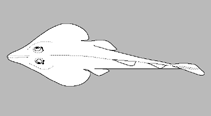 No image available for this species;
drawing shows typical species in Rhinobatidae.
imej Google
drawing shows typical species in Rhinobatidae.
klasifikasi / Nama Nama-nama umum | Sinonim (persamaan) | Catalog of Fishes(Marga, Jenis) | ITIS | CoL | WoRMS | Cloffa
Ikan bertulang rawan (sharks and rays) > Rhinopristiformes (Shovelnose rays) > Rhinobatidae (Guitarfishes)
Etymology: Rhinobatos: Greek, rhinos = nose + Greek, batis, -idos = a ray (Raja sp.) (Ref. 45335); manai: Named for Dr. Ralph Mana of the University of Papua New Guinea.
Eponymy: Dr Ralph Reeves Mana is Associate Professor in the Department of Biological Sciences at the University of Papua New Guinea. [...] (Ref. 128868), visit book page.
Etymology: Rhinobatos: Greek, rhinos = nose + Greek, batis, -idos = a ray (Raja sp.) (Ref. 45335); manai: Named for Dr. Ralph Mana of the University of Papua New Guinea.
Eponymy: Dr Ralph Reeves Mana is Associate Professor in the Department of Biological Sciences at the University of Papua New Guinea. [...] (Ref. 128868), visit book page.
Lingkungan: lingkungan / zona iklim / kisaran kedalaman / jangkauan distribusi Ekologi
laut pelagic-neritic; kisaran kedalaman 191 - 290 m (Ref. 117108). Tropical
Penyebaran Wilayah | Daerah-daerah FAO | Ekosistem | Kemunculan | peta titik | Introduksi | Faunafri
Southwest Pacific: Papua New Guinea.
Ukuran / Berat / umur
deskripsi pendek Kunci identifiaksi (pengenalan) | Morfologi | Morfometrik
This species is distinguished by the following set of characters: a wedge-shaped disc, with its
dorsal surface covered in minute dermal denticles but without thorns; long snout, its length 3.6 times interspiracular distance; moderately large orbit, its diameter 1.7 times spiracle length; oblique nostrils, its length 1.6 times internarial distance; the anterior nasal flaps are inserted into internarial space well away from nostril margin; posterior nasal flaps are broad; ridges of rostral cartilage well-separated dorsally and almost parallel; narrow prebranchial sensory-pore patch, extending to first gill slit; distance between first gill slits is 1.5 times distance between fifth gill slits; distance between fifth gill slits is 3.4 times in ventral head length; long postscapular sensory canal, not grooved and extending more than three-quarters distance to pectoral-fin insertions; moderately tall dorsal fins; pelvic fin's inner margin is shorter than its base; interdorsal distance is more than 3.1 times first dorsal-fin base; outer spiracular fold is distinctly larger than the inner fold; dorsal margin of caudal fin ca. 2 times preventral margin; post-synarcual (free) vertebral centra 171; total vertebral centra 180; nasal lamellae 52; dorsal disc is brownish and covered with well defined rusty brown spots and blotches and poorly defined white spots with greyish edges (Ref. 117108).
Body shape (shape guide): other (see remarks); Cross section: flattened.
Body shape (shape guide): other (see remarks); Cross section: flattened.
Siklus hidup dan perilaku kawin Kematangan | Reproduksi, perkembang biakan | Pemijahan | telur-telur | Fekunditas | Larva
rujukan utama
Unggah referensi Anda | Acuan | Koordinator : McEachran, John | mitra
White, W.T., P.R. Last and G.J.P. Naylor, 2016. Rhinobatos manai sp. nov., a new species of guitarfish (Rhinopristiformes: Rhinobatidae) from New Ireland, Papua New Guinea. Zootaxa 4175(6):588-600. (Ref. 117108)
Status IUCN Red List (Ref. 130435: Version 2025-2 (Global))
kurang bimbang (LC) ; Date assessed: 12 May 2020
ancaman kepada manusia
Harmless
penggunaan manusia
FAO - Publication: search | FishSource |
informasi lanjut
Ekologi trofik
Item makanan (mangsa)
Komposisi makanan
Konsumsi makanan
Ransum makanan
Pemangsa
Item makanan (mangsa)
Komposisi makanan
Konsumsi makanan
Ransum makanan
Pemangsa
Ekologi
Ekologi
Ekologi
Dinamika populasi
Parameter pertumbuhan
Maks. usia / ukuran
Panjang-berat rel.
Panjang-panjang rel.
ukuran frekuensi
Konversi massa
pemulihan
Kelimpahan
Parameter pertumbuhan
Maks. usia / ukuran
Panjang-berat rel.
Panjang-panjang rel.
ukuran frekuensi
Konversi massa
pemulihan
Kelimpahan
Siklus hidup
Reproduksi, perkembang biakan
Kematangan
Kedewasaan / insang rel.
Fekunditas
Pemijahan
Agregasi pemijahan
telur-telur
pekembangan telor
Larva
Dinamika larva
Reproduksi, perkembang biakan
Kematangan
Kedewasaan / insang rel.
Fekunditas
Pemijahan
Agregasi pemijahan
telur-telur
pekembangan telor
Larva
Dinamika larva
Anatomi
Area insang
Otak
Otolith
Area insang
Otak
Otolith
Fisiologi
Komposisi tubuh
Nutrisi
Konsumsi oksigen
Jenis renang
Kecepatan berenang
Pigmen visual
Suara ikan
Penyakit & Parasit
Toksisitas (LC50)
Komposisi tubuh
Nutrisi
Konsumsi oksigen
Jenis renang
Kecepatan berenang
Pigmen visual
Suara ikan
Penyakit & Parasit
Toksisitas (LC50)
Genetika
genom
Genetika
Heterozigositas
Diturunkan
Keanekaragaman Genetik
genom
Genetika
Heterozigositas
Diturunkan
Keanekaragaman Genetik
Yang berhubungan dengan manusia
Sistem akuakultur
profil budidaya air
Strain
Kasus Ciguatera
Perangko, koin, dll.
Sistem akuakultur
profil budidaya air
Strain
Kasus Ciguatera
Perangko, koin, dll.
Alat, peralatan
E-book | Penuntun lapangan | tanda freqkuenci panjang | peringkat sejarah hidup | peta titik |
Tangkap-MSY |
laporan khas
muat turun XML
Sumber internet
AFORO (otoliths) | Aquatic Commons | BHL | Cloffa | Websites from users | semak peneliti ikan | CISTI | Catalog of Fishes: Marga, Jenis | DiscoverLife | ECOTOX | FAO - Publication: search | Faunafri | Fishipedia | Fishtrace | GloBI | Google Books | Google Scholar | Google | IGFA World Record | OneZoom | Open Tree of Life | Otolith Atlas of Taiwan Fishes | PubMed | Reef Life Survey | Socotra Atlas | TreeBase | Tree of Life | Wikipedia: pergi, Cari | World Records Freshwater Fishing | Zoobank | Catatan Zoologi
Estimasi berdasarkan model
Indeks keanekaragaman filogenetik (Acuan 82804): PD50 = 0.5000 [Uniqueness, from 0.5 = low to 2.0 = high].
Bayesian length-weight: a=0.01000 (0.00244 - 0.04107), b=3.04 (2.81 - 3.27), in cm total length, based on all LWR estimates for this body shape (Ref. 93245).
Tingkat Trofik (Acuan 69278): 3.7 ±0.4 se; based on size and trophs of closest relatives
Daya lenting (Acuan 120179): Rendah, Waktu penggandaan populasi minimum 4.5 - 14 tahun (Preliminary low fecundity).