



Cirrhilabrus greeni Allen & Hammer, 2017
Sunset fairy-wrasse
Envoyez vos Photos et vidéos
Images Google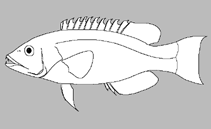 No image available for this species;
drawing shows typical species in Labridae.
Images Google
drawing shows typical species in Labridae.
Classification / Noms Noms communs | Synonymes | Catalog of Fishes(Genre, Espèce) | ITIS | CoL | WoRMS | Cloffa
> Eupercaria/misc (Various families in series Eupercaria) > Labridae (Wrasses) > Cirrhilabrinae
Etymology: Cirrhilabrus: Latin, cirrus = curl fringe + Greek, labros = furious (Ref. 45335); greeni: Named in honor of Tim Green of Monsoon Aquatics (Darwin, Australia).
Eponymy: Tim Green of Monsoon Aquatics, Darwin, Australia, collected the type specimens. He collects fish and corals for the aquarium trade. (Ref. 128868), visit book page.
Etymology: Cirrhilabrus: Latin, cirrus = curl fringe + Greek, labros = furious (Ref. 45335); greeni: Named in honor of Tim Green of Monsoon Aquatics (Darwin, Australia).
Eponymy: Tim Green of Monsoon Aquatics, Darwin, Australia, collected the type specimens. He collects fish and corals for the aquarium trade. (Ref. 128868), visit book page.
Environnement : milieu / zone climatique / profondeur / gamme de distribution Écologie
marin récifal; profondeur 18 - 40 m (Ref. 118280). Tropical
Distribution Territoires | Zones FAO | Écosystèmes | Occurrences | Carte par point | Introductions | Faunafri
Western Indian Ocean: Darwin, Northern Territory, Australia.
Taille / Poids / Âge
Maturité: Lm ? range ? - ? cm
Max length : 4.7 cm SL mâle / non sexé; (Ref. 118280); 4.0 cm SL (female)
Max length : 4.7 cm SL mâle / non sexé; (Ref. 118280); 4.0 cm SL (female)
Description synthétique Clés d'identification | Morphologie | Morphométrie
Épines dorsales (Total) : 11; Rayons mous dorsaux (Total) : 9; Épines anales: 3; Rayons mous anaux: 9; Vertèbres: 24 - 25. The species is distinguished by the following characters: D XI,9; A III,9; pectoral-fin rays 15; lateral-line scales 16-17 + 6-7; median predorsal scales 5; single horizontal scale rows on cheek below eye; gill rakers 13; body depth 3.6-3.7 in SL; head length 2.9-3.0 in SL; snout length 3.5-4.3 in HL; dorsal fin mostly uniform height; pelvic fins of TP male moderately elongate, reaching posteriorly to about base of first soft anal-fin ray, 2.7-3.9 in SL; caudal fin distinctly emarginate, appearing lunate in males due to tapering red bands along dorsal and ventral margins. TP male in life mainly reddish on upper half of body and bright yellow below; dorsal fin mainly yellow orange, grading to reddish basally with dark-edged white or clear bands on basal half of soft rays; anal fin scarlet red; caudal fin translucent medially with tapering red bands along dorsal and ventral margins; pelvic fins pinkish; pectoral fins translucent with brilliant red triangular mark immediately above base; female in life rosy pink on upper two-thirds of head and body, grading to whitish ventrally; body with 4-5 narrow reddish stripes on upper half; dorsal fin pinkish yellow with faint red bands and dark brown first spine; anal fin pink with faint red bands; caudal fin with numerous transverse rows of faint red spots, except darker red along edge of lower lobe; black spot, about one-third to half pupil size, on upper side of caudal peduncle (Ref. 118280).
Body shape (shape guide): elongated; Cross section: compressed.
Body shape (shape guide): elongated; Cross section: compressed.
Inhabits sloping rubble bottoms with scattered low outcrops of rock or coral and occasional large coral outcrops. Associated with its congeners, including Cirrhilabrus hygroxerus and four species of undetermined status that are related to C. cyanopleura (Bleeker, 1851); C. exquisitus Smith, 1957; C. punctatusC. temminckii Bleeker, 1853 (Ref. 118280).
Cycle de vie et comportement reproducteur Maturité | Reproduction | Frai | Œufs | Fécondité | Larves
Référence principale
Téléchargez vos références | Références | Coordinateur : Westneat, Mark | Collaborateurs
Allen, G.R. and M.P. Hammer, 2017. Cirrhilabrus greeni, a new species of wrasse (Pisces: Labridae) from the Timor Sea, northern Australia. J. Ocean Sci. Found. 29:55-65. (Ref. 118280)
CITES
Not Evaluated
Menace pour l'homme
Harmless
Utilisations par l'homme
FAO - Publication: search | FishSource |
Plus d'informations
Écologie trophique
Aliments (proies)
Composition du régime alimentaire
Consommation alimentaire
Rations alimentaires
Prédateurs
Aliments (proies)
Composition du régime alimentaire
Consommation alimentaire
Rations alimentaires
Prédateurs
Écologie
Écologie
Écologie
Dynamique des populations
Paramètres de croissance
Âges / tailles maximales
Longueur-poids rel.
Rel. longueur-longueur.
Fréquences de longueurs
Conversion de masse
Recrutement
Abondance
Paramètres de croissance
Âges / tailles maximales
Longueur-poids rel.
Rel. longueur-longueur.
Fréquences de longueurs
Conversion de masse
Recrutement
Abondance
Cycle de vie
Reproduction
Maturité
Maturité/épines rel.
Fécondité
Frai
Agrégats de frai
Œufs
Développement de l'œuf
Larves
Dynamique des populations larvaires
Reproduction
Maturité
Maturité/épines rel.
Fécondité
Frai
Agrégats de frai
Œufs
Développement de l'œuf
Larves
Dynamique des populations larvaires
Anatomie
Surface branchiale
Cerveau
Otolithe
Surface branchiale
Cerveau
Otolithe
Physiologie
Composition corporelle
Nutriments
Consommation d'oxygène
Type de natation
Vitesse de nage
Pigments visuels
Son de poisson
Maladies et parasites
Toxicité (CL50)
Composition corporelle
Nutriments
Consommation d'oxygène
Type de natation
Vitesse de nage
Pigments visuels
Son de poisson
Maladies et parasites
Toxicité (CL50)
Génétique
génôme
Génétique
Hétérozygotie
Héritabilité
Diversité génétique
génôme
Génétique
Hétérozygotie
Héritabilité
Diversité génétique
Liées à l'homme
Systèmes d'aquaculture
Profils d'aquaculture
Souches
Cas de ciguatera
Timbres, pièces de monnaie, divers
Systèmes d'aquaculture
Profils d'aquaculture
Souches
Cas de ciguatera
Timbres, pièces de monnaie, divers
Outils
E-book | Guide de terrain | Générateur de fréquences de longueur | Outil de dynamique de population | Carte par point |
Capture-MSY |
Articles particuliers
Télécharger en XML
Sources Internet
AFORO (otoliths) | Aquatic Commons | BHL | Cloffa | Websites from users | FishWatcher | CISTI | Catalog of Fishes: Genre, Espèce | DiscoverLife | ECOTOX | FAO - Publication: search | Faunafri | Fishipedia | Fishtrace | GloBI | Google Books | Google Scholar | Google | IGFA World Record | OneZoom | Open Tree of Life | Otolith Atlas of Taiwan Fishes | PubMed | Reef Life Survey | Socotra Atlas | TreeBase | Arbre de Vie | Wikipedia: aller à, chercher | World Records Freshwater Fishing | Zoobank | Zoological Record
Estimations basées sur des modèles
Indice de diversité phylogénétique (Réf. 82804): PD50 = 0.5000 [Uniqueness, from 0.5 = low to 2.0 = high].
Bayesian length-weight: a=0.00389 (0.00180 - 0.00842), b=3.12 (2.94 - 3.30), in cm total length, based on all LWR estimates for this body shape (Ref. 93245).
Niveau trophique (Réf. 69278): 3.2 ±0.4 se; based on size and trophs of closest relatives
Résilience (Réf. 120179): Haut, temps minimum de doublement de population inférieur à 15 mois (Preliminary K or Fecundity.).