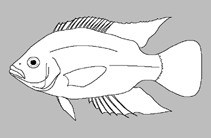
>
Cichliformes (Cichlids, convict blennies) >
Cichlidae (Cichlids) > Pseudocrenilabrinae
Etymology: Pelvicachromis: Latin, pelvica, -ae = bassin + Greek, chromis = a fish, perhaps a perch (Ref. 45335); sacrimontis: Sacri from Latin sacer, meaning holy, and montis from Latin mons/montis meaning mountain; in total the name serves as a Latin translation for Heiligenberg, a German biologist cited by Paulo in his descriptionof the species (Ref. 119364).
Eponymy: Walter Heiligenberg (1938–1994) was a German American neuroethologist who specialised in the motivational behaviours of cichlids and crickets. [...] (Ref. 128868), visit book page.
Environment: milieu / climate zone / تغييرات عمق / distribution range
بوم شناسي
; آب شيرين نزديك كف زي. Tropical
Africa: Niger and Cross River systems in southwestern parts of Nigeria (Ref. 119364).
Size / Weight / سن
بلوغ: Lm ? range ? - ? cm
Max length : 7.8 cm SL جنس نر / بدون خواص جنسي; (Ref. 119364)
توصيف مختصر
كليدهاي شناسايي | ريخت شناسي | ريخت ستجي بوسيله انداره گيري
خارهاي باله پشتي (کل) : 15 - 17; شعاع نرم باله پشتي (کل) : 8 - 10; خارهاي باله مخرجي: 3; شعاع نرم باله مخرجي: 6 - 8; مهره ها: 26 - 27. Diagnosis: It is a species of Pelvicachromis, distinguished from all congeners by a combination of characters as follows: it differs from Pelvicachromis taeniatus and P. subocellatus in absence of a pattern of pale blue and reddish dots on the caudal fin of adult males; it differs from P. roloffi in a broader midlateral band on the body, absence of small dots in the male caudal fin, absence of red margin with whitish to bluish submargin in the female dorsal fin; it differs from P. humilis, P. rubrolabiatus and P. signatus in absence of dark vertical bars on body; it differs from P. pulcher in a broader midlateral band on the body, usually as broad or broader than a pale yellowish band dorsal to this dark band, iridescent blueish to turquoise colouration band on cheeks and a different colouration of the dorsal fin in females; no margin, spiny portion pale to dark and dusky orange, soft parts yellowish to clear in most posterior regions vs. black margin, yellow submargin and black fin base in P. pulcher (Ref. 119364).
Body shape (shape guide): fusiform / normal.
In aquaria, this species is a monogamous, pair bonding cave-spawner (Ref. 119364).
Life cycle and mating behavior
بلوغ | تولید مثل | تخم ریزی | تخم ها | Fecundity | توزاد ( لارو)
In aquaria, this species is a monogamous, pair bonding cave-spawner (Ref. 119364). Eggs are guarded by both sexes, but always more intensively and more often by the female; hatching occurs after three days post-spawn; larvae are usually deposited on the bottom of the cave, rarely in other caves nearby the original cave; juveniles are free swimming eight or nine days post-hatching and guarded by both parents for about five to six weeks; breeding and guarding individuals of both sexes regularly exhibit a more prominent midlateral black stripe (Ref. 119364).
Lamboj, A. and C. Pichler, 2012. On the validity of Pelvicachromis sacrimontis Paulo, 1977 (Perciformes, Cichlidae), with designation of a neotype, and redescription of the species. Zootaxa 3436:61-68. (Ref. 119364)
وضعيت در فهرست قرمز IUCN (Ref. 130435: Version 2025-1)
خطر برای انسان ها
Harmless
استفاده انسانی
ابزارها
گزارش های ويژه
بارگيری XML
منابع اينترنتي
Estimates based on models
Phylogenetic diversity index (مرجع
82804): PD
50 = 0.5039 [Uniqueness, from 0.5 = low to 2.0 = high].
Bayesian length-weight: a=0.01000 (0.00244 - 0.04107), b=3.04 (2.81 - 3.27), in cm total length, based on all LWR estimates for this body shape (Ref.
93245).
Trophic level (مرجع
69278): 3.3 ±0.4 se; based on size and trophs of closest relatives
جهندگی (مرجع
120179): زياد, كمينه زمان لازم براي دو برابر شدن جمعيت ، كمتر از 15 ماه (Preliminary K or Fecundity.).
Fishing Vulnerability (Ref.
59153): Low vulnerability (10 of 100).
🛈