



Koumansetta hoesei Kovačić, Bogorodsky, Mal & Alpermann, 2018
Hochladen Photos und videos
Bilder | Google Bild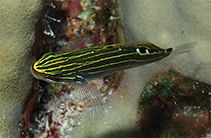 Koumansetta hoesei
Photo von Hazes, B.
Bilder | Google Bild
Photo von Hazes, B.
Klassifizierung / Names Namen | Synonyme | Catalog of Fishes(Gattung, Arten) | ITIS | CoL | WoRMS | Cloffa
> Gobiiformes (Gobies) > Gobiidae (Gobies) > Gobiinae
Etymology: hoesei: Named for Douglass F. Hoese.
Eponymy: Dr Frederik Petrus Koumans (1905–1977) was a Dutch ichthyologist who was Curator of Fishes at Rijksmuseum van Natuurlijke Historie (Leiden, Netherlands). [...] Dr Douglass Fielding ‘Doug’ Hoese (d: 1942) is Senior Fellow, Ichthyology Collection, Australian Museum, Sydney. [...] (Ref. 128868), visit book page.
Etymology: hoesei: Named for Douglass F. Hoese.
Eponymy: Dr Frederik Petrus Koumans (1905–1977) was a Dutch ichthyologist who was Curator of Fishes at Rijksmuseum van Natuurlijke Historie (Leiden, Netherlands). [...] Dr Douglass Fielding ‘Doug’ Hoese (d: 1942) is Senior Fellow, Ichthyology Collection, Australian Museum, Sydney. [...] (Ref. 128868), visit book page.
Umwelt: Milieu / Klimazone / Tiefenbereich / Verbreitungsgebiet Ökologie
seewasser riff-verbunden; tiefenbereich 3 - 26 m (Ref. 119548). Tropical
Verbreitung Territorien | FAO Gebiete | Ökosysteme | Vorkommen | Punkt Karte | Einführungen | Faunafri
Western Indian Ocean: restricted to the Red Sea and inner Gulf of Aden (Gulf of Tadjoura).
Größe / Gewicht / Alter
Geschlechtsreife: Lm ? range ? - ? cm
Max length : 4.1 cm SL Männchen/unbestimmt; (Ref. 119548); 3.9 cm SL (female)
Max length : 4.1 cm SL Männchen/unbestimmt; (Ref. 119548); 3.9 cm SL (female)
Kurzbeschreibung Bestimmungsschlüssel | Morphologie | Morphometrie
Rückenflossenstacheln (insgesamt) : 7; Rückenflossenweichstrahlen (insgesamt) : 15 - 16; Afterflossenstacheln: 1; Afterflossenweichstrahlen: 15. This species is distinguished by the following characters: D VI + I,15-16; A I,15; pectoral-fin rays 15; longitudinal scale series 50-54; scales in transverse series 14-17; predorsal scales 19-23; naked cheek and opercle; scales cover the basal 1/4-1/6 of the caudal fin and becoming rapidly smaller and cycloid; prepectoral area with about 3-6 vertical series of fine cycloid scales covering the entire base of the pectoral fin; cycloid scales on prepelvic area , 9-11 in the midventral row; interorbital 90-100% of eye diameter; width of body at anal-fin origin 10.8-12.4% of SL; depth of caudal peduncle 64.6-73.7% of its length; head depth 55.2-60.5% of HL; length of 11th second dorsal-fin ray 9.9-11.5% of SL; length of 8th anal-fin ray 10.2-13.5% of SL. Body with longitudinal yellow stripes only on upper half of body; mid-dorsal stripe and the pair of dorsolateral stripes diverging before eyes and then converging halfway between eye and first dorsal fin, a yellow stripe between mid-dorsal and dorsolateral stripes extending from side of nape continuing along dorsal-fin bases and almost reaching, with interruptions, to ocellus on back; head brown dorsally and whitish ventrally, yellowish white demarcation stripe, starting anteriorly at angle of jaw and going back to middle of pectoral-fin base; another yellowish white stripe beginning from the posterior part of upper jaw across upper cheek, opercle, and upper pectoral-fin base becoming a demarcation stripe behind pectoral fin, dividing the brown upper part of body from the grey lower part, and disappearing below middle of second dorsal fin; first dorsal fin with dark red or red-brown ocellus, a black center and edged with black; a weak orange-red streak is visible above ocellus (Ref. 119548).
Body shape (shape guide): elongated; Cross section: compressed.
Body shape (shape guide): elongated; Cross section: compressed.
A coral-reef species that is usually seen hovering a short distance above the substratum in lagoons and seaward reefs. Usually solitary, but sometimes seen in a small group, where each individual is at moderate distance from the others. From the food items found in the gut of one specimen of Koumansetta hectori (filamentous algae, harpacticoid copepods, amphipods, ostracods, and nematodes) a similar benthic, omnivorous diet may be expected for this species (Ref. 119548).
Lebenszyklus und Paarungsverhalten Geschlechtsreife | Fortpflanzung | Ablaichen | Eier | Fruchtbarkeit | Larven
Hauptreferenz
Laden Sie Ihre Referenzen hoch | Referenzen | Koordinator | Partner
Kovačić, M., S.V. Bogorodsky, A.O. Mal and T.J. Alpermann, 2018. Redescription of the genus Koumansetta (Teleostei: Gobiidae), with description of a new species from the Red Sea. Zootaxa 4459(3):453-481. (Ref. 119548)
IUCN Rote Liste Status (Ref. 130435: Version 2025-2 (Global))
nicht bedroht (LC) ; Date assessed: 21 March 2024
CITES
Not Evaluated
Bedrohung für Menschen
Harmless
Nutzung durch Menschen
FAO - Publication: search | FishSource |
Mehr Information
Trophische Ökologie
Lebensmittel (Beutetiere)
Nahrungszusammensetzung
Nahrungsaufnahme
Lebensmittelrationen
Räuber
Lebensmittel (Beutetiere)
Nahrungszusammensetzung
Nahrungsaufnahme
Lebensmittelrationen
Räuber
Ökologie
Ökologie
Ökologie
Populationsdynamik
Wachstumsparameter
Max. Alter/Größen
Länge-Gewicht-Rel.
Länge-Länge-Verhältnis.
Längenhäufigkeiten
Massenkonvertierung
Rekrutierung
Dichte
Wachstumsparameter
Max. Alter/Größen
Länge-Gewicht-Rel.
Länge-Länge-Verhältnis.
Längenhäufigkeiten
Massenkonvertierung
Rekrutierung
Dichte
Lebenszyklus
Fortpflanzung
Geschlechtsreife
Reifung/Kiemen rel.
Fruchtbarkeit
Ablaichen
Laichaggregationen
Eier
Eientwicklung
Larven
Larven Pop.Dyn.
Fortpflanzung
Geschlechtsreife
Reifung/Kiemen rel.
Fruchtbarkeit
Ablaichen
Laichaggregationen
Eier
Eientwicklung
Larven
Larven Pop.Dyn.
Anatomie
Kiemenoberfläche
Gehirn
Otolith
Kiemenoberfläche
Gehirn
Otolith
Physiologie
Körperliche Zusammensetzung
Nährstoffe
Sauerstoffverbrauch
Schwimmart
Schwimmgeschwindigkeit
Visuelle Pigmente
Fischgeräusche
Krankheiten und Parasiten
Toxizität (LC50s)
Körperliche Zusammensetzung
Nährstoffe
Sauerstoffverbrauch
Schwimmart
Schwimmgeschwindigkeit
Visuelle Pigmente
Fischgeräusche
Krankheiten und Parasiten
Toxizität (LC50s)
Genetik
Genom
Genetik
Heterozygotie
Vererbbarkeit
Genetische Vielfalt
Genom
Genetik
Heterozygotie
Vererbbarkeit
Genetische Vielfalt
Menschenbezogen
Aquakultur-Systeme
Aquakultur Profile
Zuchtlinien
Ciguatera-Fälle
Briefmarken, Münzen, Verschiedenes.
Aquakultur-Systeme
Aquakultur Profile
Zuchtlinien
Ciguatera-Fälle
Briefmarken, Münzen, Verschiedenes.
Tools
Zusatzinformationen
Download XML
Zusammenfassung | Punktdaten | Namen | Photos
Internet Quellen
AFORO (otoliths) | Aquatic Commons | BHL | Cloffa | Websites from users | FishWatcher Einträge suchen | CISTI | Catalog of Fishes: Gattung, Arten | DiscoverLife | ECOTOX | FAO - Publication: search | Faunafri | Fishipedia | Fishtrace | GloBI | Google Books | Google Scholar | Google | IGFA World Record | OneZoom | Open Tree of Life | Otolith Atlas of Taiwan Fishes | PubMed | Reef Life Survey | Socotra Atlas | TreeBase | Tree of Life | Wikipedia: Gehe zu, Suchen | World Records Freshwater Fishing | Zoobank | Zoologischer Rekord
Schätzungen auf der Grundlage von Modellen
Phylogenetischer Diversitätsindex (Ref. 82804): PD50 = 0.6250 [Uniqueness, from 0.5 = low to 2.0 = high].
Bayesian length-weight: a=0.00759 (0.00420 - 0.01370), b=3.06 (2.91 - 3.21), in cm total length, based on LWR estimates for this species & (Sub)family-body (Ref. 93245).
Trophische Ebene (Ref. 69278): 3.2 ±0.3 se; based on size and trophs of closest relatives
Widerstandsfähigkeit (Ref. 120179): hoch, Verdopplung der Population dauert weniger als 15 Monate. (Preliminary K or Fecundity.).