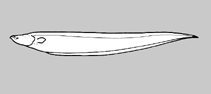
Klassifizierung / Names
Namen | Synonyme | Catalog of Fishes(Gattung, Arten) | ITIS | CoL | WoRMS | Cloffa
>
Gymnotiformes (Knifefishes) >
Gymnotidae (Naked-back knifefishes) > Electrophorinae
Etymology: Electrophorus: Greek, elektron = amber + Greek,pherein = to carry (Ref. 45335); voltai: Named for Alessandro Giuseppe Antonio Anastasio Volta (1745-1827).
Eponymy: Alessandro Giuseppe Antonio Anastasio Volta (1745–1827) was an Italian physicist, chemist and pioneer of electricity. [...] (Ref. 128868), visit book page.
Environment: milieu / climate zone / Tiefenbereich / distribution range
Ökologie
; süßwasser benthopelagisch. Tropical
South America: generally in the north-flowing rivers of the Brazilian shield and south-flowing rivers of the Guyana shield. Occurs with Electrophorus varii in some streams in the Guiana Shield (Ref. 120918).
Size / Gewicht / Alter
Geschlechtsreife: Lm ? range ? - ? cm
Max length : 171 cm TL Männchen/unbestimmt; (Ref. 120918)
Kurzbeschreibung
Bestimmungsschlüssel | Morphologie | Morphometrie
This species differs from E. electricus by having a ventral outline of head ovoid, widest anterior to branchial opening (vs. U-shaped) and with 112-146 lateral-line pores (vs. 88-101); differs from E. varii by having the skull depressed (vs. deep), cleithrum lies between vertebrae 5 and 6 (vs. between vertebrae 1 and 2), wide head (vs. narrow); distance between medial margins of contralateral dentaries at transverse through last two ventral pores 2-3 times longer in E. voltai than E. varii; low-voltage electric organ discharges or EOD duration 1.72 ms; high-voltage EOD 860 V at 121.9 cm TL (Ref. 120918).
Body shape (shape guide): elongated; Cross section: oval.
Obligate air-breathing (Ref. 126274)
Life cycle and mating behavior
Geschlechtsreife | Fortpflanzung | Ablaichen | Eier | Fecundity | Larven
de Santana, C.D., W.G.R. Crampton, C.B. Dillman, R.G. Frederico, M.H. Sabaj, R. Covain, J. Ready, J. Zuanon, R.R. de Oliveira, R.N. Mendes-Júnior, D.A. Bastos, T.F. Teixeira, J. Mol, W. Ohara, N.C. de Castro, L.A. Peixoto et al., 2019. Unexpected species diversity in electric eels with a description of the strongest living bioelectricity generator. Nature Communications (2019)10:4000. [+authors; Nagamachi, C.; Sousa, L.; Montag, L.F.A.; Ribeiro, F.; Waddell, J.C.; Piorsky, N.M.; Vari, R.P.; Wosiacki, W.B.] (Ref. 120918)
IUCN Rote Liste Status (Ref. 130435: Version 2025-1)
Bedrohung für Menschen
Harmless
Nutzung durch Menschen
Tools
Zusatzinformationen
Download XML
Internet Quellen
Estimates based on models
Phylogenetic diversity index (Ref.
82804): PD
50 = 0.6250 [Uniqueness, from 0.5 = low to 2.0 = high].
Bayesian length-weight: a=0.00389 (0.00180 - 0.00842), b=3.12 (2.94 - 3.30), in cm total length, based on all LWR estimates for this body shape (Ref.
93245).
Trophic level (Ref.
69278): 3.6 ±0.5 se; based on size and trophs of closest relatives
Widerstandsfähigkeit (Ref.
120179): sehr niedrig, Verdopplung der Population dauert mehr als 14 Jahre. (Preliminary K or Fecundity.).
Fishing Vulnerability (Ref.
59153): Very high vulnerability (90 of 100).
🛈